What is the smallest possible feature size that can be resolved by using a 193-nm optical...
What is the smallest possible feature size that can be resolved by using a 193-nm optical source and the highest possible NA that can be obtained by a lens when exposing the image in air? Note that NA can be determined by the equation
NA = n∙sin(θ)
where n is the index of refraction of the medium in which the lens is working (air in this instance) and θ is the maximal half-angle of the cone of light that can enter or exit the lens and has a maximum possible value of 90˚ for a very large lens.
Homework Answers
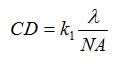
The smallest possible feature size, that is the critical dimension (CD) can calculate by the following expression.
Step 2
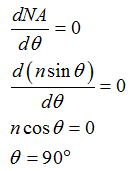
Write the expression for the numerical aperture (NA) of the lens.

Calculate the angle (θ) for the maximum numerical aperture (NAmax) as below,
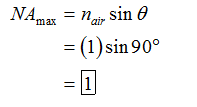
Thus, the maximum numerical aperture (NAmax) is,
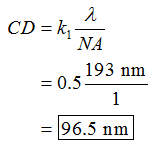
The lithography k1 coefficient is 0.5 at 193 nm optical source.
Thus, the smallest possible feature size, that is the critical dimension (CD) is,
Add Answer to:
What is the smallest possible feature size that can be resolved
by using a 193-nm optical...
(1 point) READING 4 The resolution of a microscope is diffraction limited, just as the eye, but gains a significant advantage because an object can be placed very close to its objective lens. The sma...
 (1 point) READING 4 The resolution of a microscope is diffraction limited, just as the eye, but gains a significant advantage because an object can be placed very close to its objective lens. The smallest resolvable linear separation xTor an ordinary light microscope is: where λ is he wavelength o light used, and Θ ls he half Viewing angle 0 he obiective The quantity n sne s ca e the num enca aperture of he obiective where n s the...
Write your answers as A, B, C, D, E, F, G, etc. on the answer page....
 Write your answers as A, B, C, D, E, F, G, etc. on the answer page. Any answers NOT recorded on the answer page will NOT be counted. 1. The diagram shows a wave moving in the direction of the arrow. What type of wave is it? A) longitudinal B) pressure C) transverse D) None of these. yzing the light from a distant star, an astronomer determines that normal 4.5733104 Hz light has a frequency of 4.7243104 Hz in the...
Part I: Background When a ray of light strikes a smooth surface, it can either reflect,...
 Part I: Background When a ray of light strikes a smooth surface, it can either reflect, such as with a mirror, or it can both reflect and refract, such as with glass. In this make-up lab activity, we shall look at both situations. This make-up lab shall try to replicate the lab from your lab manual as best possible. Be sure to read the "Discussion" in your regular lab manual. You will be using the Bending Light simulation. Part II:...
Question 5: How would dust and oil on the glass plates affect the results? EXPERIMENT 10 THIN FILM I...
 Question 5:
How would dust and oil on the glass plates affect the
results?
EXPERIMENT 10 THIN FILM INTERFERENCE Light from a monochromatic source is shined downward on two glass plates that are separated at one end by a hair. Light that is reflected from the top and bottom surfaces of the wedge-shaped thin film of air undergoes interference, and a series of dark and light lines are seen. By counting the number of dark or light lines over a...
Question 5:
How would dust and oil on the glass plates affect the
results?
EXPERIMENT 10 THIN FILM INTERFERENCE Light from a monochromatic source is shined downward on two glass plates that are separated at one end by a hair. Light that is reflected from the top and bottom surfaces of the wedge-shaped thin film of air undergoes interference, and a series of dark and light lines are seen. By counting the number of dark or light lines over a...
What are the instruments that have been utilized for the review article discussions? ` 1. Introduction...
 What are the instruments that have been utilized for the
review article discussions?
`
1. Introduction In recent years, nanoclays have been the object of particular interest for many scientists and researchers in chemistry, physics, engineering and biology due to their excellent properties as well as their sustain- ability [1-3]. For instance, they represent the starting point to the de velopment of smart materials for drug delivery (4-9), food packaging [10-12), environmental remediation and wastewater treatment [13], cultural heritage [14–17and...
What are the instruments that have been utilized for the
review article discussions?
`
1. Introduction In recent years, nanoclays have been the object of particular interest for many scientists and researchers in chemistry, physics, engineering and biology due to their excellent properties as well as their sustain- ability [1-3]. For instance, they represent the starting point to the de velopment of smart materials for drug delivery (4-9), food packaging [10-12), environmental remediation and wastewater treatment [13], cultural heritage [14–17and...
 (1 point) READING 4 The resolution of a microscope is diffraction limited, just as the eye, but gains a significant advantage because an object can be placed very close to its objective lens. The smallest resolvable linear separation xTor an ordinary light microscope is: where λ is he wavelength o light used, and Θ ls he half Viewing angle 0 he obiective The quantity n sne s ca e the num enca aperture of he obiective where n s the...
 Write your answers as A, B, C, D, E, F, G, etc. on the answer page. Any answers NOT recorded on the answer page will NOT be counted. 1. The diagram shows a wave moving in the direction of the arrow. What type of wave is it? A) longitudinal B) pressure C) transverse D) None of these. yzing the light from a distant star, an astronomer determines that normal 4.5733104 Hz light has a frequency of 4.7243104 Hz in the...
 Part I: Background When a ray of light strikes a smooth surface, it can either reflect, such as with a mirror, or it can both reflect and refract, such as with glass. In this make-up lab activity, we shall look at both situations. This make-up lab shall try to replicate the lab from your lab manual as best possible. Be sure to read the "Discussion" in your regular lab manual. You will be using the Bending Light simulation. Part II:...
 Question 5:
How would dust and oil on the glass plates affect the
results?
EXPERIMENT 10 THIN FILM INTERFERENCE Light from a monochromatic source is shined downward on two glass plates that are separated at one end by a hair. Light that is reflected from the top and bottom surfaces of the wedge-shaped thin film of air undergoes interference, and a series of dark and light lines are seen. By counting the number of dark or light lines over a...
Question 5:
How would dust and oil on the glass plates affect the
results?
EXPERIMENT 10 THIN FILM INTERFERENCE Light from a monochromatic source is shined downward on two glass plates that are separated at one end by a hair. Light that is reflected from the top and bottom surfaces of the wedge-shaped thin film of air undergoes interference, and a series of dark and light lines are seen. By counting the number of dark or light lines over a...
 What are the instruments that have been utilized for the
review article discussions?
`
1. Introduction In recent years, nanoclays have been the object of particular interest for many scientists and researchers in chemistry, physics, engineering and biology due to their excellent properties as well as their sustain- ability [1-3]. For instance, they represent the starting point to the de velopment of smart materials for drug delivery (4-9), food packaging [10-12), environmental remediation and wastewater treatment [13], cultural heritage [14–17and...
What are the instruments that have been utilized for the
review article discussions?
`
1. Introduction In recent years, nanoclays have been the object of particular interest for many scientists and researchers in chemistry, physics, engineering and biology due to their excellent properties as well as their sustain- ability [1-3]. For instance, they represent the starting point to the de velopment of smart materials for drug delivery (4-9), food packaging [10-12), environmental remediation and wastewater treatment [13], cultural heritage [14–17and...
Most questions answered within 3 hours.
-
Where is the error in this code sequence?
String s1 = "Hello";
String s2 = "ello";...
asked 10 months ago -
Financial data for Joel de Paris, Inc., for last year
follow:
Joel de Paris, Inc.
Balance...
asked 10 months ago -
Consider this reaction:
Al2(SO4)3 (aq)+ BaCl3
(aq) Al2Cl6 (aq)- +
3BaSO4(s) . What is the...
asked 10 months ago -
Suppose that Savneet is considering increasing her
recent random sample from 20 car rentals to 40...
asked 10 months ago -
Trucks arrive at an unloading terminal at an average rate of 120
per hour.
Trucks arrive...
asked 10 months ago -
Why are methanol and ethanol completely soluble in water while
octanol is not very little soluble....
asked 10 months ago -
A facilities manager at a university reads in a research report
that the mean amount of...
asked 10 months ago -
When the CuSO4 is rehydrated by adding water to the anhydrous
compound, is this an endothermic...
asked 10 months ago -
A ray of sunlight is passing from diamond into crown glass; the
angle of incidence is...
asked 10 months ago -
A block of mass 0.249 kg is placed on top of a light, vertical
spring of...
asked 10 months ago -
how do the kidneys compensate in the presences of acidosis
a) trigger hyperventilate
b) reserve acid...
asked 10 months ago -
Question 501 pts
The rental rate of capital to the firm increases. Which of the
following...
asked 10 months ago