In this experiment, you were told to avoid getting air bubbles on the rock chunks while...
In this experiment, you were told to avoid getting air bubbles on the rock chunks while measuring your volume. Would air bubbles increase, decrease, or have no effect on the density of the rocks?
Homework Answers
Air bubbles would decrease the density of the rocks. According to the density equation , Density = Mass/Volume
Air bubbles add the volume , not the mass. So as the density decreases, volume will increase as per the equation.
Add Answer to:
In this experiment, you were told to avoid getting air bubbles
on the rock chunks while...
3. During volcanic eruptions, chunks of solid rock can be blasted out of the volcano; these...
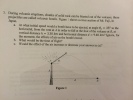 3. During volcanic eruptions, chunks of solid rock can be blasted out of the volcano; these projectiles are called volcanic bombs. Figure shows a cross section of Mt. Fuji, in Japan.a. At what initial speed would a bomb have to be ejected, at angle Theta o = 35 Degree to the horizontal, from the vent at A in order to fall at the foot of the volcano at B, at vertical distance h = 3.30 km and horizontal distance d...
Q19) You and your buddy are scuba diving and notice that air bubbles triple in volume...
Q19) You and your buddy are scuba diving and notice that air bubbles triple in volume as they rise to the surface from where you are in the ocean. Ignoring any temperature changes, how far below the surface of the water (in m) are you when these bubbles are released? The ocean has a density of 1032 kg/m3.
If you increase the temperature of a volume of air by four times while at the...
 If you increase the temperature of a volume of air by four times while at the same time doubling the pressure, would the volume of the air increase or decrease? Why?
While rotating the tires on your car you notice a rock [mass = 0.1 Kg] stuck...
While rotating the tires on your car you notice a rock [mass = 0.1 Kg] stuck in one. You learn online that the rock and the tire have a μ=0.6 between them and a maximum normal force equal to 140 times the rocks weight, and you find that your tire has a diameter of 24 inches. You turn on your car, put it in first gear, and start pushing the accelerator. At what “speed” on your speedometer does the rock...
If you were told your IQ was 150, what effect would that have on you (be
If you were told your IQ was 150, what effect would that have on you (be
If you were going to design an experiment on the effects of air pollution, how would...
If you were going to design an experiment on the effects of air pollution, how would you account for the effects that variations in health, gender, age, and ethnicity can cause? If you were going to measure whether two groups differ in a genetic predisposition to heart disease, stroke, or hypertension, how would you make sure that difference in air pollution levels experienced by the two groups didn't confound your results?
DISCUSSION QUESTIONS 1. If the liquid did not completely vaporize in the experiment, would the ap-...
 DISCUSSION QUESTIONS 1. If the liquid did not completely vaporize in the experiment, would the ap- parent molecular weight be larger, smaller, or unchanged compared to that determined if the experiment had been properly performed? Would the error in part (1) have a larger, smaller, or the same effect as the errors that might be made in measuring the temperature of the water in the flask, the barometric pressure, or the volume of the flask? Explain your answer. 2. What...
1aYou are measuring 10.00mL of liquid with a volumetric pipet. While you are drawing the liquid...
1aYou are measuring 10.00mL of liquid with a volumetric pipet. While you are drawing the liquid into the pipet, you remove the tip of the pipet from the solution and suck up a little bit of air into the pipet. You adjust the liquid so that the meniscus is at the calibration line, but you notice there are some air bubbles in the pipet. 1a.) How do the bubbles impact the amount of liquid that you will dispense? Will you...
This was a experiment using the Atwood Machine, and graphs were plotted (net force vs. aexp)...
This was a experiment using the Atwood Machine, and graphs were plotted (net force vs. aexp) Describe how the following factors would increase or decrease the values you found for aexp (a) Air Resistance (b) Pulley Friction: (c) String Mass (d) Rotational Inertia of the Pulley
3. Suppose you have a rock with a mass of 305 g. When attached to a...
 3. Suppose you have a rock with a mass of 305 g. When attached to a spring scale and lowered completely into water the spring scale reads Fe 2.10 N. Note that this reading is significantly lower than the rock's weight Fo Mg (3 N), because of the buoyant force helping to support it. From this information, calculate the following: (a) Fe: the magnitude of the buoyant force exerted on the rock. Use N2L in conjunction with the FBD shown...
 3. During volcanic eruptions, chunks of solid rock can be blasted out of the volcano; these projectiles are called volcanic bombs. Figure shows a cross section of Mt. Fuji, in Japan.a. At what initial speed would a bomb have to be ejected, at angle Theta o = 35 Degree to the horizontal, from the vent at A in order to fall at the foot of the volcano at B, at vertical distance h = 3.30 km and horizontal distance d...
 If you increase the temperature of a volume of air by four times while at the same time doubling the pressure, would the volume of the air increase or decrease? Why?
 DISCUSSION QUESTIONS 1. If the liquid did not completely vaporize in the experiment, would the ap- parent molecular weight be larger, smaller, or unchanged compared to that determined if the experiment had been properly performed? Would the error in part (1) have a larger, smaller, or the same effect as the errors that might be made in measuring the temperature of the water in the flask, the barometric pressure, or the volume of the flask? Explain your answer. 2. What...
 3. Suppose you have a rock with a mass of 305 g. When attached to a spring scale and lowered completely into water the spring scale reads Fe 2.10 N. Note that this reading is significantly lower than the rock's weight Fo Mg (3 N), because of the buoyant force helping to support it. From this information, calculate the following: (a) Fe: the magnitude of the buoyant force exerted on the rock. Use N2L in conjunction with the FBD shown...
Most questions answered within 3 hours.
-
Where is the error in this code sequence?
String s1 = "Hello";
String s2 = "ello";...
asked 10 months ago -
Financial data for Joel de Paris, Inc., for last year
follow:
Joel de Paris, Inc.
Balance...
asked 10 months ago -
Consider this reaction:
Al2(SO4)3 (aq)+ BaCl3
(aq) Al2Cl6 (aq)- +
3BaSO4(s) . What is the...
asked 10 months ago -
Suppose that Savneet is considering increasing her
recent random sample from 20 car rentals to 40...
asked 10 months ago -
Trucks arrive at an unloading terminal at an average rate of 120
per hour.
Trucks arrive...
asked 10 months ago -
Why are methanol and ethanol completely soluble in water while
octanol is not very little soluble....
asked 10 months ago -
A facilities manager at a university reads in a research report
that the mean amount of...
asked 10 months ago -
When the CuSO4 is rehydrated by adding water to the anhydrous
compound, is this an endothermic...
asked 10 months ago -
A ray of sunlight is passing from diamond into crown glass; the
angle of incidence is...
asked 10 months ago -
A block of mass 0.249 kg is placed on top of a light, vertical
spring of...
asked 10 months ago -
how do the kidneys compensate in the presences of acidosis
a) trigger hyperventilate
b) reserve acid...
asked 10 months ago -
Question 501 pts
The rental rate of capital to the firm increases. Which of the
following...
asked 10 months ago