What is the best current theory for where mitochondria and chloroplasts come from? Explain. a. they...
What is the best current theory for where mitochondria and chloroplasts come from? Explain.
a. they are living organisms that have entered other cells.
b. they are proteins that have evolved into organelles.
c. they are phospholipid membranes that have evolved into organelles.
Homework Answers
a.) They are living organisms that have entered other cells.
According to endosymbiont theory, mitochondria and chloroplasts are evolved from the bacteria which are prokaryotic organisms. There are too many similarities between the bacteria and these two organelles. Like bacteria both the organelles do have their independent genetic material which is ds circular DNA. Mitochondria and chloroplast are of the same size as the bacteria. And these organelles also divide by binary fission like bacteria.
Add Answer to:
What is the best current theory for where mitochondria and
chloroplasts come from? Explain.
a. they...
Mitochondria and chloroplasts were once free-living bacteria that later migrated into eukaryotic cells. Mitochondria make energy...
Mitochondria and chloroplasts were once free-living bacteria that later migrated into eukaryotic cells. Mitochondria make energy while chloroplasts prepare their own food. How can a mitochondrion live by itself? Explain your answer by mentioning the specific processes that this organelle performs. What does a chloroplast do to survive in its free living condition? What important chemicals does it need froma sorrounding primordial soup to prepare its own food? Apart from the process by which chloroplasts prepare their own food, what...
pts Which of the following is FALSE about the Theory of Endosymbiosis? Chloroplasts and mitochondria have...
 pts Which of the following is FALSE about the Theory of Endosymbiosis? Chloroplasts and mitochondria have their own DNA Chloroplasts and mitochondria are enclosed in a double membrane Chloroplasts and mitochondria divide by a process that closely resembles binary fission Chloroplasts are present in all eukaryotic cells The DNA of chloroplasts and mitochondria is very similar to that of other free-living prokaryotes Previous Next →
According to the endosymbiosis theory, chloroplasts and mitochondria are derived from bacteria that took up residence...
According to the endosymbiosis theory, chloroplasts and mitochondria are derived from bacteria that took up residence within eukaryotic cells. At one time, prior to being taken up by eukaryotic cells, these bacteria were free-living organisms. However, we cannot take a chloroplast or mitochondrion out of a living eukaryotic cell and get it to survive and replicate on its own. Why not?
5. Mitochondria and chloroplasts were once free-living bacteria that later migrated into eukaryotic cells. Mitochondria...
5. Mitochondria and chloroplasts were once free-living bacteria that later migrated into eukaryotic cells. Mitochondria make energy while chloroplasts prepare their own food. a) If Gregor Mendel were a molecular biologist and laid his hands on a free-living mitochondrion, would he have got his 3:1 ratio crossing two mitochondria? b) In its free-living condition, can a chloroplast code for proteins, and if yes, what are the two most important enzymes that aid in its survival? c) After endosymbiosis, what happenned...
Q23.7: According to the endosymbiotic theory, mitochondria and plastids (e.g. chloroplasts) are descendents of Afree living...
 Q23.7: According to the endosymbiotic theory, mitochondria and plastids (e.g. chloroplasts) are descendents of Afree living prokaryotic cells B alpha-proteobacteria. Cfree living eukaryotic cells Da chimeric cell with archaea and bacteria ancestry
Which of the following are generally viewed as evidence that mitochondria and chloroplasts are derived from...
Which of the following are generally viewed as evidence that mitochondria and chloroplasts are derived from single celled organisms (select all that apply)? Both miochondria and chloroplasts divide autonomously using a mechanism that resembles binary fission Mitochondrial and chloroplast genomes both exhibit sequence similarity to extant single celled organisms Mitochondria and chloroplasts are both capable of persisting indefinitely outside of eukaryotic cells Both mitochondria and chloroplasts have their own circular genomes
What is the endosymbiotic theory as it relates to the cellular organelles, mitochondria & chloroplasts, found in eu...
What is the endosymbiotic theory as it relates to the cellular organelles, mitochondria & chloroplasts, found in eukaryotic cells? There have been several different characters throughout the years that have served as Batman’s sidekick under the codename ‘Robin’. Name as many as you can: The resolution of a microscope (commonly abbreviated as D) is way to objectively describe the magnification ability. As resolution increases by changing objective lens, what happens to depth of field? What is the relationship between magnification,...
According to the endosymbiotic theory 24 Multiple Choice all living organisms are composed of cells and...
 According to the endosymbiotic theory 24 Multiple Choice all living organisms are composed of cells and that a cell is the smallest unit considered to be living living organisms can arise from non-living matter and that the type of organism formed depends on the type of non-living matter chloroplasts and mitochondria evolved from small prokaryotes that were consumed by a larger eukaryotic cell new species arise when a portion of the population becomes isolated from the remainder of the population...
(2). Consider that mitochondria and chloroplasts were once free-living prokaryotes. If you isolated these organelles from...
 (2). Consider that mitochondria and chloroplasts were once free-living prokaryotes. If you isolated these organelles from a plant, which of the following structures would you expect to find? Choose all of the correct answers. (1 point) (a) plasma membrane (b) ribosomes (c) circular DNA (d) linear chromosomes (e) ribosomal RNA (f) proteins (g) nucleus
1.67 pts According to the Endosymbiotic Theory chloroplasts descend from free living photosynthetic prokaryotes. mitochondria descend...
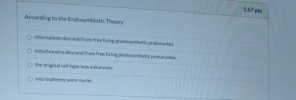 1.67 pts According to the Endosymbiotic Theory chloroplasts descend from free living photosynthetic prokaryotes. mitochondria descend from free living photosynthetic prokaryotes, the original cell type was eukaryotic. Omicrospheres were nuclei.
 pts Which of the following is FALSE about the Theory of Endosymbiosis? Chloroplasts and mitochondria have their own DNA Chloroplasts and mitochondria are enclosed in a double membrane Chloroplasts and mitochondria divide by a process that closely resembles binary fission Chloroplasts are present in all eukaryotic cells The DNA of chloroplasts and mitochondria is very similar to that of other free-living prokaryotes Previous Next →
 Q23.7: According to the endosymbiotic theory, mitochondria and plastids (e.g. chloroplasts) are descendents of Afree living prokaryotic cells B alpha-proteobacteria. Cfree living eukaryotic cells Da chimeric cell with archaea and bacteria ancestry
 According to the endosymbiotic theory 24 Multiple Choice all living organisms are composed of cells and that a cell is the smallest unit considered to be living living organisms can arise from non-living matter and that the type of organism formed depends on the type of non-living matter chloroplasts and mitochondria evolved from small prokaryotes that were consumed by a larger eukaryotic cell new species arise when a portion of the population becomes isolated from the remainder of the population...
 (2). Consider that mitochondria and chloroplasts were once free-living prokaryotes. If you isolated these organelles from a plant, which of the following structures would you expect to find? Choose all of the correct answers. (1 point) (a) plasma membrane (b) ribosomes (c) circular DNA (d) linear chromosomes (e) ribosomal RNA (f) proteins (g) nucleus
 1.67 pts According to the Endosymbiotic Theory chloroplasts descend from free living photosynthetic prokaryotes. mitochondria descend from free living photosynthetic prokaryotes, the original cell type was eukaryotic. Omicrospheres were nuclei.
Most questions answered within 3 hours.
-
Where is the error in this code sequence?
String s1 = "Hello";
String s2 = "ello";...
asked 10 months ago -
Financial data for Joel de Paris, Inc., for last year
follow:
Joel de Paris, Inc.
Balance...
asked 10 months ago -
Consider this reaction:
Al2(SO4)3 (aq)+ BaCl3
(aq) Al2Cl6 (aq)- +
3BaSO4(s) . What is the...
asked 10 months ago -
Suppose that Savneet is considering increasing her
recent random sample from 20 car rentals to 40...
asked 10 months ago -
Trucks arrive at an unloading terminal at an average rate of 120
per hour.
Trucks arrive...
asked 10 months ago -
Why are methanol and ethanol completely soluble in water while
octanol is not very little soluble....
asked 10 months ago -
A facilities manager at a university reads in a research report
that the mean amount of...
asked 10 months ago -
When the CuSO4 is rehydrated by adding water to the anhydrous
compound, is this an endothermic...
asked 10 months ago -
A ray of sunlight is passing from diamond into crown glass; the
angle of incidence is...
asked 10 months ago -
A block of mass 0.249 kg is placed on top of a light, vertical
spring of...
asked 10 months ago -
how do the kidneys compensate in the presences of acidosis
a) trigger hyperventilate
b) reserve acid...
asked 10 months ago -
Question 501 pts
The rental rate of capital to the firm increases. Which of the
following...
asked 10 months ago