how would you differentiate between a leaf and a leaflet according to the size, colour, shape...
how would you differentiate between a leaf and a leaflet according to the size, colour, shape and chlorophyll... please answer all the aspects..
Homework Answers
LEAF:
A leaf is a common organ of any plant.
Leaves differ greatly in appearance and are a good first step in recognizing a plant, though some plants can have a very different looking leaf depending on the conditions in which the plant is grown.
An important part of the identification of a plant through the leaf is the pattern of its veins. There are three major venation patterns. In the pinnate pattern a main vein runs down the middle length of the lamina and smaller veins form on each side.
Leaf shapes you’ll see often in aquatic-plant literature include lanceolate (long and tapered at the end like a lance), ovate (egg shaped), oblong (long oval shape with long sides parallel), elliptic (long oval shape with rounded long sides), cordate (heart shaped), and linear (very long and narrow).
Leaf shapes and margins are often mentioned together in literature, although sometimes only one is mentioned if it’s the distinguishing feature of a plant. Entire margins are smooth, serrate margins have a jagged teeth-like edge, and undulate margins are wavy. Oak trees is a good example of a lobed leaf margin. Feathery leaves are described as pinnate, pinnatifid, or bipinnate.
The four primary pigments that produce color within a leaf are: chlorophyll (green); xanthophylls (yellow); carotenoids (orange); and anthocyanins (reds and purples).
LEAFLETS:
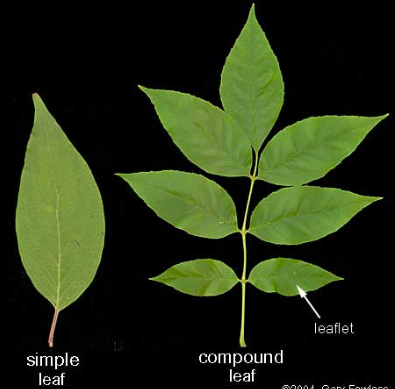
A leaflet refers to a small leaf or a leaf-like part of a compound leaf.
A leaflet is a leaf-like part of a compound leaf. Though it resembles an entire leaf, a leaflet is not borne on a main plant stem or branch, as a leaf is, but rather on a petiole or a branch of the leaf. Compound leaves are common in many plant families and they differ widely in morphology. The two main classes of compound leaf morphology are palmate and pinnate. For example, a hemp plant has palmate compound leaves, whereas some species of Acacia have pinnate leaves.
a bud node at the base of each stem/petiole but no bud node at the base of each leaflet on midribs and the rachis of the compound leaf.
leaflets are arranged on what are actually secondary stems, which grow off a main stem, or rachis.
leaflets radiate out from the center of their attachment to the petiole or leaf stem, which is again attached to the twig.
Add Answer to:
how would you differentiate between a leaf and a
leaflet according to the size, colour, shape...
How would you differentiate between a Frog and Salamander?
How would you differentiate between a Frog and Salamander?
How would you differentiate between labyrinthitis, benign paroxysmal positional vertigo, and Meniere’s disease?
How would you differentiate between labyrinthitis, benign paroxysmal positional vertigo, and Meniere’s disease?
Describe how the shape and standard deviation of a sampling distribution changes as sample size increases....
Describe how the shape and standard deviation of a sampling distribution changes as sample size increases. In other words, describe the changes that occur to a sampling distribution according to the Central Limit Theorem. Make sure you describe what a sampling distribution is in your answer. Generate pictures/diagrams to illustrate your thoughts if you would like.
You have been given a task to differentiate between the images of a cat and a...
You have been given a task to differentiate between the images of a cat and a dog. You have been given a dataset of 50000 coloured images of size 40x40 which contains either a cat or a dog. Being as specific as you can, please detail the procedure of how you are going to solve this problem.
3. How would you differentiate between the following pairs of molecules using 'H and C NMR?...
 3. How would you differentiate between the following pairs of molecules using 'H and C NMR? a) OI b) H3C CH3 он Vs CH3 CH3 VS Br Br
) If you want to increase the capacitance but NOT change the shape and size how...
) If you want to increase the capacitance but NOT change the shape and size how could you do it? Explain in some detail why your idea will increase the capacitance.
How do you differentiate between heart attack and myocardial infarction?
How do you differentiate between heart attack and myocardial infarction?
How can you differentiate between S1 and S2 heart sounds?
How can you differentiate between S1 and S2 heart sounds?
How would you draw a stem and leaf display with decimals such as 18.8 and 20.3?
How would you draw a stem and leaf display with decimals such as 18.8 and 20.3?
12. Which of the following reagents or tests would you use to differentiate between the following...
 12. Which of the following reagents or tests would you use to differentiate between the following two compounds? Select only one answer and explain why you selected that answer.) C-H a) Chromic acid b) Benedict's test c) lodoform 13. Which of the following reagents or tests would you use to differentiate between the following two compounds? Sclect only one answer and explain why you selected that answer.) -H a) Chromic acid b) Benedict's test c) lodoform 14. An unknown compound...
 3. How would you differentiate between the following pairs of molecules using 'H and C NMR? a) OI b) H3C CH3 он Vs CH3 CH3 VS Br Br
 12. Which of the following reagents or tests would you use to differentiate between the following two compounds? Select only one answer and explain why you selected that answer.) C-H a) Chromic acid b) Benedict's test c) lodoform 13. Which of the following reagents or tests would you use to differentiate between the following two compounds? Sclect only one answer and explain why you selected that answer.) -H a) Chromic acid b) Benedict's test c) lodoform 14. An unknown compound...
Most questions answered within 3 hours.
-
Where is the error in this code sequence?
String s1 = "Hello";
String s2 = "ello";...
asked 1 year ago -
Financial data for Joel de Paris, Inc., for last year
follow:
Joel de Paris, Inc.
Balance...
asked 1 year ago -
Consider this reaction:
Al2(SO4)3 (aq)+ BaCl3
(aq) Al2Cl6 (aq)- +
3BaSO4(s) . What is the...
asked 1 year ago -
Suppose that Savneet is considering increasing her
recent random sample from 20 car rentals to 40...
asked 1 year ago -
Trucks arrive at an unloading terminal at an average rate of 120
per hour.
Trucks arrive...
asked 1 year ago -
Why are methanol and ethanol completely soluble in water while
octanol is not very little soluble....
asked 1 year ago -
A facilities manager at a university reads in a research report
that the mean amount of...
asked 1 year ago -
When the CuSO4 is rehydrated by adding water to the anhydrous
compound, is this an endothermic...
asked 1 year ago -
A ray of sunlight is passing from diamond into crown glass; the
angle of incidence is...
asked 1 year ago -
A block of mass 0.249 kg is placed on top of a light, vertical
spring of...
asked 1 year ago -
how do the kidneys compensate in the presences of acidosis
a) trigger hyperventilate
b) reserve acid...
asked 1 year ago -
Question 501 pts
The rental rate of capital to the firm increases. Which of the
following...
asked 1 year ago