The reaction of (S)-2-bromopentane with potassium cyanide to yield 2-methylpentanenitrile (2-cyanopentane) occurs via a nucleophilic substitution...
The reaction of (S)-2-bromopentane with potassium cyanide to yield 2-methylpentanenitrile (2-cyanopentane) occurs via a nucleophilic substitution pathway. The reaction is 100% stereospecific. What does this tell you about the mechanism of the reaction?
Homework Answers


Add Answer to:
The reaction of (S)-2-bromopentane with potassium cyanide to
yield 2-methylpentanenitrile (2-cyanopentane) occurs via a
nucleophilic substitution...
The reaction given in equation 1 occurs via an associative mechanism that involves nucleophilic attack of...
 The reaction given in equation 1 occurs via an associative mechanism that involves nucleophilic attack of Yon [ML,X] . Draw out and label the reaction profile for this reaction pathway. [ML,X]2+ + Y- → [ML,Y]2+ + X (eq 1) Sketch the reaction profile diagram for an inner-sphere electron transfer, assuming that the rate-determining step is the electron transfer step. Label each part of the profile (intermediates, energies). (ii) How does the mechanism for an inner-sphere mechanism differ from an outer-sphere...
Identify the major product(s) in the reaction of (R)-2-bromopentane with sodium cyanide in DMSO. Please draw...
 Identify the major product(s) in the reaction of
(R)-2-bromopentane with sodium cyanide in DMSO. Please draw the
correct answer choice with its stereochemistry.
6) Identify the major product(s) in the reaction of (R)-2-bromopentane with sodium cyanide in DMSO. Please draw the correct answer choice with its stereochemistry. A) B) C) D) (S)-2-cyanopentane racemic mixture of 2-cyanopentane (R)-2-cyanopentane trans-2-pentene
Identify the major product(s) in the reaction of
(R)-2-bromopentane with sodium cyanide in DMSO. Please draw the
correct answer choice with its stereochemistry.
6) Identify the major product(s) in the reaction of (R)-2-bromopentane with sodium cyanide in DMSO. Please draw the correct answer choice with its stereochemistry. A) B) C) D) (S)-2-cyanopentane racemic mixture of 2-cyanopentane (R)-2-cyanopentane trans-2-pentene
For the following reaction, the cyanide nucleophile could reasonably substitute at either of two positions. One...
 For the following reaction, the cyanide nucleophile could
reasonably substitute at either of two positions. One mechanism
produces 4-cyanoheptane and dimethylsulfide. The competing
mechanism produces 4-methylthioheptane and acetonitrile (CH3CN). In
practice, only one substitution is observed. Choose the most likely
mechanistic pathway for this reaction and draw both of the
products. Select whether it proceeds via an SN1 or SN2
mechanism.
This is a Mixed question/ It is worth 4 points / You have unlimited attempts / There is a...
For the following reaction, the cyanide nucleophile could
reasonably substitute at either of two positions. One mechanism
produces 4-cyanoheptane and dimethylsulfide. The competing
mechanism produces 4-methylthioheptane and acetonitrile (CH3CN). In
practice, only one substitution is observed. Choose the most likely
mechanistic pathway for this reaction and draw both of the
products. Select whether it proceeds via an SN1 or SN2
mechanism.
This is a Mixed question/ It is worth 4 points / You have unlimited attempts / There is a...
Ph3P CH3 Ph H3C H3C Eto2C The Fischer esterification reaction synthesizes an ester via a nucleophilic...
 Ph3P CH3 Ph H3C H3C Eto2C The Fischer esterification reaction synthesizes an ester via a nucleophilic acyl substitution reaction The stereochemistry the alcohol oxygen that makes the nucleophilic attack. The Mitsunobu reaction, on the other hand, allows the synthesis of an ester in which the stereochemistry of the alcohol is inverted. The reaction involves a carboxylic acid and an alcohol, as well as triphenylphosphine and an azo compound termed diethyl azodicarboxylate DEAD). As with the Fischer esterification, H20 is formally...
Consider the reaction of (R)-2-bromopentane and sodium cyanide in acetone. CN Br Hir.. CH5n + NaCN...
 Consider the reaction of (R)-2-bromopentane and sodium cyanide
in acetone.
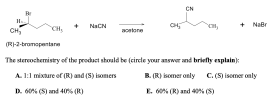
CN Br Hir.. CH5n + NaCN ch + NaBr CH, acetone CH; (R)-2-bromopentane The stereochemistry of the product should be (circle your answer and briefly explain): A. 1:1 mixture of (R) and (S) isomers B. (R) isomer only C. (S) isomer only D. 60% (S) and 40% (R) E. 60% (R) and 40% (S)
Consider the reaction of (R)-2-bromopentane and sodium cyanide
in acetone.
CN Br Hir.. CH5n + NaCN ch + NaBr CH, acetone CH; (R)-2-bromopentane The stereochemistry of the product should be (circle your answer and briefly explain): A. 1:1 mixture of (R) and (S) isomers B. (R) isomer only C. (S) isomer only D. 60% (S) and 40% (R) E. 60% (R) and 40% (S)
luction Nucleophilic substitution is a tremendously useful and important reaction in organic chemistry. No s it...
 luction Nucleophilic substitution is a tremendously useful and important reaction in organic chemistry. No s it used extensively in organic synthesis, but some biochemical processes also proceed via nucleophili Litution mechanisms. Often, nucleophilic substitution is one of the first organic reactions covered and it efore very important to understand it thoroughly. This experiment investigates the relative nucleophilicity of chloride and bromide ions. Also of interes ow varying the degree of substitution at the electrophilic center affects the reaction mechanism. The...
Questions 2-10 please!! 1) A substitution reaction is: [2] a) A reaction during which an OH...
 Questions 2-10 please!!
1) A substitution reaction is: [2] a) A reaction during which an OH group of a molecule is replaced by a halogen. b) A reaction during which water is the leaving group. c) A reaction during which a functional group of a molecule is replaced by an electrophile. d) A reaction during which a functional group of a molecule is replaced by another functional group. V 12 2) Substitution reactions are classified either as electrophilic or nucleophilic...
Questions 2-10 please!!
1) A substitution reaction is: [2] a) A reaction during which an OH group of a molecule is replaced by a halogen. b) A reaction during which water is the leaving group. c) A reaction during which a functional group of a molecule is replaced by an electrophile. d) A reaction during which a functional group of a molecule is replaced by another functional group. V 12 2) Substitution reactions are classified either as electrophilic or nucleophilic...
Complete the electron-pushing mechanism for the following reaction of the aldehyde, 2-phenylethanal, in potassium cyanide and...
 Complete the electron-pushing mechanism for the
following reaction of the aldehyde, 2-phenylethanal, in potassium
cyanide and hydrogen cyanide. Add any missing atoms, bonds,
charges, non-bonding electron pairs, and curved arrows. Details
count!
Complete the electron-pushing mechanism for the
following reaction of the aldehyde, 2-phenylethanal, in potassium
cyanide and hydrogen cyanide. Add any missing atoms, bonds,
charges, non-bonding electron pairs, and curved arrows. Details
count!
Part 2. Nucleophilic substitution The reaction below is a nucleophilic substitution. Answer the following questions OH...
 Part 2. Nucleophilic substitution The reaction below is a nucleophilic substitution. Answer the following questions OH NaOH MeOH Br 1. What is the intermediate? (4 pts) 2. What is the product? Pay attention to stereochemistry where appropriate. (4 pts) Part 3. Integrated question The reaction below has been asked in our lecture. What are reagents required to complete the synthesis? (Hints: two steps) (6 pts) SCH3
The following nucleophilic substitution reaction has been reported in the chemical literature. Draw the product by...
 The following nucleophilic substitution reaction has been
reported in the chemical literature. Draw the product by analogy to
what you know about nucleophilic substitution in simple
systems.
1 attempts left Check my work Click the "draw structure" button to launch the drawing utility. The following nucleophilic substitution reaction has been reported in the chemical literature. Draw the product by analogy to what you know about nucleophilic substitution in simple systems. O,N- ÕNa Naci acetic acid edit structure ... p-Nitrobenzyl chloride
The following nucleophilic substitution reaction has been
reported in the chemical literature. Draw the product by analogy to
what you know about nucleophilic substitution in simple
systems.
1 attempts left Check my work Click the "draw structure" button to launch the drawing utility. The following nucleophilic substitution reaction has been reported in the chemical literature. Draw the product by analogy to what you know about nucleophilic substitution in simple systems. O,N- ÕNa Naci acetic acid edit structure ... p-Nitrobenzyl chloride
 The reaction given in equation 1 occurs via an associative mechanism that involves nucleophilic attack of Yon [ML,X] . Draw out and label the reaction profile for this reaction pathway. [ML,X]2+ + Y- → [ML,Y]2+ + X (eq 1) Sketch the reaction profile diagram for an inner-sphere electron transfer, assuming that the rate-determining step is the electron transfer step. Label each part of the profile (intermediates, energies). (ii) How does the mechanism for an inner-sphere mechanism differ from an outer-sphere...
 Identify the major product(s) in the reaction of
(R)-2-bromopentane with sodium cyanide in DMSO. Please draw the
correct answer choice with its stereochemistry.
6) Identify the major product(s) in the reaction of (R)-2-bromopentane with sodium cyanide in DMSO. Please draw the correct answer choice with its stereochemistry. A) B) C) D) (S)-2-cyanopentane racemic mixture of 2-cyanopentane (R)-2-cyanopentane trans-2-pentene
Identify the major product(s) in the reaction of
(R)-2-bromopentane with sodium cyanide in DMSO. Please draw the
correct answer choice with its stereochemistry.
6) Identify the major product(s) in the reaction of (R)-2-bromopentane with sodium cyanide in DMSO. Please draw the correct answer choice with its stereochemistry. A) B) C) D) (S)-2-cyanopentane racemic mixture of 2-cyanopentane (R)-2-cyanopentane trans-2-pentene
 For the following reaction, the cyanide nucleophile could
reasonably substitute at either of two positions. One mechanism
produces 4-cyanoheptane and dimethylsulfide. The competing
mechanism produces 4-methylthioheptane and acetonitrile (CH3CN). In
practice, only one substitution is observed. Choose the most likely
mechanistic pathway for this reaction and draw both of the
products. Select whether it proceeds via an SN1 or SN2
mechanism.
This is a Mixed question/ It is worth 4 points / You have unlimited attempts / There is a...
For the following reaction, the cyanide nucleophile could
reasonably substitute at either of two positions. One mechanism
produces 4-cyanoheptane and dimethylsulfide. The competing
mechanism produces 4-methylthioheptane and acetonitrile (CH3CN). In
practice, only one substitution is observed. Choose the most likely
mechanistic pathway for this reaction and draw both of the
products. Select whether it proceeds via an SN1 or SN2
mechanism.
This is a Mixed question/ It is worth 4 points / You have unlimited attempts / There is a...
 Ph3P CH3 Ph H3C H3C Eto2C The Fischer esterification reaction synthesizes an ester via a nucleophilic acyl substitution reaction The stereochemistry the alcohol oxygen that makes the nucleophilic attack. The Mitsunobu reaction, on the other hand, allows the synthesis of an ester in which the stereochemistry of the alcohol is inverted. The reaction involves a carboxylic acid and an alcohol, as well as triphenylphosphine and an azo compound termed diethyl azodicarboxylate DEAD). As with the Fischer esterification, H20 is formally...
 Consider the reaction of (R)-2-bromopentane and sodium cyanide
in acetone.
CN Br Hir.. CH5n + NaCN ch + NaBr CH, acetone CH; (R)-2-bromopentane The stereochemistry of the product should be (circle your answer and briefly explain): A. 1:1 mixture of (R) and (S) isomers B. (R) isomer only C. (S) isomer only D. 60% (S) and 40% (R) E. 60% (R) and 40% (S)
Consider the reaction of (R)-2-bromopentane and sodium cyanide
in acetone.
CN Br Hir.. CH5n + NaCN ch + NaBr CH, acetone CH; (R)-2-bromopentane The stereochemistry of the product should be (circle your answer and briefly explain): A. 1:1 mixture of (R) and (S) isomers B. (R) isomer only C. (S) isomer only D. 60% (S) and 40% (R) E. 60% (R) and 40% (S)
 luction Nucleophilic substitution is a tremendously useful and important reaction in organic chemistry. No s it used extensively in organic synthesis, but some biochemical processes also proceed via nucleophili Litution mechanisms. Often, nucleophilic substitution is one of the first organic reactions covered and it efore very important to understand it thoroughly. This experiment investigates the relative nucleophilicity of chloride and bromide ions. Also of interes ow varying the degree of substitution at the electrophilic center affects the reaction mechanism. The...
 Questions 2-10 please!!
1) A substitution reaction is: [2] a) A reaction during which an OH group of a molecule is replaced by a halogen. b) A reaction during which water is the leaving group. c) A reaction during which a functional group of a molecule is replaced by an electrophile. d) A reaction during which a functional group of a molecule is replaced by another functional group. V 12 2) Substitution reactions are classified either as electrophilic or nucleophilic...
Questions 2-10 please!!
1) A substitution reaction is: [2] a) A reaction during which an OH group of a molecule is replaced by a halogen. b) A reaction during which water is the leaving group. c) A reaction during which a functional group of a molecule is replaced by an electrophile. d) A reaction during which a functional group of a molecule is replaced by another functional group. V 12 2) Substitution reactions are classified either as electrophilic or nucleophilic...
 Complete the electron-pushing mechanism for the
following reaction of the aldehyde, 2-phenylethanal, in potassium
cyanide and hydrogen cyanide. Add any missing atoms, bonds,
charges, non-bonding electron pairs, and curved arrows. Details
count!
Complete the electron-pushing mechanism for the
following reaction of the aldehyde, 2-phenylethanal, in potassium
cyanide and hydrogen cyanide. Add any missing atoms, bonds,
charges, non-bonding electron pairs, and curved arrows. Details
count!
 Part 2. Nucleophilic substitution The reaction below is a nucleophilic substitution. Answer the following questions OH NaOH MeOH Br 1. What is the intermediate? (4 pts) 2. What is the product? Pay attention to stereochemistry where appropriate. (4 pts) Part 3. Integrated question The reaction below has been asked in our lecture. What are reagents required to complete the synthesis? (Hints: two steps) (6 pts) SCH3
 The following nucleophilic substitution reaction has been
reported in the chemical literature. Draw the product by analogy to
what you know about nucleophilic substitution in simple
systems.
1 attempts left Check my work Click the "draw structure" button to launch the drawing utility. The following nucleophilic substitution reaction has been reported in the chemical literature. Draw the product by analogy to what you know about nucleophilic substitution in simple systems. O,N- ÕNa Naci acetic acid edit structure ... p-Nitrobenzyl chloride
The following nucleophilic substitution reaction has been
reported in the chemical literature. Draw the product by analogy to
what you know about nucleophilic substitution in simple
systems.
1 attempts left Check my work Click the "draw structure" button to launch the drawing utility. The following nucleophilic substitution reaction has been reported in the chemical literature. Draw the product by analogy to what you know about nucleophilic substitution in simple systems. O,N- ÕNa Naci acetic acid edit structure ... p-Nitrobenzyl chloride
Most questions answered within 3 hours.
-
Where is the error in this code sequence?
String s1 = "Hello";
String s2 = "ello";...
asked 11 months ago -
Financial data for Joel de Paris, Inc., for last year
follow:
Joel de Paris, Inc.
Balance...
asked 11 months ago -
Consider this reaction:
Al2(SO4)3 (aq)+ BaCl3
(aq) Al2Cl6 (aq)- +
3BaSO4(s) . What is the...
asked 11 months ago -
Suppose that Savneet is considering increasing her
recent random sample from 20 car rentals to 40...
asked 11 months ago -
Trucks arrive at an unloading terminal at an average rate of 120
per hour.
Trucks arrive...
asked 11 months ago -
Why are methanol and ethanol completely soluble in water while
octanol is not very little soluble....
asked 11 months ago -
A facilities manager at a university reads in a research report
that the mean amount of...
asked 11 months ago -
When the CuSO4 is rehydrated by adding water to the anhydrous
compound, is this an endothermic...
asked 11 months ago -
A ray of sunlight is passing from diamond into crown glass; the
angle of incidence is...
asked 11 months ago -
A block of mass 0.249 kg is placed on top of a light, vertical
spring of...
asked 11 months ago -
how do the kidneys compensate in the presences of acidosis
a) trigger hyperventilate
b) reserve acid...
asked 11 months ago -
Question 501 pts
The rental rate of capital to the firm increases. Which of the
following...
asked 11 months ago