Draw the diagram for thermodynamic work cycle of a Carnot Engine on a pressure-volume graph. Label...
Draw the diagram for thermodynamic work cycle of a Carnot Engine on a pressure-volume graph. Label the 4 phases of the work cycle A, B, C and D. Describe what is happening in each phase.
Homework Answers


Add Answer to:
Draw the diagram for thermodynamic work cycle of a Carnot Engine
on a pressure-volume graph. Label...
A refrigerator is constructed with a Carnot engine. Draw a diagram of the Carnot cycle in...
 A refrigerator is constructed with a Carnot engine. Draw a diagram of the Carnot cycle in a P-V diagram, label the components, and then detail the processes that occur (I short phrase each is all that is necessary). Draw a diagram of the Carnot cycle in a H-S diagram, and label it to match (a) Note: His enthalpy and S is entropy. Water is brought to 0 °C in the refrigerator with the heat being discharged into a reservoir at...
Draw a diagram of the Carnot cycle on a Pressure-Specific Volume (m^3/kg) diagram for air as...
Draw a diagram of the Carnot cycle on a Pressure-Specific Volume (m^3/kg) diagram for air as a working fluid. Please make sure the horizontal axis is specific volume and not volume.
4. (a) On the pressure-volume diagram Step 1 shown at the right, draw in the four...
 4. (a) On the pressure-volume diagram Step 1 shown at the right, draw in the four Step 2 lines which illustrate the P-V behavior Step 3 Step 4 during the four steps of the Carnot cycle. Label the steps as 1, 2, 3 & 4 and indicate in the space provided, whether each step is isothermal or adiabatic. (b) The Carnot heat engine operates between a hot reservoir at T, - 300 °C and a cold reservoir at T. The...
3: Consider the Rankine power cycle using vapor and liquid. a: Explain what kinds of problems the Carnot Vapor Cycle has. b: Draw a T-s diagram for the ideal Rankine cycle and label each process...
 3: Consider the Rankine power cycle using vapor and liquid. a: Explain what kinds of problems the Carnot Vapor Cycle has. b: Draw a T-s diagram for the ideal Rankine cycle and label each process explicitly c: There is a method to lower the condenser pressure (or to decrease the average low temperature) in order to improve the efficiency of the ideal Rankine cycle. Explain its advantages and disadvantages explicitly. d: Name the gas power cycle which uses the same...
4. Consider a heat engine based on the Stirling cycle. Pressure Vs Volume V2 Steps 1-2...
 4. Consider a heat engine based on the Stirling cycle. Pressure Vs Volume V2 Steps 1-2 and 3-4 are at constant temperature (1-2 at temperature TH and 3-4 at temperature To, and steps 4-1 and 2-3 are at constant volume (2-3 at volume V2, and 4-1 at volume V) a) Determine expressions for the heat and work in each step. b) Calculate an expression for the efficiency e of this heat engine as a function of TH TC, V2, Vi,...
A heat engine takes 0.262 mol of a diatomic deal gas around the cycle shown in the pV-diagram bel...
 A heat engine takes 0.262 mol of a diatomic deal gas around the cycle shown in the pV-diagram below. Process 1 → 2 is at constant volume, process 2-) 3 is adiabatic, and process 3-1 is at a constant pressure of P = 2.00 atm. The value of r for this gas is 1.4 2,7-600K T,-300 K T, 492 K 0 (a) Find the pressure and volume at points 1, 2, and 3. pressure (Pa) volume (m3) point 1 point...
7. Consider a Carnot-cycle heat engine with water as the working fluid. The heat transfer to...
 7. Consider a Carnot-cycle heat engine with water as the working fluid. The heat transfer to the water occurs at 150°C, during which process the water changes from saturated liquid to saturated vapor. The heat is rejected from the water at 25°C. (a) Show the Carnot-cycle on a T-s diagram (b) Find the properties (P, T, v, h, s) water at each state. Here v is the specific volume. (c) Determine the cycle thermal efficiency, net heat added and work...
4. The pressure-volume diagram below shows a special reversible cycle called the Carnot cycle A mole...
 4. The pressure-volume diagram below shows a special reversible cycle called the Carnot cycle A mole of an ideal gas starts off in state 1 in contact with a large thermal reservoir at temperature Th. The gas then undergoes an isothermal expansion from Vi to V2. Upon reaching state 2, the gas container is removed from contact with the thermal reservoir and covered with thermal insulation. Next the gas is allowed to expand adiabatically from V2to Vs. Because the expansion...
? Question 3: A heat engine is assumed to operate on a Carnot cycle. It receives...
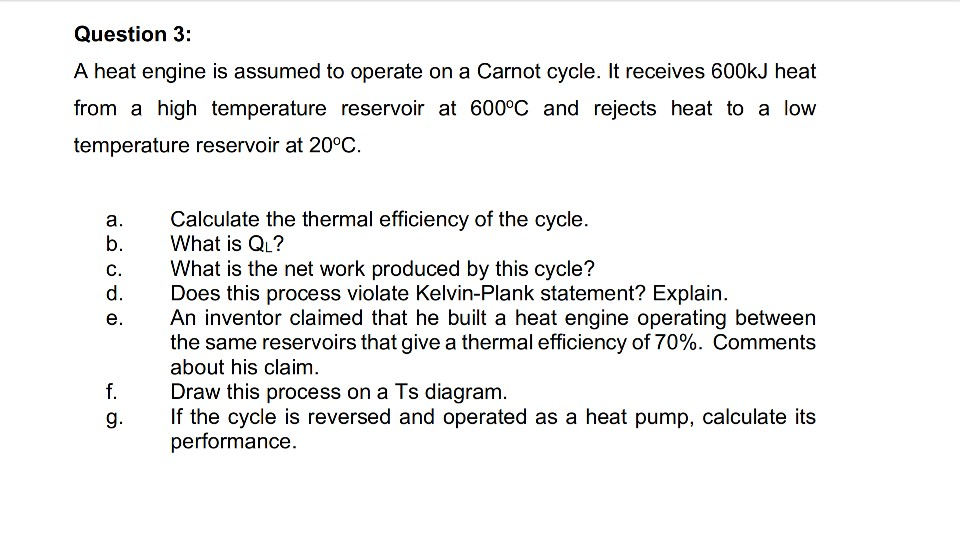 ?
Question 3: A heat engine is assumed to operate on a Carnot cycle. It receives 600kJ heat from a high temperature reservoir at 600°C and rejects heat to a low temperature reservoir at 20°C. ooooo Calculate the thermal efficiency of the cycle. What is QL? What is the net work produced by this cycle? Does this process violate Kelvin-Plank statement? Explain. An inventor claimed that he built a heat engine operating between the same reservoirs that give a thermal...
?
Question 3: A heat engine is assumed to operate on a Carnot cycle. It receives 600kJ heat from a high temperature reservoir at 600°C and rejects heat to a low temperature reservoir at 20°C. ooooo Calculate the thermal efficiency of the cycle. What is QL? What is the net work produced by this cycle? Does this process violate Kelvin-Plank statement? Explain. An inventor claimed that he built a heat engine operating between the same reservoirs that give a thermal...
A heat engine takes for 0.40 mol of ideal H2 gas around the cycle shown in the pV- diagram.
 A heat engine takes for 0.40 mol of ideal H2 gas around the cycle shown in the pV- diagram.Ta=400KTb=800KTc=592K Process a→b is at constant volume, process b→c is adiabatic, and process c-> a is at constant pressure of 2 atm. The value of y for this gas is 1.40. (a) Find the pressure and volume at points a, b and c (b) Calculate Q, W, and AU for each of the processes. (c) Find the net work done by the gas in the cycle (d)...
 A refrigerator is constructed with a Carnot engine. Draw a diagram of the Carnot cycle in a P-V diagram, label the components, and then detail the processes that occur (I short phrase each is all that is necessary). Draw a diagram of the Carnot cycle in a H-S diagram, and label it to match (a) Note: His enthalpy and S is entropy. Water is brought to 0 °C in the refrigerator with the heat being discharged into a reservoir at...
 4. (a) On the pressure-volume diagram Step 1 shown at the right, draw in the four Step 2 lines which illustrate the P-V behavior Step 3 Step 4 during the four steps of the Carnot cycle. Label the steps as 1, 2, 3 & 4 and indicate in the space provided, whether each step is isothermal or adiabatic. (b) The Carnot heat engine operates between a hot reservoir at T, - 300 °C and a cold reservoir at T. The...
 3: Consider the Rankine power cycle using vapor and liquid. a: Explain what kinds of problems the Carnot Vapor Cycle has. b: Draw a T-s diagram for the ideal Rankine cycle and label each process explicitly c: There is a method to lower the condenser pressure (or to decrease the average low temperature) in order to improve the efficiency of the ideal Rankine cycle. Explain its advantages and disadvantages explicitly. d: Name the gas power cycle which uses the same...
 4. Consider a heat engine based on the Stirling cycle. Pressure Vs Volume V2 Steps 1-2 and 3-4 are at constant temperature (1-2 at temperature TH and 3-4 at temperature To, and steps 4-1 and 2-3 are at constant volume (2-3 at volume V2, and 4-1 at volume V) a) Determine expressions for the heat and work in each step. b) Calculate an expression for the efficiency e of this heat engine as a function of TH TC, V2, Vi,...
 A heat engine takes 0.262 mol of a diatomic deal gas around the cycle shown in the pV-diagram below. Process 1 → 2 is at constant volume, process 2-) 3 is adiabatic, and process 3-1 is at a constant pressure of P = 2.00 atm. The value of r for this gas is 1.4 2,7-600K T,-300 K T, 492 K 0 (a) Find the pressure and volume at points 1, 2, and 3. pressure (Pa) volume (m3) point 1 point...
 7. Consider a Carnot-cycle heat engine with water as the working fluid. The heat transfer to the water occurs at 150°C, during which process the water changes from saturated liquid to saturated vapor. The heat is rejected from the water at 25°C. (a) Show the Carnot-cycle on a T-s diagram (b) Find the properties (P, T, v, h, s) water at each state. Here v is the specific volume. (c) Determine the cycle thermal efficiency, net heat added and work...
 4. The pressure-volume diagram below shows a special reversible cycle called the Carnot cycle A mole of an ideal gas starts off in state 1 in contact with a large thermal reservoir at temperature Th. The gas then undergoes an isothermal expansion from Vi to V2. Upon reaching state 2, the gas container is removed from contact with the thermal reservoir and covered with thermal insulation. Next the gas is allowed to expand adiabatically from V2to Vs. Because the expansion...
Most questions answered within 3 hours.
-
Where is the error in this code sequence?
String s1 = "Hello";
String s2 = "ello";...
asked 10 months ago -
Financial data for Joel de Paris, Inc., for last year
follow:
Joel de Paris, Inc.
Balance...
asked 10 months ago -
Consider this reaction:
Al2(SO4)3 (aq)+ BaCl3
(aq) Al2Cl6 (aq)- +
3BaSO4(s) . What is the...
asked 10 months ago -
Suppose that Savneet is considering increasing her
recent random sample from 20 car rentals to 40...
asked 10 months ago -
Trucks arrive at an unloading terminal at an average rate of 120
per hour.
Trucks arrive...
asked 10 months ago -
Why are methanol and ethanol completely soluble in water while
octanol is not very little soluble....
asked 10 months ago -
A facilities manager at a university reads in a research report
that the mean amount of...
asked 10 months ago -
When the CuSO4 is rehydrated by adding water to the anhydrous
compound, is this an endothermic...
asked 10 months ago -
A ray of sunlight is passing from diamond into crown glass; the
angle of incidence is...
asked 10 months ago -
A block of mass 0.249 kg is placed on top of a light, vertical
spring of...
asked 10 months ago -
how do the kidneys compensate in the presences of acidosis
a) trigger hyperventilate
b) reserve acid...
asked 10 months ago -
Question 501 pts
The rental rate of capital to the firm increases. Which of the
following...
asked 10 months ago