Discuss the biochemistry behind the MR-VP microbiology tests .
Discuss the biochemistry behind the MR-VP microbiology tests .
Homework Answers
MRVP tests are part of IMViC tests which are used to differentiate between enterics (members of family Enterobacteriaceae). Here MR stands for Methyl Red Test and VP stands for Voges-Proskauer tests.
IMViC tests include:
- Indole test
- Methyl red test
- Voges-Proskauer test
- Citrate test
(Source: https://laboratoryinfo.com/methyl-red-test/)
MRVP tests use the same broth for bacterial growth. The broth is called MRVP broth. After growth, the broth is separated into two different tubes, one for the methyl red (MR) test and one for the Voges-Proskauer (VP) test. (Source: https://en.wikipedia.org/wiki/IMViC).
The Methyl Red (MR) test is based on the use of methyl red, a pH indicator, to detect acidity when an organism ferments glucose. Clark and Lubs, in 1915, discovered the ability of coliforms to produce and maintain acid products when cultivated in specific media. They found that cultures of Escherichia coli produced a red color upon addition of methyl red. This color development was a result of strong acid production from dextrose-fermentation. (Source: https://catalog.hardydiagnostics.com/cp_prod/Content/hugo/MR-VPBroth.htm)
Voges and Proskauer, in 1898, first observed the production of a red color after the addition of potassium hydroxide to cultures grown on specific media.Harden later revealed that the development of the red color was a result of acetyl-methyl carbinol (acetoin) production. In 1936, Barrit made the test more sensitive by adding alpha-naphthol to the medium before adding potassium hydroxide. (Source: https://catalog.hardydiagnostics.com/cp_prod/Content/hugo/MR-VPBroth.htm). The test is performed by adding alpha-naphthol and potassium hydroxide to the Voges-Proskauer broth which has been inoculated with bacteria. A cherry red color indicates a positive result, while a yellow-brown color indicates a negative result. (Source: https://en.wikipedia.org/wiki/Voges%E2%80%93Proskauer_test) Clark and Lubs developed MR-VP Broth which allowed both the MR and VP tests to be performed from the same inoculated medium by aliquoting portions to different tubes. (Source: https://catalog.hardydiagnostics.com/cp_prod/Content/hugo/MR-VPBroth.htm)
Biochemistry of MRVP: MR-VP test is used to determine which fermentation pathway is used to utilize glucose. In the mixed acid fermentation pathway, glucose is fermented and produces several organic acids (lactic, acetic, succinic, and formic acids). The stable production of enough acid to overcome the phosphate buffer will result in a pH of below 4.4. If the pH indicator (methyl red) is added to an aliquot of the culture broth and the pH is below 4.4, a red color will appear (first picture, tube on the left). If the MR turns yellow, the pH is above 6.0 and the mixed acid fermentation pathway has not been utilized (first picture, tube on the right). The 2,3 butanediol fermentation pathway will ferment glucose and produce a 2,3 butanediol end product instead of organic acids. In order to test this pathway, an aliquot of the MR/VP culture is removed and a-naphthol and KOH are added. They are shaken together vigorously and set aside for about one hour until the results can be read. The Voges-Proskauer test detects the presence of acetoin, a precursor of 2,3 butanediol. If the culture is positive for acetoin, it will turn “brownish-red to pink” (tube on the left in the second picture). If the culture is negative for acetoin, it will turn “brownish-green to yellow” (tube on the left in the second picture). Note: A culture will usually only be positive for one pathway: either MR+ or VP+. Escherichia coli is MR+ and VP-. In contrast, Enterobacter aerogenes and Klebsiella pneumoniae are MR- and VP+. Pseudomonas aeruginosa is a glucose nonfermenter and is thus MR- and VP-.(Source: https://www.uwyo.edu/molb2210_lab/info/biochemical_tests.htm#methyl_red)
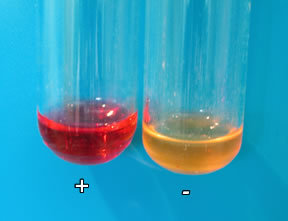
 (Source:
https://www.uwyo.edu/molb2210_lab/info/biochemical_tests.htm#methyl_red)
(Source:
https://www.uwyo.edu/molb2210_lab/info/biochemical_tests.htm#methyl_red)
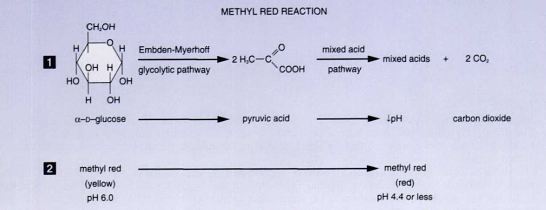
(Source: //img.homeworklib.com/questions/2030aa30-0d09-11f0-a172-bb47a949f8df.jpg?x-oss-process=image/resize,w_560)
Microbiology Q1 Q2 Escherichia coli is a red-pigmented organism. True O False The results of the...
 Microbiology
Q1
Q2
Escherichia coli is a red-pigmented organism. True O False The results of the MR-VP test can be directly read from the test without the addition of any other chemicals. True False
Microbiology
Q1
Q2
Escherichia coli is a red-pigmented organism. True O False The results of the MR-VP test can be directly read from the test without the addition of any other chemicals. True False
Microbiology Q1 Q2 Q3 Salmonella is associated with the handling of contaminated beef True False Escherichia...
 Microbiology
Q1
Q2
Q3
Salmonella is associated with the handling of contaminated beef True False Escherichia coli is a red-pigmented organism. True O False The results of the MR-VP test can be directly read from the test without the addition of any other chemicals. True False
Microbiology
Q1
Q2
Q3
Salmonella is associated with the handling of contaminated beef True False Escherichia coli is a red-pigmented organism. True O False The results of the MR-VP test can be directly read from the test without the addition of any other chemicals. True False
Describe the purpose, principle, testing method and interpretation for the following tests: ONPG Oxidase indole MR-methyl...
Describe the purpose, principle, testing method and interpretation for the following tests: ONPG Oxidase indole MR-methyl red VP- voges proskauer Nitrate reduction Urea agar Citrate agar phenylalanine Deaminase Motility Decarboxylase media TSI - Triple Sugar iron agar Kia - Kligler iron agar OF- oxidase fermentation agar
Medium/test used for/ determines indicator / key ingredients positive result negative result Comments/ additional info MR/VP...
 Medium/test used for/ determines indicator / key ingredients positive result negative result Comments/ additional info MR/VP broth MR test: VP test: nitrate broth catalase test oxidase test casein agar gelatin deep lysine iron Pseudo. F agar & Pseudo. P agar temp specific incubations
Methyl Red and Voges-Proskauer tests
Some protocols callfor a shorter incubation time for the MR and VP tests. Other protocols allow for up to 10 days incubation with virtually no risk of producting afalse positive.a. Which of the two tests would likely produce more false negatives with a shorter incubation time. Why?Which test would likely benefit most from a longer incubation time? Why?
“Bioinformatics increasingly impacts on all main areas of Microbiology”. Discuss this statement with reference to examples.
“Bioinformatics increasingly impacts on all main areas of Microbiology”. Discuss this statement with reference to examples.
Practice short answer: In relation to metabolic biochemistry, briefly discuss variation in metabolism, that is, the...
Practice short answer: In relation to metabolic biochemistry, briefly discuss variation in metabolism, that is, the differences between organs and organisms.
Microbiology Q1 Q2 Q3 Salmonella is associated with the handling of contaminated beef True False Which...
 Microbiology
Q1
Q2
Q3
Salmonella is associated with the handling of contaminated beef True False Which test(s) would you use to find out more about Gram-positive organisms? SIM O MR Citrate None of the tests listed. Fermentation of sugars usually results in end products. Acidic Basic (Alkaline)
Microbiology
Q1
Q2
Q3
Salmonella is associated with the handling of contaminated beef True False Which test(s) would you use to find out more about Gram-positive organisms? SIM O MR Citrate None of the tests listed. Fermentation of sugars usually results in end products. Acidic Basic (Alkaline)
Microbiology Q1 Q2 Q3 What is the color of SIM medium that contains an organism that...
 Microbiology
Q1
Q2
Q3
What is the color of SIM medium that contains an organism that forms hydrogen sulfide (is positive for sulfur)? Blue Black Red Yellow Which test(s) would you use to find out more about Gram-positive organisms? SIM MR Citrate None of the tests listed. Fermentation of sugars usually results in end products. Acidic Basic (Alkaline)
Microbiology
Q1
Q2
Q3
What is the color of SIM medium that contains an organism that forms hydrogen sulfide (is positive for sulfur)? Blue Black Red Yellow Which test(s) would you use to find out more about Gram-positive organisms? SIM MR Citrate None of the tests listed. Fermentation of sugars usually results in end products. Acidic Basic (Alkaline)
Methyl Red and Voges-Proskauer Tests OBSERVATIONS AND INTERPRETATIONS 5-3 1 Refer to Tables 5-3 and 5-4,...
 Methyl Red and Voges-Proskauer Tests OBSERVATIONS AND INTERPRETATIONS 5-3 1 Refer to Tables 5-3 and 5-4, page 290, as you record your results (color) and interpretations in the table below Organism Uninoculated control MR Result VP Result Interpretation QUESTIONS Some protocols call for a shorter incubation time for the MR and VP tests. Other protocols alloue for up to 10 days incubation with virtually no risk of producing a false positive. a. Which of the two tests would likely produce...
 Microbiology
Q1
Q2
Escherichia coli is a red-pigmented organism. True O False The results of the MR-VP test can be directly read from the test without the addition of any other chemicals. True False
Microbiology
Q1
Q2
Escherichia coli is a red-pigmented organism. True O False The results of the MR-VP test can be directly read from the test without the addition of any other chemicals. True False
 Microbiology
Q1
Q2
Q3
Salmonella is associated with the handling of contaminated beef True False Escherichia coli is a red-pigmented organism. True O False The results of the MR-VP test can be directly read from the test without the addition of any other chemicals. True False
Microbiology
Q1
Q2
Q3
Salmonella is associated with the handling of contaminated beef True False Escherichia coli is a red-pigmented organism. True O False The results of the MR-VP test can be directly read from the test without the addition of any other chemicals. True False
 Medium/test used for/ determines indicator / key ingredients positive result negative result Comments/ additional info MR/VP broth MR test: VP test: nitrate broth catalase test oxidase test casein agar gelatin deep lysine iron Pseudo. F agar & Pseudo. P agar temp specific incubations
 Microbiology
Q1
Q2
Q3
Salmonella is associated with the handling of contaminated beef True False Which test(s) would you use to find out more about Gram-positive organisms? SIM O MR Citrate None of the tests listed. Fermentation of sugars usually results in end products. Acidic Basic (Alkaline)
Microbiology
Q1
Q2
Q3
Salmonella is associated with the handling of contaminated beef True False Which test(s) would you use to find out more about Gram-positive organisms? SIM O MR Citrate None of the tests listed. Fermentation of sugars usually results in end products. Acidic Basic (Alkaline)
 Microbiology
Q1
Q2
Q3
What is the color of SIM medium that contains an organism that forms hydrogen sulfide (is positive for sulfur)? Blue Black Red Yellow Which test(s) would you use to find out more about Gram-positive organisms? SIM MR Citrate None of the tests listed. Fermentation of sugars usually results in end products. Acidic Basic (Alkaline)
Microbiology
Q1
Q2
Q3
What is the color of SIM medium that contains an organism that forms hydrogen sulfide (is positive for sulfur)? Blue Black Red Yellow Which test(s) would you use to find out more about Gram-positive organisms? SIM MR Citrate None of the tests listed. Fermentation of sugars usually results in end products. Acidic Basic (Alkaline)
 Methyl Red and Voges-Proskauer Tests OBSERVATIONS AND INTERPRETATIONS 5-3 1 Refer to Tables 5-3 and 5-4, page 290, as you record your results (color) and interpretations in the table below Organism Uninoculated control MR Result VP Result Interpretation QUESTIONS Some protocols call for a shorter incubation time for the MR and VP tests. Other protocols alloue for up to 10 days incubation with virtually no risk of producing a false positive. a. Which of the two tests would likely produce...
Most questions answered within 3 hours.
-
Where is the error in this code sequence?
String s1 = "Hello";
String s2 = "ello";...
asked 11 months ago -
Financial data for Joel de Paris, Inc., for last year
follow:
Joel de Paris, Inc.
Balance...
asked 11 months ago -
Consider this reaction:
Al2(SO4)3 (aq)+ BaCl3
(aq) Al2Cl6 (aq)- +
3BaSO4(s) . What is the...
asked 11 months ago -
Suppose that Savneet is considering increasing her
recent random sample from 20 car rentals to 40...
asked 11 months ago -
Trucks arrive at an unloading terminal at an average rate of 120
per hour.
Trucks arrive...
asked 11 months ago -
Why are methanol and ethanol completely soluble in water while
octanol is not very little soluble....
asked 11 months ago -
A facilities manager at a university reads in a research report
that the mean amount of...
asked 11 months ago -
When the CuSO4 is rehydrated by adding water to the anhydrous
compound, is this an endothermic...
asked 11 months ago -
A ray of sunlight is passing from diamond into crown glass; the
angle of incidence is...
asked 11 months ago -
A block of mass 0.249 kg is placed on top of a light, vertical
spring of...
asked 11 months ago -
how do the kidneys compensate in the presences of acidosis
a) trigger hyperventilate
b) reserve acid...
asked 11 months ago -
Question 501 pts
The rental rate of capital to the firm increases. Which of the
following...
asked 11 months ago