What molecule (CO, CS, CSe, N2) will have the strongest bond to a metal atom, and...
What molecule (CO, CS, CSe, N2) will have the strongest bond to a metal atom, and why?
Which do you think backbonding would be the strongest, and why?
Homework Answers
1. Molecule with the Strongest Bond to a Metal Atom
Carbon Monoxide (CO) will form the strongest bond with a metal atom.
Reason:
CO has the highest electronegativity difference and a strong ability to engage in π-backbonding.
CS and CSe have larger atoms (S and Se), leading to poorer overlap and weaker bonds.
N₂ has a weaker π-acceptor ability than CO.
CO is a strong field ligand and participates in both σ-donation from the lone pair on carbon and π-backbonding from the metal's d-orbitals to the empty π* anti-bonding orbitals of CO.
The strong synergic bonding increases the strength of the metal-ligand bond.
The bond strength order generally follows:
CO > CS > CSe > N₂ because:
2. Molecule with the Strongest Backbonding
CO again has the strongest backbonding.
Reason:
The π* orbitals in CO are lower in energy and better suited for backbonding compared to other molecules.
CO’s ability to accept electron density via π-backbonding stabilizes the metal-ligand interaction, making the bond stronger.
CS and CSe also show backbonding, but sulfur and selenium are less effective π-acceptors due to their larger size and higher energy orbitals.
N₂ is a poor π-acceptor compared to CO, making its backbonding much weaker.
In summary: CO has both the strongest bond and the strongest backbonding to a metal atom.
Add Answer to:
What molecule (CO, CS, CSe, N2) will have the strongest bond to
a metal atom, and...
Carbon monoxide (CO) forms bonds to a variety of metals and metal ions. Its ability to...
 Carbon monoxide (CO) forms bonds to a variety of metals and metal ions. Its ability to bond to iron in hemoglobin is the reason that CO is so toxic. The bond carbon monoxide forms to metals is through the carbon atom: M -C= 0 a. On the basis of electronegativities, would you expect the carbon atom or the oxygen atom to form bonds to metals? b. Assign formal charges to the atoms in CO. Which atom would you expect to...
2. The following questions refer to the bolded carbon atom in the molecule: CH3CHCHCH3 How many ...
2. The following questions refer to the bolded carbon atom in the molecule: CH3CHCHCH3 How many areas of high electron density surround the indicated C? Give the AXmEn notation for the in this molecule? (Look on page 6 of this experiment) What is the electronic geometry for this molecule? What is the molecular geometry for this molecule? What are the bond angles surrounding C? Do you expect any isomers for this molecule? If you do, give their structures. g) Is...
2. The following questions refer to the bolded carbon atom in the molecule: CH3CHCHCH3 How many...
2. The following questions refer to the bolded carbon atom in the molecule: CH3CHCHCH3 How many areas of high electron density surround the indicated C? Give the AXmEn notation for the in this molecule? (Look on page 6 of this experiment) What is the electronic geometry for this molecule? What is the molecular geometry for this molecule? What are the bond angles surrounding C? Do you expect any isomers for this molecule? If you do, give their structures. g) Is...
What is the strongest type of intermolecular force in the following compounds? N2 PF3 KrCI2 CO...
 What is the strongest type of intermolecular force in the following compounds? N2 PF3 KrCI2 CO CH3CH2NH2 УНСІ
(a) Consider a gaseous mixture of N2 and CO and compare it with a gaseous mixture...
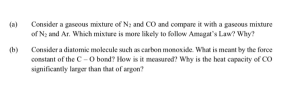 (a) Consider a gaseous mixture of N2 and CO and compare it with a gaseous mixture of N2 and Ar. Which mixture is more likely to follow Amagat's Law? Why? Consider a diatomic molecule such as carbon monoxide. What is meant by the force constant of the C-O bond? How is it measured? Why is the heat capacity of CO significantly larger than that of argon?
7. Rank the following ligands from strongest to weakest metal-ligand bond strength. | F, CH,CO2, NHẠC,H,NH,...
 7. Rank the following ligands from strongest to weakest metal-ligand bond strength. | F, CH,CO2, NHẠC,H,NH, CÓ 8. In many cases, a transition metal ion is colored because the metal ion has an electron residing in a d-orbital that absorbs energy and is promoted to a higher energy d-orbital. The energy difference between the d-orbitals depends on the metal ion and the ligand. The complexes Co(NH3)2+ and Co(H20) 2+ are colored, one is red and one is yellow. Predict which...
@ CHEMICAL BONDING Predicting bond angles in molecules with one central atom and n.. What is...
 @ CHEMICAL BONDING Predicting bond angles in molecules with one central atom and n.. What is the angle between the carbon-sulfur bonds in the carbon disulfide (CS, ) molecule? X 5 ?
What is nanotechnology? What is nanomaterial? What is atom, molecule, ion, and bond? Describe strong and...
 What is nanotechnology? What is nanomaterial? What is atom, molecule, ion, and bond? Describe strong and weak bonds. Explain sp^2 hybridization using frames and arrows representing electrons, and principles of a semiconductor using a models of Si atom. What is conduction and valence band and what is energy gap? What would be the necessary energy and wavelength of photons to excite electrons in materials with energy gap of 5.5 eV (diamond), 1.1 eV(Si) and 0.57 eV(Ge)? What would be necessary...
Part A. Which of the following is the strongest bond? C≡C, C–O, C–N, C–C, C=C . What is the average bond order for a CO...
 Part A. Which of the following is the strongest bond?
C≡C, C–O, C–N, C–C, C=C
.
What is the average bond order for a CO bond in the carbonate ion? :0 Ö: 2
Part A. Which of the following is the strongest bond?
C≡C, C–O, C–N, C–C, C=C
.
What is the average bond order for a CO bond in the carbonate ion? :0 Ö: 2
What do you think is the strongest objection to Singer's position? How do you think Singer...
What do you think is the strongest objection to Singer's position? How do you think Singer would reply to this objection? Do you think that the objection shows that Singer's theory is incorrect? Why or why not?
 Carbon monoxide (CO) forms bonds to a variety of metals and metal ions. Its ability to bond to iron in hemoglobin is the reason that CO is so toxic. The bond carbon monoxide forms to metals is through the carbon atom: M -C= 0 a. On the basis of electronegativities, would you expect the carbon atom or the oxygen atom to form bonds to metals? b. Assign formal charges to the atoms in CO. Which atom would you expect to...
 What is the strongest type of intermolecular force in the following compounds? N2 PF3 KrCI2 CO CH3CH2NH2 УНСІ
 (a) Consider a gaseous mixture of N2 and CO and compare it with a gaseous mixture of N2 and Ar. Which mixture is more likely to follow Amagat's Law? Why? Consider a diatomic molecule such as carbon monoxide. What is meant by the force constant of the C-O bond? How is it measured? Why is the heat capacity of CO significantly larger than that of argon?
 7. Rank the following ligands from strongest to weakest metal-ligand bond strength. | F, CH,CO2, NHẠC,H,NH, CÓ 8. In many cases, a transition metal ion is colored because the metal ion has an electron residing in a d-orbital that absorbs energy and is promoted to a higher energy d-orbital. The energy difference between the d-orbitals depends on the metal ion and the ligand. The complexes Co(NH3)2+ and Co(H20) 2+ are colored, one is red and one is yellow. Predict which...
 @ CHEMICAL BONDING Predicting bond angles in molecules with one central atom and n.. What is the angle between the carbon-sulfur bonds in the carbon disulfide (CS, ) molecule? X 5 ?
 What is nanotechnology? What is nanomaterial? What is atom, molecule, ion, and bond? Describe strong and weak bonds. Explain sp^2 hybridization using frames and arrows representing electrons, and principles of a semiconductor using a models of Si atom. What is conduction and valence band and what is energy gap? What would be the necessary energy and wavelength of photons to excite electrons in materials with energy gap of 5.5 eV (diamond), 1.1 eV(Si) and 0.57 eV(Ge)? What would be necessary...
 Part A. Which of the following is the strongest bond?
C≡C, C–O, C–N, C–C, C=C
.
What is the average bond order for a CO bond in the carbonate ion? :0 Ö: 2
Part A. Which of the following is the strongest bond?
C≡C, C–O, C–N, C–C, C=C
.
What is the average bond order for a CO bond in the carbonate ion? :0 Ö: 2
Most questions answered within 3 hours.
-
Where is the error in this code sequence?
String s1 = "Hello";
String s2 = "ello";...
asked 10 months ago -
Financial data for Joel de Paris, Inc., for last year
follow:
Joel de Paris, Inc.
Balance...
asked 10 months ago -
Consider this reaction:
Al2(SO4)3 (aq)+ BaCl3
(aq) Al2Cl6 (aq)- +
3BaSO4(s) . What is the...
asked 10 months ago -
Suppose that Savneet is considering increasing her
recent random sample from 20 car rentals to 40...
asked 10 months ago -
Trucks arrive at an unloading terminal at an average rate of 120
per hour.
Trucks arrive...
asked 10 months ago -
Why are methanol and ethanol completely soluble in water while
octanol is not very little soluble....
asked 10 months ago -
A facilities manager at a university reads in a research report
that the mean amount of...
asked 10 months ago -
When the CuSO4 is rehydrated by adding water to the anhydrous
compound, is this an endothermic...
asked 10 months ago -
A ray of sunlight is passing from diamond into crown glass; the
angle of incidence is...
asked 10 months ago -
A block of mass 0.249 kg is placed on top of a light, vertical
spring of...
asked 10 months ago -
how do the kidneys compensate in the presences of acidosis
a) trigger hyperventilate
b) reserve acid...
asked 10 months ago -
Question 501 pts
The rental rate of capital to the firm increases. Which of the
following...
asked 10 months ago