In Big-Θ notation, analyze the running time of the following pieces of code/pseudo-code. Describe the running...
In Big-Θ notation, analyze the running time of the following pieces of code/pseudo-code. Describe the running time as a function of the input size (here, n)
int *a = new int [10]; // new is O(1)
int size = 10;
for (int i = 0; i < n; i ++)
  {
    if (i == size)
      {
        int newsize = 3*size/2;
        int *b = new int [newsize];  // new is O(1)
        for (int j = 0; j < size; j ++) b[j] = a[j];
        delete [] a;  // delete is O(1)
        a = b;
        size = newsize;
      }
    a[i] = i*i;
}Homework Answers


Add Answer to:
In Big-Θ notation, analyze the running time of the following
pieces of code/pseudo-code. Describe the running...
In Big-Θ notation, analyze the running time of the following pieces of code/pseudo-code. Describe the running...
In Big-Θ notation, analyze the running time of the following pieces of code/pseudo-code. Describe the running time as a function of the input size (here, n) for(int i=n-1; i >=0; i--){ for(int k=0; k < i*n; k++){ // do something that takes O(1) time } }
Describe the worst case running time of the following pseudocode functions in Big-Oh notation in terms...
 Describe the worst case running time of the following
pseudocode functions in Big-Oh notation in terms of the variable n.
Show your work
b) void func(int n) { for (int i = 0; i < n; i = i + 10) { for (int j = 0; j < i; ++i) { System.out.println("i = " + i); System.out.println("j = " + j);
Describe the worst case running time of the following
pseudocode functions in Big-Oh notation in terms of the variable n.
Show your work
b) void func(int n) { for (int i = 0; i < n; i = i + 10) { for (int j = 0; j < i; ++i) { System.out.println("i = " + i); System.out.println("j = " + j);
1. Analyze the running time of the following algorithm and write it using ( notation. You...
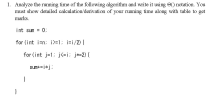 1. Analyze the running time of the following algorithm and write it using ( notation. You must show detailed calculation/derivation of your running time along with table to get marks. int sum = 0; for (int i=n; i)=1; i=i/2) { for (int j=1; j<=i; j*=2) { sum+=i*j; } }
Analyze the following code and provide a "Big-O" estimate of its running time in terms of...
Analyze the following code and provide a "Big-O" estimate of its running time in terms of n. Explain your analysis. Assume k is a constant given by the problem. for (i=1; i<=n; i++) p = pow(i,k); // p = i to the power of k for (j=1; j<=p; j++) Some O(1) work end for end for
Question 1 (25 pts) Find the running time complexity for the following code fragments. Express yo...
 Question 1 (25 pts)
Find the running time complexity for the following code
fragments. Express your answers using either the Big-O or Big-Θ
notations, and the tightest bound possible. Justify your
answers.
for(int count O , i -0; i < n* n; i++) for(int i0 ; j <i; j++) count++
for(int count O , i -0; i
Question 1 (25 pts)
Find the running time complexity for the following code
fragments. Express your answers using either the Big-O or Big-Θ
notations, and the tightest bound possible. Justify your
answers.
for(int count O , i -0; i < n* n; i++) for(int i0 ; j <i; j++) count++
for(int count O , i -0; i
4. Big-Oh and Rune time Analysis: describe the worst case running time of the following pseudocode...
 4. Big-Oh and Rune time Analysis: describe the worst case running time of the following pseudocode functions in Big-Oh notation in terms of the variable n. howing your work is not required (although showing work may allow some partial t in the case your answer is wrong-don't spend a lot of time showing your work.). You MUST choose your answer from the following (not given in any particular order), each of which could be re-used (could be the answer for...
Q-1: Given the following code fragment, what is its Big-O running time? test = 0 for...
Q-1: Given the following code fragment, what is its Big-O running time? test = 0 for i in range(n): for j in range(n): test= test + i *j Q-2: Given3 the following code fragment what is its Big-O running time? for i in range(n): test=test+1 for j in range(n): test= test - 2 Q-3: Given the following code fragment what is its Big-O running time? i = n while i > 0: k=2+2 i...
Give the time complexities (Big-O notation) of the following running times expressed as a function of...
Give the time complexities (Big-O notation) of the following running times expressed as a function of the input size N. a) N12+ 25N10+ 8 b) N + 3logN + 12n√n c) 12NlogN + 15N2 logN
Using C++ please explain What is the Big-O time complexity of the following code: for (int...
 Using C++ please explain
What is the Big-O time complexity of the following code: for (int i=0; i<N; i+=2) { ... constant time operations... Select one: o a. O(n^2) O b. O(log n) c. O(n) O d. 0(1) What is the Big-O time complexity of the following code: for(int i=1; i<N; i*=2) { ... constant time operations... Select one: O O a. O(n^2) b. 0(1) c. O(n) d. O(log n) O What is the Big-O time complexity of the following...
Using C++ please explain
What is the Big-O time complexity of the following code: for (int i=0; i<N; i+=2) { ... constant time operations... Select one: o a. O(n^2) O b. O(log n) c. O(n) O d. 0(1) What is the Big-O time complexity of the following code: for(int i=1; i<N; i*=2) { ... constant time operations... Select one: O O a. O(n^2) b. 0(1) c. O(n) d. O(log n) O What is the Big-O time complexity of the following...
find complexity Problem 1 Find out the computational complexity (Big-Oh notation) of the code snippet: Code...
find complexity Problem 1 Find out the computational complexity (Big-Oh notation) of the code snippet: Code 1: for (int i = n; i > 0; i /= 2) { for (int j = 1; j < n; j *= 2) { for (int k = 0; k < n; k += 2) { // constant number of operations here } } } Code 2: Hint: Lecture Note 5, Page 7-8 void f(int n) { if (n...
 Describe the worst case running time of the following
pseudocode functions in Big-Oh notation in terms of the variable n.
Show your work
b) void func(int n) { for (int i = 0; i < n; i = i + 10) { for (int j = 0; j < i; ++i) { System.out.println("i = " + i); System.out.println("j = " + j);
Describe the worst case running time of the following
pseudocode functions in Big-Oh notation in terms of the variable n.
Show your work
b) void func(int n) { for (int i = 0; i < n; i = i + 10) { for (int j = 0; j < i; ++i) { System.out.println("i = " + i); System.out.println("j = " + j);
 1. Analyze the running time of the following algorithm and write it using ( notation. You must show detailed calculation/derivation of your running time along with table to get marks. int sum = 0; for (int i=n; i)=1; i=i/2) { for (int j=1; j<=i; j*=2) { sum+=i*j; } }
 Question 1 (25 pts)
Find the running time complexity for the following code
fragments. Express your answers using either the Big-O or Big-Θ
notations, and the tightest bound possible. Justify your
answers.
for(int count O , i -0; i < n* n; i++) for(int i0 ; j <i; j++) count++
for(int count O , i -0; i
Question 1 (25 pts)
Find the running time complexity for the following code
fragments. Express your answers using either the Big-O or Big-Θ
notations, and the tightest bound possible. Justify your
answers.
for(int count O , i -0; i < n* n; i++) for(int i0 ; j <i; j++) count++
for(int count O , i -0; i
 4. Big-Oh and Rune time Analysis: describe the worst case running time of the following pseudocode functions in Big-Oh notation in terms of the variable n. howing your work is not required (although showing work may allow some partial t in the case your answer is wrong-don't spend a lot of time showing your work.). You MUST choose your answer from the following (not given in any particular order), each of which could be re-used (could be the answer for...
 Using C++ please explain
What is the Big-O time complexity of the following code: for (int i=0; i<N; i+=2) { ... constant time operations... Select one: o a. O(n^2) O b. O(log n) c. O(n) O d. 0(1) What is the Big-O time complexity of the following code: for(int i=1; i<N; i*=2) { ... constant time operations... Select one: O O a. O(n^2) b. 0(1) c. O(n) d. O(log n) O What is the Big-O time complexity of the following...
Using C++ please explain
What is the Big-O time complexity of the following code: for (int i=0; i<N; i+=2) { ... constant time operations... Select one: o a. O(n^2) O b. O(log n) c. O(n) O d. 0(1) What is the Big-O time complexity of the following code: for(int i=1; i<N; i*=2) { ... constant time operations... Select one: O O a. O(n^2) b. 0(1) c. O(n) d. O(log n) O What is the Big-O time complexity of the following...
Most questions answered within 3 hours.
-
Where is the error in this code sequence?
String s1 = "Hello";
String s2 = "ello";...
asked 10 months ago -
Financial data for Joel de Paris, Inc., for last year
follow:
Joel de Paris, Inc.
Balance...
asked 10 months ago -
Consider this reaction:
Al2(SO4)3 (aq)+ BaCl3
(aq) Al2Cl6 (aq)- +
3BaSO4(s) . What is the...
asked 10 months ago -
Suppose that Savneet is considering increasing her
recent random sample from 20 car rentals to 40...
asked 10 months ago -
Trucks arrive at an unloading terminal at an average rate of 120
per hour.
Trucks arrive...
asked 10 months ago -
Why are methanol and ethanol completely soluble in water while
octanol is not very little soluble....
asked 10 months ago -
A facilities manager at a university reads in a research report
that the mean amount of...
asked 10 months ago -
When the CuSO4 is rehydrated by adding water to the anhydrous
compound, is this an endothermic...
asked 10 months ago -
A ray of sunlight is passing from diamond into crown glass; the
angle of incidence is...
asked 10 months ago -
A block of mass 0.249 kg is placed on top of a light, vertical
spring of...
asked 10 months ago -
how do the kidneys compensate in the presences of acidosis
a) trigger hyperventilate
b) reserve acid...
asked 10 months ago -
Question 501 pts
The rental rate of capital to the firm increases. Which of the
following...
asked 10 months ago