Explain the relationship between bond’s volatility and a bond's coupon and bond’s maturity. How do volatility...
Explain the relationship between bond’s volatility and a bond's coupon and bond’s maturity.
How do volatility and risk change for a zero coupon bond?
What is bond price volatility and how can it be calculated?
Homework Answers
1.
Higher the maturity higher the volatility
Higher the coupon lower the volatility
2.
Volatility for zero coupon bond is highest
3.
Bond price volatility is duration and can be calculated as % change
in price of bond with 1% change in yield
Bond Volatility :-
1. Coupon & Maturity Impact on Volatility
Lower Coupon = Higher Volatility (Prices swing more because most value comes from the faraway principal payment).
Longer Maturity = Higher Volatility (More time means more uncertainty about future rates).
Example:-
A 5% coupon bond drops ~7.4% when rates rise 1%.
A 10% coupon bond drops less because its coupons cushion the blow.
2. Zero-Coupon Bonds = Maximum Volatility
No coupons → all value depends on maturity payment.
A 10-year zero-coupon bond drops ~9% when rates rise 1% (vs. ~7% for coupon bonds).
3. Measuring Volatility: Modified Duration
"How much will price drop if rates rise 1%?"
Formula: Price Change ≈ -Duration × Rate Change
Example: A bond with Duration = 4.4 falls ~4.4% if rates rise 1%.
Bottom Line:
Want stability? Pick high-coupon, short-term bonds.
Higher risk/reward? Zero-coupon or long-term bonds swing more.
Add Answer to:
Explain the relationship between bond’s volatility and a bond's
coupon and bond’s maturity.
How do volatility...
1. The term structure of interest rates refers to the relationship between _____. a bond's time to maturity and its coupon rate a bond's age since issue and its coupon rate a bond's age si...
1. The term structure of interest rates refers to the relationship between _____. a bond's time to maturity and its coupon rate a bond's age since issue and its coupon rate a bond's age since issue and its yield a bond's time to maturity and its yield. 2. The yield on 12-month treasury bills is 1.4% and the yield on 2-year treasury STRIPS is 2%. a. What is the implied 1-year forward rate one year from now? 3. The term...
3) What is the relationship between the coupon rate of a bond and the yield to...
3) What is the relationship between the coupon rate of a bond and the yield to maturity in terms of the bond's price. In particular, when do we have a discount bond, a par bond, and a premium bond? Please explain the rational behind the relationship as if you are explaining this relationship to a novice of Finance.
How to calculate coupon bond's Yields to Maturity? Table 1 Yields to Maturity on a 10%-coupon-Rate...
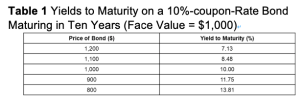 How to calculate coupon bond's Yields to Maturity?
Table 1 Yields to Maturity on a 10%-coupon-Rate Bond Maturing in Ten Years (Face Value = $1,000) Price of Bond (s) Yield to Maturity (%) 1,200 1,100 7.13 8.48 10.00 1,000 900 11.75 800 13.81
How to calculate coupon bond's Yields to Maturity?
Table 1 Yields to Maturity on a 10%-coupon-Rate Bond Maturing in Ten Years (Face Value = $1,000) Price of Bond (s) Yield to Maturity (%) 1,200 1,100 7.13 8.48 10.00 1,000 900 11.75 800 13.81
Suppose you are setting a coupon for a callable bond. What is the relationship between coupon...
Suppose you are setting a coupon for a callable bond. What is the relationship between coupon level and volatility? Why would required coupon levels change if vol changes in the market. (You can answer in terms of price instead of coupon if you find it easier.)
Consider a 2-year coupon bond, with annual coupons and a coupon rate of 7%. You do...
Consider a 2-year coupon bond, with annual coupons and a coupon rate of 7%. You do not know the yield to maturity, but you do know that it remains constant. Then over time what do we expect to happen to the bond’s price? a. The bond's price will gradually fall to par as it approaches maturity. b. The bond's price will gradually increase to par as it approaches maturity. c. The bond's price will remain equal to par as it...
What is the relationship between a bondholder's rate of return and the bond's yield to maturity...
What is the relationship between a bondholder's rate of return and the bond's yield to maturity if he does not hold the bond until it matures? A. The rate of return will be lower than the yield to maturity. B. The rate of return will be higher than the yield to maturity. C. The rate of return will equal the yield to maturity. D. It could be higher or lower.
Zero-coupon bond. Addison Company will issue a zero-coupon bond this coming month. The bond's projected yield...
 Zero-coupon bond. Addison Company will issue a zero-coupon bond this coming month. The bond's projected yield is 8%. If the par value is $5,000, what is the bond's price using a semiannual convention if a. the maturity is 10 years? b. the maturity is 35 years? c. the maturity is 70 years? d. the maturity is 100 years?
How does a bond’s par value differ from the market value? Explain the difference between a...
How does a bond’s par value differ from the market value? Explain the difference between a bond’s coupon rate, current yield and required rate of return. After answering the question, provide a detailed example of a current bond (price, coupon, YTM, time, etc) and using the data you have created, provide a calculation for one of the variables (for example, what is the present value, or what are the coupon payments). You may choose which variable to calculate.
29. What is the relationship between the price of a straight bond and the price of...
 29. What is the relationship between the price of a straight bond and the price of a callable bond? (a) (b) The straight bond's price will be higher than the callable bond's price for low interest rates. The straight bond's price will be lower than the callable bond's price for low interest rates. There is no consistent relationship between the two types of bonds' prices. The straight bond and callable bond will have the same price. (c) 30. The basic...
Huntsville Enterprise's bonds have a 20-year maturity, a yield to maturity of 8.20%, and an annual...
Huntsville Enterprise's bonds have a 20-year maturity, a yield to maturity of 8.20%, and an annual coupon rate of 8.60%. The bond makes semi-annual payments. Complete the following questions: The bond's current price = Enter your answer as a number with two decimal places of precision (i.e. 1.23) and no dollar signs or commas. Do not enter your answer as a negative number. The bond's current yield? = Enter your answer as a decimal with a leading zero and 4...
 How to calculate coupon bond's Yields to Maturity?
Table 1 Yields to Maturity on a 10%-coupon-Rate Bond Maturing in Ten Years (Face Value = $1,000) Price of Bond (s) Yield to Maturity (%) 1,200 1,100 7.13 8.48 10.00 1,000 900 11.75 800 13.81
How to calculate coupon bond's Yields to Maturity?
Table 1 Yields to Maturity on a 10%-coupon-Rate Bond Maturing in Ten Years (Face Value = $1,000) Price of Bond (s) Yield to Maturity (%) 1,200 1,100 7.13 8.48 10.00 1,000 900 11.75 800 13.81
 Zero-coupon bond. Addison Company will issue a zero-coupon bond this coming month. The bond's projected yield is 8%. If the par value is $5,000, what is the bond's price using a semiannual convention if a. the maturity is 10 years? b. the maturity is 35 years? c. the maturity is 70 years? d. the maturity is 100 years?
 29. What is the relationship between the price of a straight bond and the price of a callable bond? (a) (b) The straight bond's price will be higher than the callable bond's price for low interest rates. The straight bond's price will be lower than the callable bond's price for low interest rates. There is no consistent relationship between the two types of bonds' prices. The straight bond and callable bond will have the same price. (c) 30. The basic...
Most questions answered within 3 hours.
-
Where is the error in this code sequence?
String s1 = "Hello";
String s2 = "ello";...
asked 11 months ago -
Financial data for Joel de Paris, Inc., for last year
follow:
Joel de Paris, Inc.
Balance...
asked 11 months ago -
Consider this reaction:
Al2(SO4)3 (aq)+ BaCl3
(aq) Al2Cl6 (aq)- +
3BaSO4(s) . What is the...
asked 11 months ago -
Suppose that Savneet is considering increasing her
recent random sample from 20 car rentals to 40...
asked 11 months ago -
Trucks arrive at an unloading terminal at an average rate of 120
per hour.
Trucks arrive...
asked 11 months ago -
Why are methanol and ethanol completely soluble in water while
octanol is not very little soluble....
asked 11 months ago -
A facilities manager at a university reads in a research report
that the mean amount of...
asked 11 months ago -
When the CuSO4 is rehydrated by adding water to the anhydrous
compound, is this an endothermic...
asked 11 months ago -
A ray of sunlight is passing from diamond into crown glass; the
angle of incidence is...
asked 11 months ago -
A block of mass 0.249 kg is placed on top of a light, vertical
spring of...
asked 11 months ago -
how do the kidneys compensate in the presences of acidosis
a) trigger hyperventilate
b) reserve acid...
asked 11 months ago -
Question 501 pts
The rental rate of capital to the firm increases. Which of the
following...
asked 11 months ago