which of the following atoms is diamagnetic in its ground state? Cu As none of these...
which of the following atoms is diamagnetic in its ground state? Cu As none of these Ca Fe
Homework Answers
cu = atomic number =29 electronic configuration [ 1S2 2S2
2P6 3S2 3P6 4S1 3d10] although it consists of lone electron but it
is diamagnetic
As = atomic number =33 electronic configuration [ 1S2 2S2 2P6 3S2 3P6 4S2 3d10 4p3] three unpaired electrons so para magnetic
Ca = atomic number = 20 electronic configuration [ 1S2 2S2 2P6 3S2 3P6 4S2 ] it is diamagnetic because of metallic nature
Fe = atomic number = 26 electronic configuration [ 1S2 2S2 2P6 3S2 3P6 4S2 3d6 ] it is a ferro magnetic (spins are aligned anti parallel )
answer => cu
To determine which atom is diamagnetic in its ground state, we need to understand that diamagnetic atoms have all their electrons paired up (no unpaired electrons).
Let's check each option:
Cu (Copper):
Atomic number: 29
Electron configuration: [Ar] 4s¹ 3d¹⁰
The 4s electron is unpaired, so paramagnetic.
As (Arsenic):
Atomic number: 33
Electron configuration: [Ar] 4s² 3d¹⁰ 4p³
The 4p subshell has 3 unpaired electrons, so paramagnetic.
Ca (Calcium):
Atomic number: 20
Electron configuration: [Ar] 4s²
All electrons are paired, so diamagnetic.
Fe (Iron):
Atomic number: 26
Electron configuration: [Ar] 4s² 3d⁶
The 3d subshell has unpaired electrons, so paramagnetic.
Answer is :-
Calcium (Ca) is the only diamagnetic atom in this list because all its electrons are paired.
Add Answer to:
which of the following atoms is diamagnetic in its ground state?
Cu As none of these...
Which gas-phase atoms in their ground states are diamagnetic? I. Fe II. Zn
Which gas-phase atoms in their ground states are diamagnetic? I. Fe II. Zn
Determine if each of the following atoms/ions are diamagnetic or paramagnetic according to typical Aufbau Principle...
 Determine if each of the following atoms/ions are diamagnetic or paramagnetic according to typical Aufbau Principle rules: a. Fe b. Cu c. Mnº+
the following, S, Xe, Hg, P are expected to be diamagnetic in their ground state onfigurations?...
 the following, S, Xe, Hg, P are expected to be diamagnetic in their ground state onfigurations? Which of the following represents an excited state configuration (i.e., one not a ground cate, but does not violate the Pauli principle)?
write abbreviated electron configurations for the following atoms in the ground state: 1) Cu ------> i...
write abbreviated electron configurations for the following atoms in the ground state: 1) Cu ------> i got [Ar] 4s^2 3d^9 2) U ------> i got [Rn] 5f^8 3) H 4) Re thanks.
(a) Which of the following atoms or ions is diamagnetic? Cr Br Mn2+ B C4+ (b)...
(a) Which of the following atoms or ions is diamagnetic? Cr Br Mn2+ B C4+ (b) Which of the following atoms or ions is paramagnetic? C4- S4+ V4+ Se2- Ge4+ (c) Which one of the following elements has a +2 ion with 1 unpaired electron? Se Mg N V Fe (d) Use periodic trends and predict which of the following elements has the smallest first ionization energy. Na F K P (e) Use periodic trends and predict which of the...
Which of the following atoms is paramagnetic in its ground state? Select one: O a. sodium...
 Which of the following atoms is paramagnetic in its ground state? Select one: O a. sodium (Na) O b. neon (Ne) mercury (Hg) barium (ba) nobelium (No)
which of the following has NO unpaired electrons in its ground state? Select all that apply. Be, Ca, Fe, C, Ne, Zn, Cl...
which of the following has NO unpaired electrons in its ground state? Select all that apply. Be, Ca, Fe, C, Ne, Zn, Cl, O
5.) The square planar complex [PdCL)2- is diamagnetic in its ground state, but can absorb a...
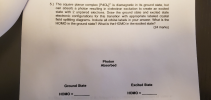 5.) The square planar complex [PdCL)2- is diamagnetic in its ground state, but can absorb a photon resulting in d-electron excitation to create an excited state with 2 unpaired electrons. Draw the ground state and excited state electronic configurations for this transition with appropriate labeled crystal field splitting diagrams. Include all orbital labels in your answer. What is the HOMO in the ground state? What is the HOMO in the excited state? (24 marks) Photon Absorbed Ground State Excited State...
Un the following, S, Xe, Hg, P are expected to be diamagnetic in their ground state...
 Un the following, S, Xe, Hg, P are expected to be diamagnetic in their ground state configurations? Vhich of the following represents an excited state lowing represents an excited state configuration (i.e., one not a ground tate, but does not violate the Pauli principle)? a. [Ar] 4s 3ds b. [Ar] 4s3d" C. [Xe] 5s? 5p1 d. [Xe] 6s24f?
[6] (a) Write an orbital diagram for the ground state of Magnesium (Mg) and Phosphorous (P). (Marks = 1) [6] (b) Which of the following elements would be expected to be paramagnetic or diamagnetic and...
 [6] (a) Write an orbital
diagram for the ground state of Magnesium (Mg) and Phosphorous (P).
(Marks = 1) [6] (b) Which of the following elements would be
expected to be paramagnetic or diamagnetic and why? (Marks = 1)
Magnesium (Mg) and Phosphorous (P)
[6] (a) Write an orbital diagram for the ground state of Magnesium (Mg) and Phosphorous (P) Marks-I) [6] (b) Which of the following elements would be expected to be paramagnetic or diamagnetic and why? (Marks 1)...
[6] (a) Write an orbital
diagram for the ground state of Magnesium (Mg) and Phosphorous (P).
(Marks = 1) [6] (b) Which of the following elements would be
expected to be paramagnetic or diamagnetic and why? (Marks = 1)
Magnesium (Mg) and Phosphorous (P)
[6] (a) Write an orbital diagram for the ground state of Magnesium (Mg) and Phosphorous (P) Marks-I) [6] (b) Which of the following elements would be expected to be paramagnetic or diamagnetic and why? (Marks 1)...
 Determine if each of the following atoms/ions are diamagnetic or paramagnetic according to typical Aufbau Principle rules: a. Fe b. Cu c. Mnº+
 the following, S, Xe, Hg, P are expected to be diamagnetic in their ground state onfigurations? Which of the following represents an excited state configuration (i.e., one not a ground cate, but does not violate the Pauli principle)?
 Which of the following atoms is paramagnetic in its ground state? Select one: O a. sodium (Na) O b. neon (Ne) mercury (Hg) barium (ba) nobelium (No)
 5.) The square planar complex [PdCL)2- is diamagnetic in its ground state, but can absorb a photon resulting in d-electron excitation to create an excited state with 2 unpaired electrons. Draw the ground state and excited state electronic configurations for this transition with appropriate labeled crystal field splitting diagrams. Include all orbital labels in your answer. What is the HOMO in the ground state? What is the HOMO in the excited state? (24 marks) Photon Absorbed Ground State Excited State...
 Un the following, S, Xe, Hg, P are expected to be diamagnetic in their ground state configurations? Vhich of the following represents an excited state lowing represents an excited state configuration (i.e., one not a ground tate, but does not violate the Pauli principle)? a. [Ar] 4s 3ds b. [Ar] 4s3d" C. [Xe] 5s? 5p1 d. [Xe] 6s24f?
 [6] (a) Write an orbital
diagram for the ground state of Magnesium (Mg) and Phosphorous (P).
(Marks = 1) [6] (b) Which of the following elements would be
expected to be paramagnetic or diamagnetic and why? (Marks = 1)
Magnesium (Mg) and Phosphorous (P)
[6] (a) Write an orbital diagram for the ground state of Magnesium (Mg) and Phosphorous (P) Marks-I) [6] (b) Which of the following elements would be expected to be paramagnetic or diamagnetic and why? (Marks 1)...
[6] (a) Write an orbital
diagram for the ground state of Magnesium (Mg) and Phosphorous (P).
(Marks = 1) [6] (b) Which of the following elements would be
expected to be paramagnetic or diamagnetic and why? (Marks = 1)
Magnesium (Mg) and Phosphorous (P)
[6] (a) Write an orbital diagram for the ground state of Magnesium (Mg) and Phosphorous (P) Marks-I) [6] (b) Which of the following elements would be expected to be paramagnetic or diamagnetic and why? (Marks 1)...
Most questions answered within 3 hours.
-
Where is the error in this code sequence?
String s1 = "Hello";
String s2 = "ello";...
asked 11 months ago -
Financial data for Joel de Paris, Inc., for last year
follow:
Joel de Paris, Inc.
Balance...
asked 11 months ago -
Consider this reaction:
Al2(SO4)3 (aq)+ BaCl3
(aq) Al2Cl6 (aq)- +
3BaSO4(s) . What is the...
asked 11 months ago -
Suppose that Savneet is considering increasing her
recent random sample from 20 car rentals to 40...
asked 11 months ago -
Trucks arrive at an unloading terminal at an average rate of 120
per hour.
Trucks arrive...
asked 11 months ago -
Why are methanol and ethanol completely soluble in water while
octanol is not very little soluble....
asked 11 months ago -
A facilities manager at a university reads in a research report
that the mean amount of...
asked 11 months ago -
When the CuSO4 is rehydrated by adding water to the anhydrous
compound, is this an endothermic...
asked 11 months ago -
A ray of sunlight is passing from diamond into crown glass; the
angle of incidence is...
asked 11 months ago -
A block of mass 0.249 kg is placed on top of a light, vertical
spring of...
asked 11 months ago -
how do the kidneys compensate in the presences of acidosis
a) trigger hyperventilate
b) reserve acid...
asked 11 months ago -
Question 501 pts
The rental rate of capital to the firm increases. Which of the
following...
asked 11 months ago