Good afternoon! Hope you have a productive day. Could you please describe what is spectrophotometry and...
Homework Answers
spectrophotometry is a method to measure how much a chemical substance absorbs light by measuring the intensity of light as a beam of light passes through the sample solution. the basic principle is that each compound absorbs or transmits light over a certain range of wavelength. this measurement can also be used to measure the amount of known chemical substance.the spectophotometer is an optical instrument for measuring the intensity of light relative to wavelength.
BEER- LAMBERT'S LAW- states that there is a linear relationship between the absorbance and concentration of the sample.
A=elc
A = measure of absorbance (no units)
e= molar extinction coefficient
l= path length
c= concentration
the Spectrophotometry has its application in many biochemical experiments that involve DNA, RNA, and protein isolation, enzyme kinetics and biochemical analysis. spectrophotometry is also a helpful process for protein purification.
the spectrophotometric assay is a classic enzyme test in which
the operator follows the course of an enzyme reaction by measuring
the changes in intensity of the light absorbed or scattered by the
reaction solution. most test use the UV/VISIBLE spectroscopy as
detection method, which usually falls into the wavelength range of
100-1100 nm. if the light is in the visible region, meaning the
wavelength of 400-900 nm, the color of the assay can be visibly
captured by naked eyes.therefore this type of assay is also called
as colorimetric assay.
-when UV/VISIBLE spectroscopy is performed to determine the
reaction rate or catalysis efficiency, the reaction solution
presents color or brightness drifts can be detected by the
UV/VISIBLE spectrometer. subsequently, the rate constant of the
enzyme reaction can be quantified by measuring the UV/VISIBLE
absorbance spectrum over a period. often in first step the optimal
wavelengths for detecting all species in the reaction will be
determined. the ideal wavelength should clearly indicate the
difference between the reactant and the product. sometimes more
than one wavelength need to be used to produce strong signals to
calculate the enzyme activity.
Affinity measurement
in this the biochemical mixture based on highly specific interaction between antigen and antibody, enzyme and substrate or receptor and ligand is separated.
such interactions have ionic, hydrogen bonding, disulphide bridges, hydrophobic interaction and more.
The image shows a question asking for a description of spectrophotometry and its use in enzyme activity and affinity measurement.
Spectrophotometry is a technique that measures how much a chemical substance absorbs or transmits light. It's based on the principle that different substances absorb or transmit light at different wavelengths. By shining a light beam through a sample and measuring the intensity of the transmitted light, one can determine the concentration of the substance.
How it's used in enzyme activity and affinity measurement:
Enzyme Activity: Spectrophotometry is frequently used to monitor the progress of enzyme-catalyzed reactions. Many enzyme reactions involve a change in color or turbidity of the solution due to the formation or disappearance of a product. By measuring the change in absorbance over time, one can determine the rate of the reaction, which is a measure of enzyme activity.
Example: Following the oxidation of NADH to NAD+ which has a distinct change in absorbance at 340nm.
Enzyme Affinity: Spectrophotometry can be used to determine the affinity of an enzyme for its substrate or inhibitor. This is often done by measuring the initial rate of the enzyme reaction at different substrate concentrations. The data can then be used to calculate the Michaelis-Menten constant (Km), which is a measure of the substrate concentration at which the reaction rate is half of its maximum value. A lower Km indicates a higher affinity of the enzyme for its substrate.
In summary, spectrophotometry is a powerful tool in enzymology, allowing researchers to quantify enzyme activity and determine the affinity of enzymes for their substrates or inhibitors. This information is crucial for understanding enzyme kinetics, mechanisms, and regulation.
Add Answer to:
Good afternoon! Hope you have a productive day.
Could you please describe what is spectrophotometry and...
Good evening! Hope you have a grate day! Please, help me. How these logarithms could be...
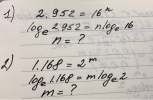 Good evening! Hope you have a grate day!
Please, help me. How these logarithms could be solved?
1) 2. 952 = 6* loge 2.952=nloge 16 n= 2 4) 2. /6P - m lope 1.168 = m loge 2 168 = mloge?
Good evening! Hope you have a grate day!
Please, help me. How these logarithms could be solved?
1) 2. 952 = 6* loge 2.952=nloge 16 n= 2 4) 2. /6P - m lope 1.168 = m loge 2 168 = mloge?
hello how are you ? I hope you are doing well can you please help me...
hello how are you ? I hope you are doing well can you please help me to understand what is western bolting by writing a summary that describe a situation where you would need this technique and the steps of the procedure or how it works. thank you so much
Hello, I hope you are having a good day... Please explain how to find the moments...
 Hello,
I hope you are having a good day...
Please explain how to find the moments for this beam. It is a
problem I made up. I really would like you to
explain how to handle odd situations like this. I am used to when
none of the forces touch, but I've run into situations when they
begin and end at the same location... And this example, one force
begins during another.
Again, the answers are not important. What is important...
Hello,
I hope you are having a good day...
Please explain how to find the moments for this beam. It is a
problem I made up. I really would like you to
explain how to handle odd situations like this. I am used to when
none of the forces touch, but I've run into situations when they
begin and end at the same location... And this example, one force
begins during another.
Again, the answers are not important. What is important...
Hello, I hope you are having a good day. Please confirm the work I did is...
 Hello,
I hope you are having a good day.
Please confirm the work I did is correct. I need to better
understand how exactly to calculate moment using the internal
forces.
I don't understand why the moment did not return to zero at the
point 4.5 m from the beginning. I'm used to the moment beginning at
zero and ending at zero,
at the last force. This is a cantilever beam; maybe that is
why???
Please let me know if...
Hello,
I hope you are having a good day.
Please confirm the work I did is correct. I need to better
understand how exactly to calculate moment using the internal
forces.
I don't understand why the moment did not return to zero at the
point 4.5 m from the beginning. I'm used to the moment beginning at
zero and ending at zero,
at the last force. This is a cantilever beam; maybe that is
why???
Please let me know if...
Good morning! Wish you a great day! Could you please help me with the clock reaction....
Good morning! Wish you a great day! Could you please help me with the clock reaction. Please, describe the clock reaction that does not involve persulfate with relevant equations. Also, could you please include some sources where can I read about it. Many thanks! Where I can*
Good afternoon Can you help me solve this problems 1-5 With your expertise It's for computer...
 Good afternoon
Can you help me solve this problems 1-5
With your expertise
It's for computer science
Intro software enginnering
What are activities in the five core workflows of the unified process? (Requirements workflow, Analysis workflow, Design workflow, Implementation workflow, Test Workflow) Describe different types of risks in software development. What are characteristics of Object-Oriented Paradigm? Describe software life-cycle models. What are metrics used in different aspects of software engineering? 1. 2. 3. 4. 5.
Good afternoon
Can you help me solve this problems 1-5
With your expertise
It's for computer science
Intro software enginnering
What are activities in the five core workflows of the unified process? (Requirements workflow, Analysis workflow, Design workflow, Implementation workflow, Test Workflow) Describe different types of risks in software development. What are characteristics of Object-Oriented Paradigm? Describe software life-cycle models. What are metrics used in different aspects of software engineering? 1. 2. 3. 4. 5.
You have what you hope is a linked list, but you are concerned that it may...
You have what you hope is a linked list, but you are concerned that it may contain a cycle. Describe an algorithm FINDLOOP that takes a reference to the front of the list as input and either returns false if the list has no loops, true otherwise. I would prefer the answer in pseudocode format. Thank you!
please kindly help me solve this Human computer Interaction question. Thank you so much Good day,...
 please kindly help me solve this Human computer Interaction
question. Thank you so much
Good day,
kindly Help me to solve this Human Computer Interaction
Questions. Thank you
Question 3 (20 marks): Evaluate and Redesigning Application Interfaces you think are Bad Designs Choose any IT garget, an application or a website of your interest. Study and evaluate the interface of this chosen application or website applying the concepts you have learnt in the HCI class. Redesign the interface, detailing things...
please kindly help me solve this Human computer Interaction
question. Thank you so much
Good day,
kindly Help me to solve this Human Computer Interaction
Questions. Thank you
Question 3 (20 marks): Evaluate and Redesigning Application Interfaces you think are Bad Designs Choose any IT garget, an application or a website of your interest. Study and evaluate the interface of this chosen application or website applying the concepts you have learnt in the HCI class. Redesign the interface, detailing things...
Could you please explain the process on how to solve this question? Also, I am very...
 Could you please explain the process on how to solve this
question? Also, I am very confused as to why there are two sets of
data xxxx / xxxx. Thank you! Despite the wording, it was actually
how the question was given...
2. Predict lac enzyme activities in a partial diploid strain FO+Z+Y/POCZYh. (Fill in the following table with for enzyme activity and for no activity) Permease (lacY) B-galactosidase (lacz) Uninduced Uninduced Induced Induced b) c)
Could you please explain the process on how to solve this
question? Also, I am very confused as to why there are two sets of
data xxxx / xxxx. Thank you! Despite the wording, it was actually
how the question was given...
2. Predict lac enzyme activities in a partial diploid strain FO+Z+Y/POCZYh. (Fill in the following table with for enzyme activity and for no activity) Permease (lacY) B-galactosidase (lacz) Uninduced Uninduced Induced Induced b) c)
Hello, I have a homework to describe and discuss about the topic "Thinking Outside The Box,...
Hello, I have a homework to describe and discuss about the topic "Thinking Outside The Box, Ref: Dr. Peter Suedfeld" I am responsible to search for the topic from Internet and Library sources and discuss what I understand. However, I made some research but could not find any beneficial documents about this topic. If you find documents which you think that would be the good documents to read and make analyze, please share with me :) Thank you so much...
 Good evening! Hope you have a grate day!
Please, help me. How these logarithms could be solved?
1) 2. 952 = 6* loge 2.952=nloge 16 n= 2 4) 2. /6P - m lope 1.168 = m loge 2 168 = mloge?
Good evening! Hope you have a grate day!
Please, help me. How these logarithms could be solved?
1) 2. 952 = 6* loge 2.952=nloge 16 n= 2 4) 2. /6P - m lope 1.168 = m loge 2 168 = mloge?
 Hello,
I hope you are having a good day...
Please explain how to find the moments for this beam. It is a
problem I made up. I really would like you to
explain how to handle odd situations like this. I am used to when
none of the forces touch, but I've run into situations when they
begin and end at the same location... And this example, one force
begins during another.
Again, the answers are not important. What is important...
Hello,
I hope you are having a good day...
Please explain how to find the moments for this beam. It is a
problem I made up. I really would like you to
explain how to handle odd situations like this. I am used to when
none of the forces touch, but I've run into situations when they
begin and end at the same location... And this example, one force
begins during another.
Again, the answers are not important. What is important...
 Hello,
I hope you are having a good day.
Please confirm the work I did is correct. I need to better
understand how exactly to calculate moment using the internal
forces.
I don't understand why the moment did not return to zero at the
point 4.5 m from the beginning. I'm used to the moment beginning at
zero and ending at zero,
at the last force. This is a cantilever beam; maybe that is
why???
Please let me know if...
Hello,
I hope you are having a good day.
Please confirm the work I did is correct. I need to better
understand how exactly to calculate moment using the internal
forces.
I don't understand why the moment did not return to zero at the
point 4.5 m from the beginning. I'm used to the moment beginning at
zero and ending at zero,
at the last force. This is a cantilever beam; maybe that is
why???
Please let me know if...
 Good afternoon
Can you help me solve this problems 1-5
With your expertise
It's for computer science
Intro software enginnering
What are activities in the five core workflows of the unified process? (Requirements workflow, Analysis workflow, Design workflow, Implementation workflow, Test Workflow) Describe different types of risks in software development. What are characteristics of Object-Oriented Paradigm? Describe software life-cycle models. What are metrics used in different aspects of software engineering? 1. 2. 3. 4. 5.
Good afternoon
Can you help me solve this problems 1-5
With your expertise
It's for computer science
Intro software enginnering
What are activities in the five core workflows of the unified process? (Requirements workflow, Analysis workflow, Design workflow, Implementation workflow, Test Workflow) Describe different types of risks in software development. What are characteristics of Object-Oriented Paradigm? Describe software life-cycle models. What are metrics used in different aspects of software engineering? 1. 2. 3. 4. 5.
 please kindly help me solve this Human computer Interaction
question. Thank you so much
Good day,
kindly Help me to solve this Human Computer Interaction
Questions. Thank you
Question 3 (20 marks): Evaluate and Redesigning Application Interfaces you think are Bad Designs Choose any IT garget, an application or a website of your interest. Study and evaluate the interface of this chosen application or website applying the concepts you have learnt in the HCI class. Redesign the interface, detailing things...
please kindly help me solve this Human computer Interaction
question. Thank you so much
Good day,
kindly Help me to solve this Human Computer Interaction
Questions. Thank you
Question 3 (20 marks): Evaluate and Redesigning Application Interfaces you think are Bad Designs Choose any IT garget, an application or a website of your interest. Study and evaluate the interface of this chosen application or website applying the concepts you have learnt in the HCI class. Redesign the interface, detailing things...
 Could you please explain the process on how to solve this
question? Also, I am very confused as to why there are two sets of
data xxxx / xxxx. Thank you! Despite the wording, it was actually
how the question was given...
2. Predict lac enzyme activities in a partial diploid strain FO+Z+Y/POCZYh. (Fill in the following table with for enzyme activity and for no activity) Permease (lacY) B-galactosidase (lacz) Uninduced Uninduced Induced Induced b) c)
Could you please explain the process on how to solve this
question? Also, I am very confused as to why there are two sets of
data xxxx / xxxx. Thank you! Despite the wording, it was actually
how the question was given...
2. Predict lac enzyme activities in a partial diploid strain FO+Z+Y/POCZYh. (Fill in the following table with for enzyme activity and for no activity) Permease (lacY) B-galactosidase (lacz) Uninduced Uninduced Induced Induced b) c)
Most questions answered within 3 hours.
-
Where is the error in this code sequence?
String s1 = "Hello";
String s2 = "ello";...
asked 11 months ago -
Financial data for Joel de Paris, Inc., for last year
follow:
Joel de Paris, Inc.
Balance...
asked 11 months ago -
Consider this reaction:
Al2(SO4)3 (aq)+ BaCl3
(aq) Al2Cl6 (aq)- +
3BaSO4(s) . What is the...
asked 11 months ago -
Suppose that Savneet is considering increasing her
recent random sample from 20 car rentals to 40...
asked 11 months ago -
Trucks arrive at an unloading terminal at an average rate of 120
per hour.
Trucks arrive...
asked 11 months ago -
Why are methanol and ethanol completely soluble in water while
octanol is not very little soluble....
asked 11 months ago -
A facilities manager at a university reads in a research report
that the mean amount of...
asked 11 months ago -
When the CuSO4 is rehydrated by adding water to the anhydrous
compound, is this an endothermic...
asked 11 months ago -
A ray of sunlight is passing from diamond into crown glass; the
angle of incidence is...
asked 11 months ago -
A block of mass 0.249 kg is placed on top of a light, vertical
spring of...
asked 11 months ago -
how do the kidneys compensate in the presences of acidosis
a) trigger hyperventilate
b) reserve acid...
asked 11 months ago -
Question 501 pts
The rental rate of capital to the firm increases. Which of the
following...
asked 11 months ago