Systronics is considering introducing a new solvent that is biodegradable and that they believe has a...
Systronics is considering introducing a new solvent that is biodegradable and that they believe has a 60% chance of being successful. If this product is successful, Systronics expects the net profit will be $50 million. If unsuccessful the net loss is expected to be $20 million.
- Set up the payoff table on a spreadsheet and calculate the expected payoff. Which is the optimal decision using Bayes’ decision rule?
- Calculate the expected value of perfect information.
- Systronics has the option to try out the product in a test
market. Past experience has shown that products that were
ultimately successful in the broader market were approved during
the test phase 80% of the time. Products that were found to be
unsuccessful in the broader market had been approved in the testing
phase only 15% of the time.
- Draw the decision tree Systronics could use to help them decide whether or not to test the new solvent in a test market and ultimately launch the new product.
- What is the Expected Monetary Value of the decision to test the new product and what is their recommended course of action based on the results of the market test?
- How much would Systronics be willing to pay for the market test?
Homework Answers
(a)
| States of nature | Expected | ||
| Alternatives | Successful | Unsuccessful | payoff |
| Introduce | 50 | -20 | 22 |
| Don't introduce | 0 | 0 | 0 |
| Probability | 0.6 | 0.4 | |
| Opportunity loss | States of nature | Expected | |
| Alternatives | Successful | Unsuccessful | OL |
| Introduce | 0 | 20 | 8 |
| Don't introduce | 50 | 0 | 30 |
| Probability | 0.6 | 0.4 | |
As per the Baye's decision rule, we will take the alternative which minimizes the expected opportunity loss i.e. to Introduce.
(b)
Expected value of perfect information = Expected opportunity loss = $8 million
(c)
Define events as:
IS = Test approved
IF = Test failed
S = Actual success in the broad market
F = Actual failure in the broad market
Given is Priors i.e. P(S) = 0.6 and P(F) = 0.4 and conditionals i.e. P(IS | S) = 0.80 and P(IS | F) = 0.15.
Use the Baye's rule using the following table to compute the posteriors.
| IS | |||||||
| Prior | Conditional | Joint | Posterior | ||||
| P(S) | 0.6 | P(IS|S) | 0.8 | P(S) x P(IS|S) | 0.48 | P(S|IS) | 0.89 |
| P(F) | 0.4 | P(IS|F) | 0.15 | P(F) x P(IS|F) | 0.06 | P(F|IS) | 0.11 |
| Total | 1 | P(IS) | 0.54 | 1 | |||
| IF | |||||||
| Prior | Conditional | Joint | Posterior | ||||
| P(S) | 0.6 | P(IF|S) | 0.2 | P(S) x P(IF|S) | 0.12 | P(S|IF) | 0.26 |
| P(F) | 0.4 | P(IF|F) | 0.85 | P(F) x P(IF|F) | 0.34 | P(F|IF) | 0.74 |
| Total | 1 | P(IF) | 0.46 | 1 | |||
(i)
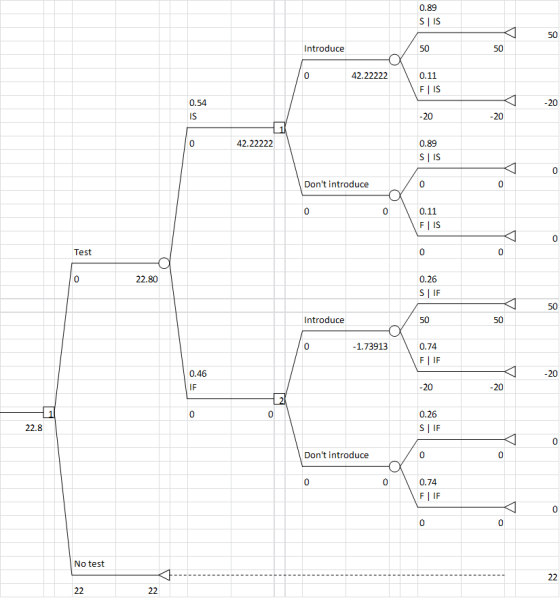
Decision tree
(ii)
The optimal decision is to go for the test and then introduce if the test shows success; don't introduce otherwise.
(iii)
Expected monetary value = 22.80 million
(iv)
Willing ot pay = 22.80 - 22 = 0.80 million or less
Add Answer to:
Systronics is considering introducing a new solvent that is
biodegradable and that they believe has a...
Osceola Electronics, Inc., has developed a new HD DVD. If the HD DVD is successful, the...
Osceola Electronics, Inc., has developed a new HD DVD. If the HD DVD is successful, the present value of the payoff (at the time the product is brought to market) is $31.9 million. If the HD DVD fails, the present value of the payoff is $5.8 million. If the product goes directly to market, there is a 60 percent chance of success. Alternatively, Osceola can delay the launch by one year and spend $1.16 million to test-market the HD DVD....
Osceola Electronics, Inc., has developed a new HD DVD. If the HD DVD is successful, the...
Osceola Electronics, Inc., has developed a new HD DVD. If the HD DVD is successful, the present value of the payoff (at the time the product is brought to market) is $27.5 million. If the HD DVD fails, the present value of the payoff is $6.9 million. If the product goes directly to market, there is a 60 percent chance of success. Alternatively, Osceola can delay the launch by one year and spend $1.43 million to test-market the HD DVD....
Need help solving this question Osceola Electronics, Inc., has developed a new HD DVD. If the...
 Need help solving this question
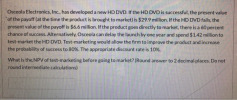
Osceola Electronics, Inc., has developed a new HD DVD. If the HD DVD is successful, the present value of the payoff (at the time the product is brought to market) is $29.9 million. If the HD DVD fails, the present value of the payoff is $6.6 million. If the product goes directly to market, there is a 60 percent chance of success. Alternatively, Osceola can delay the launch by one year and spend $1.42 million...
Need help solving this question
Osceola Electronics, Inc., has developed a new HD DVD. If the HD DVD is successful, the present value of the payoff (at the time the product is brought to market) is $29.9 million. If the HD DVD fails, the present value of the payoff is $6.6 million. If the product goes directly to market, there is a 60 percent chance of success. Alternatively, Osceola can delay the launch by one year and spend $1.42 million...
Ang Electronics, Inc., has developed a new DVDR. If the DVDR is successful, the present value...
Ang Electronics, Inc., has developed a new DVDR. If the DVDR is successful, the present value of the payoff (when the product is brought to market) is $34.3 million. If the DVDR fails, the present value of the payoff is $12.3 million. If the product goes directly to market, there is a 50 percent chance of success. Alternatively, the company can delay the launch by one year and spend $1.33 million to test market the DVDR. Test marketing would allow...
Ang Electronics, Inc., has developed a new HD DVD. If the HD DVD is successful, the...
Ang Electronics, Inc., has developed a new HD DVD. If the HD DVD is successful, the present value of the payoff (at the time the product is brought to market) is $34.8 million. If the HD DVD fails, the present value of the payoff is $12.8 million. If the product goes directly to market, there is a 40 percent chance of success. Alternatively, the company can delay the launch by one year and spend $1.38 million to test-market the HD...
Ang Electronics, Inc., has developed a new DVDR. If the DVDR is successful, the present value...
Ang Electronics, Inc., has developed a new DVDR. If the DVDR is successful, the present value of the payoff (when the product is brought to market) is $33.5 million. If the DVDR fails, the present value of the payoff is $11.5 million. If the product goes directly to market, there is a 50 percent chance of success. Alternatively, the company can delay the launch by one year and spend $1.25 million to test market the DVDR. Test marketing would allow...
Ang Electronics, Inc., has developed a new DVDR. If the DVDR is successful, the present value...
 Ang Electronics, Inc., has developed a new DVDR. If the DVDR is successful, the present value of the payoff (when the product is brought to market) is $33.1 million. If the DVDR fails, the present value of the payoff is $11.1 million. If the product goes directly to market, there is a 60 percent chance of success. Alternatively, the company can delay the launch by one year and spend $1.21 million to test market the DVDR. Test marketing would allow...
Ang Electronics, Inc., has developed a new DVDR. If the DVDR is successful, the present value...
Ang Electronics, Inc., has developed a new DVDR. If the DVDR is successful, the present value of the payoff (when the product is brought to market) is $33.4 million. If the DVDR fails, the present value of the payoff is $11.4 million. If the product goes directly to market, there is a 60 percent chance of success. Alternatively, Ang can delay the launch by one year and spend $1.24 million to test market the DVDR. Test marketing would allow the...
Ang Electronics, Inc., has developed a new DVDR. If the DVDR is successful, the present value of the payoff (when th...
 Ang Electronics, Inc., has developed a new DVDR. If the DVDR is successful, the present value of the payoff (when the product is brought to market) is $33.7 million. If the DVDR fails, the present value of the payoff is $11.7 million. If the product goes directly to market. there is a 60 percent chance of success. Alternatively, the company can delay the launch by one year and spend $1.27 million to test market the DVDR. Test marketing would allow...
B&B has a new baby powder ready to market. If the firm goes directly to the...
B&B has a new baby powder ready to market. If the firm goes directly to the market with the product, there is only a 65 percent chance of success. However, the firm can conduct customer segment research, which will take a year and cost $1.25 million. By going through research, B&B will be able to better target potential customers and will increase the probability of success to 80 percent. If successful, the baby powder will bring a present value profit...
 Need help solving this question
Osceola Electronics, Inc., has developed a new HD DVD. If the HD DVD is successful, the present value of the payoff (at the time the product is brought to market) is $29.9 million. If the HD DVD fails, the present value of the payoff is $6.6 million. If the product goes directly to market, there is a 60 percent chance of success. Alternatively, Osceola can delay the launch by one year and spend $1.42 million...
Need help solving this question
Osceola Electronics, Inc., has developed a new HD DVD. If the HD DVD is successful, the present value of the payoff (at the time the product is brought to market) is $29.9 million. If the HD DVD fails, the present value of the payoff is $6.6 million. If the product goes directly to market, there is a 60 percent chance of success. Alternatively, Osceola can delay the launch by one year and spend $1.42 million...
 Ang Electronics, Inc., has developed a new DVDR. If the DVDR is successful, the present value of the payoff (when the product is brought to market) is $33.1 million. If the DVDR fails, the present value of the payoff is $11.1 million. If the product goes directly to market, there is a 60 percent chance of success. Alternatively, the company can delay the launch by one year and spend $1.21 million to test market the DVDR. Test marketing would allow...
 Ang Electronics, Inc., has developed a new DVDR. If the DVDR is successful, the present value of the payoff (when the product is brought to market) is $33.7 million. If the DVDR fails, the present value of the payoff is $11.7 million. If the product goes directly to market. there is a 60 percent chance of success. Alternatively, the company can delay the launch by one year and spend $1.27 million to test market the DVDR. Test marketing would allow...
Most questions answered within 3 hours.
-
Where is the error in this code sequence?
String s1 = "Hello";
String s2 = "ello";...
asked 10 months ago -
Financial data for Joel de Paris, Inc., for last year
follow:
Joel de Paris, Inc.
Balance...
asked 10 months ago -
Consider this reaction:
Al2(SO4)3 (aq)+ BaCl3
(aq) Al2Cl6 (aq)- +
3BaSO4(s) . What is the...
asked 10 months ago -
Suppose that Savneet is considering increasing her
recent random sample from 20 car rentals to 40...
asked 10 months ago -
Trucks arrive at an unloading terminal at an average rate of 120
per hour.
Trucks arrive...
asked 10 months ago -
Why are methanol and ethanol completely soluble in water while
octanol is not very little soluble....
asked 10 months ago -
A facilities manager at a university reads in a research report
that the mean amount of...
asked 10 months ago -
When the CuSO4 is rehydrated by adding water to the anhydrous
compound, is this an endothermic...
asked 10 months ago -
A ray of sunlight is passing from diamond into crown glass; the
angle of incidence is...
asked 10 months ago -
A block of mass 0.249 kg is placed on top of a light, vertical
spring of...
asked 10 months ago -
how do the kidneys compensate in the presences of acidosis
a) trigger hyperventilate
b) reserve acid...
asked 10 months ago -
Question 501 pts
The rental rate of capital to the firm increases. Which of the
following...
asked 10 months ago