Please help me understand the following questions by providing me with some explanation. - What are...
Homework Answers
Enzymes are biological molecules (typically proteins) that significantly speed up the rate of virtually all of the chemical reactions that take place within cells.
Some enzymes help break large molecules into smaller pieces that are more easily absorbed by the body. Other enzymes help bind two molecules together to produce a new molecule. Enzymes are highly selective catalysts, meaning that each enzyme only speeds up a specific reaction.
The molecules that an enzyme works with are called substrates. The substrates bind to a region on the enzyme called the active site.
There are two theories explaining the enzyme-substrate interaction.
In the lock-and-key model, the active site of an enzyme is precisely shaped to hold specific substrates. In the induced-fit model, the active site and substrate don't fit perfectly together; instead, they both alter their shape to connect.
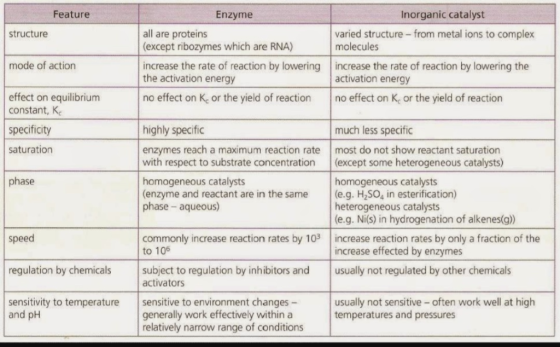
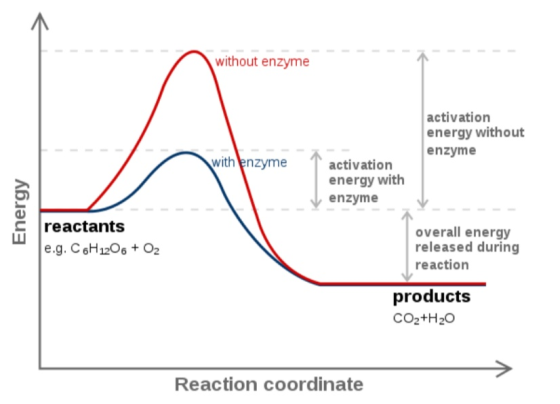
Let us consider the diagram at left to represent an elementary reaction that can take place with or without catalysis. The red curve shows the energy profile for the uncatalyzed reaction. The activation energy for uncatalyzed conversion to products is much greater than that for the catalyzed reaction (indigo curve). This means that the rate constant for the catalyzed reaction, kcat, will be much greater than kuncat, the rate constant for the uncatalyzed reaction. For both the uncatalyzed and the catalyzed reaction, the potential energy change, ΔErxn, is the same. This means that while a catalyst does not alter the conditions under which the reaction is at equilibrium, it greatly speeds up the approach to equilibrium. The reaction coordinate diagram shows that the energy of activation for the reverse reaction is lowered by the catalyst as well.
If you find the answer useful then please hit the like button.
Add Answer to:
Please help me understand the following questions by providing
me with some explanation.
- What are...
4. Please draw and label the following four types of reactions (all are single-step reactions): corresponding...
 4. Please draw and label the following four types of reactions (all are single-step reactions): corresponding reaction coordinate diagrams for the a. a fast, spontaneous (or exergonic) reaction b. a slow, spontaneous/exergonic reaction c. a fast, non-spontaneous (or endergonic) reaction d. a slow, non a. b. Reaction Progress Reaction Progress C. d. Reaction Progress Reaction Progress What makes a reaction spontaneous? What makes a reaction non-spontaneous? What makes a reaction fast? What makes a reaction slow?
2. Given the reaction coordinate diagram below, answer the following questions: Free energy Progress of the...
 2. Given the reaction coordinate diagram below, answer the following questions: Free energy Progress of the reaction a) How many intermediates are formed in the reaction? b) Which letter(s) represent(s) a transition state? c) What is the fastest step in the reaction? d) Which is more stable: A or G? e) Does A or E form faster from C? f) Which is the most stable intermediate? g) What is the reactant of the rate-determining step? h) is the first step...
1. What are the different sources of energy available to living organisms? 2. How do the...
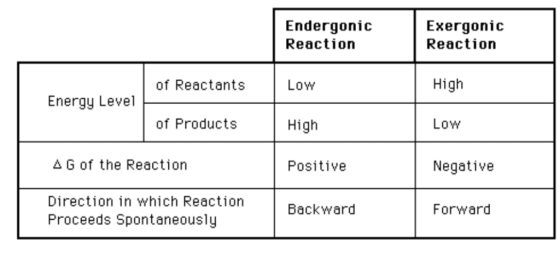
 1. What are the different sources of energy available to living organisms? 2. How do the acquisition and the use of energy by living organisms work according to the laws of thermodynamics? 3. Explain the energy use in the following reactions: endergonic/exergonic. 4. What is metabolism? How are chemical reactions related to metabolism? Why is energy needed to run a metabolism? What are coupled reactions? 5. Draw a picture of ATP. Why is this molecule so important for cells? How...
Below is a free energy change graph for a reaction in which reactants A+B produce the...
 Below is a free energy change graph for a reaction in which reactants A+B produce the product D. Use the data given to answer the following questions: What does the hump in the middle represent? What is the name of the general class of proteins that are needed to help the reactions go through that hump in a cell? How do they help the reaction go through? In this reaction is the free energy of the reactants or the free...
Answer as many as possible. Please and thank you Here is what you better know: how...
 Answer as many as possible. Please and thank
you
Here is what you better know: how exocytosis and endocytosis work what aquaporins are and how they function what osmosis is what hypotonic, hypertonic and isotonic mean and how they are used always in comparison what the three types of passive transport are, how they are similar and how they are different what active transport is what is required for active transport to occur and in which direction the solute molecules...
Answer as many as possible. Please and thank
you
Here is what you better know: how exocytosis and endocytosis work what aquaporins are and how they function what osmosis is what hypotonic, hypertonic and isotonic mean and how they are used always in comparison what the three types of passive transport are, how they are similar and how they are different what active transport is what is required for active transport to occur and in which direction the solute molecules...
With explanation please -- thanks! 1.(12 pts) Review the energy profile diagram below for an E1...
 With explanation please -- thanks!
1.(12 pts) Review the energy profile diagram below for an E1 reaction involving a carbocation rearrangement, and answer the following questions. Gibbs free energy H-A 20: H-A H . reaction coordinate A) Draw the intermediate C: B) Draw the intermediate G: D) Is the overall reaction (circle one answer): C) Which step is rate-determining? Answer like this (with letters): X-> Y exothermal isothermal endorgornic O -> endothermal exergonic isochoric
With explanation please -- thanks!
1.(12 pts) Review the energy profile diagram below for an E1 reaction involving a carbocation rearrangement, and answer the following questions. Gibbs free energy H-A 20: H-A H . reaction coordinate A) Draw the intermediate C: B) Draw the intermediate G: D) Is the overall reaction (circle one answer): C) Which step is rate-determining? Answer like this (with letters): X-> Y exothermal isothermal endorgornic O -> endothermal exergonic isochoric
ORGANIC CHEMISTRY Can someone help me understand these questions? Please include an explanation with the answer....
 ORGANIC CHEMISTRY
Can someone help me understand these questions? Please include
an explanation with the answer. Thank you!
0 1. Consider the structure of ethyl 3-methylbutanoate shown here: a. Predict 3 peaks you would expect to see in the mass spectrum of this compound. Draw the fragments which give rise to each of your peaks ㄇ b. Predict 3 peaks you would expect to see in the IR spectrum of this compound. Include information about what causes each of your...
ORGANIC CHEMISTRY
Can someone help me understand these questions? Please include
an explanation with the answer. Thank you!
0 1. Consider the structure of ethyl 3-methylbutanoate shown here: a. Predict 3 peaks you would expect to see in the mass spectrum of this compound. Draw the fragments which give rise to each of your peaks ㄇ b. Predict 3 peaks you would expect to see in the IR spectrum of this compound. Include information about what causes each of your...
Will some please help me with this Klein, Organic Chemistry, 3e Review of Concepts Answer the...
 Will some please help me with this
Klein, Organic Chemistry, 3e Review of Concepts Answer the questions below about concepts and vocabulary from Chapter 6. reactions involve a transfer of energy from the system to the surroundings, white reactions involve a tranafer of energy from the surroundings to the system Each type of bond has a unique energy, which ks the amount of energy necessary to accomolsh homolytic bond deavage. Entropy is loosely defined as the of a system. in...
Will some please help me with this
Klein, Organic Chemistry, 3e Review of Concepts Answer the questions below about concepts and vocabulary from Chapter 6. reactions involve a transfer of energy from the system to the surroundings, white reactions involve a tranafer of energy from the surroundings to the system Each type of bond has a unique energy, which ks the amount of energy necessary to accomolsh homolytic bond deavage. Entropy is loosely defined as the of a system. in...
please help ASAP in these practice questions. thank you so much in advance! Temple University Department...
 please help ASAP in these practice questions.
thank you so much in advance!
Temple University Department of Chemistry Chemistry 2201 - Organic Chemistry Exam 2 October 31, 2019 Sieburth - Motsch Answer all questions lepibly in the space provided. Sec. 012 Tues 14:00 Sec013 Wed 10:00 Sec. 014 Thurs 10:00 Check a box ( point): Sec. 011 Mon noon Sec. 015 Film Name Student ID 1. For the two exergonic substitution reactions A and B shown, *) Draw the two...
please help ASAP in these practice questions.
thank you so much in advance!
Temple University Department of Chemistry Chemistry 2201 - Organic Chemistry Exam 2 October 31, 2019 Sieburth - Motsch Answer all questions lepibly in the space provided. Sec. 012 Tues 14:00 Sec013 Wed 10:00 Sec. 014 Thurs 10:00 Check a box ( point): Sec. 011 Mon noon Sec. 015 Film Name Student ID 1. For the two exergonic substitution reactions A and B shown, *) Draw the two...
Please help answer ALL the following questions in the attachment. Please answer only if you’re certain....
 Please help answer ALL the following questions in the
attachment. Please answer only if you’re certain. Thank you so much
for your help.
1 Find the mismatched pai a) Entropy (AS-measurement of disorder in a thermodynamic system b) AG<0-Energetically favorable (spontaneous) reaction c) First Law of Thermodynamics-Energy in a system is not created nor destroyed, only transformed d) Second Law of Thermodynamics-The entropy of a perfect crystal at 0 K is exactly equal to zero. e) Standard free energy (G-The...
Please help answer ALL the following questions in the
attachment. Please answer only if you’re certain. Thank you so much
for your help.
1 Find the mismatched pai a) Entropy (AS-measurement of disorder in a thermodynamic system b) AG<0-Energetically favorable (spontaneous) reaction c) First Law of Thermodynamics-Energy in a system is not created nor destroyed, only transformed d) Second Law of Thermodynamics-The entropy of a perfect crystal at 0 K is exactly equal to zero. e) Standard free energy (G-The...
 4. Please draw and label the following four types of reactions (all are single-step reactions): corresponding reaction coordinate diagrams for the a. a fast, spontaneous (or exergonic) reaction b. a slow, spontaneous/exergonic reaction c. a fast, non-spontaneous (or endergonic) reaction d. a slow, non a. b. Reaction Progress Reaction Progress C. d. Reaction Progress Reaction Progress What makes a reaction spontaneous? What makes a reaction non-spontaneous? What makes a reaction fast? What makes a reaction slow?
 2. Given the reaction coordinate diagram below, answer the following questions: Free energy Progress of the reaction a) How many intermediates are formed in the reaction? b) Which letter(s) represent(s) a transition state? c) What is the fastest step in the reaction? d) Which is more stable: A or G? e) Does A or E form faster from C? f) Which is the most stable intermediate? g) What is the reactant of the rate-determining step? h) is the first step...
 1. What are the different sources of energy available to living organisms? 2. How do the acquisition and the use of energy by living organisms work according to the laws of thermodynamics? 3. Explain the energy use in the following reactions: endergonic/exergonic. 4. What is metabolism? How are chemical reactions related to metabolism? Why is energy needed to run a metabolism? What are coupled reactions? 5. Draw a picture of ATP. Why is this molecule so important for cells? How...
 Below is a free energy change graph for a reaction in which reactants A+B produce the product D. Use the data given to answer the following questions: What does the hump in the middle represent? What is the name of the general class of proteins that are needed to help the reactions go through that hump in a cell? How do they help the reaction go through? In this reaction is the free energy of the reactants or the free...
 Answer as many as possible. Please and thank
you
Here is what you better know: how exocytosis and endocytosis work what aquaporins are and how they function what osmosis is what hypotonic, hypertonic and isotonic mean and how they are used always in comparison what the three types of passive transport are, how they are similar and how they are different what active transport is what is required for active transport to occur and in which direction the solute molecules...
Answer as many as possible. Please and thank
you
Here is what you better know: how exocytosis and endocytosis work what aquaporins are and how they function what osmosis is what hypotonic, hypertonic and isotonic mean and how they are used always in comparison what the three types of passive transport are, how they are similar and how they are different what active transport is what is required for active transport to occur and in which direction the solute molecules...
 With explanation please -- thanks!
1.(12 pts) Review the energy profile diagram below for an E1 reaction involving a carbocation rearrangement, and answer the following questions. Gibbs free energy H-A 20: H-A H . reaction coordinate A) Draw the intermediate C: B) Draw the intermediate G: D) Is the overall reaction (circle one answer): C) Which step is rate-determining? Answer like this (with letters): X-> Y exothermal isothermal endorgornic O -> endothermal exergonic isochoric
With explanation please -- thanks!
1.(12 pts) Review the energy profile diagram below for an E1 reaction involving a carbocation rearrangement, and answer the following questions. Gibbs free energy H-A 20: H-A H . reaction coordinate A) Draw the intermediate C: B) Draw the intermediate G: D) Is the overall reaction (circle one answer): C) Which step is rate-determining? Answer like this (with letters): X-> Y exothermal isothermal endorgornic O -> endothermal exergonic isochoric
 ORGANIC CHEMISTRY
Can someone help me understand these questions? Please include
an explanation with the answer. Thank you!
0 1. Consider the structure of ethyl 3-methylbutanoate shown here: a. Predict 3 peaks you would expect to see in the mass spectrum of this compound. Draw the fragments which give rise to each of your peaks ㄇ b. Predict 3 peaks you would expect to see in the IR spectrum of this compound. Include information about what causes each of your...
ORGANIC CHEMISTRY
Can someone help me understand these questions? Please include
an explanation with the answer. Thank you!
0 1. Consider the structure of ethyl 3-methylbutanoate shown here: a. Predict 3 peaks you would expect to see in the mass spectrum of this compound. Draw the fragments which give rise to each of your peaks ㄇ b. Predict 3 peaks you would expect to see in the IR spectrum of this compound. Include information about what causes each of your...
 Will some please help me with this
Klein, Organic Chemistry, 3e Review of Concepts Answer the questions below about concepts and vocabulary from Chapter 6. reactions involve a transfer of energy from the system to the surroundings, white reactions involve a tranafer of energy from the surroundings to the system Each type of bond has a unique energy, which ks the amount of energy necessary to accomolsh homolytic bond deavage. Entropy is loosely defined as the of a system. in...
Will some please help me with this
Klein, Organic Chemistry, 3e Review of Concepts Answer the questions below about concepts and vocabulary from Chapter 6. reactions involve a transfer of energy from the system to the surroundings, white reactions involve a tranafer of energy from the surroundings to the system Each type of bond has a unique energy, which ks the amount of energy necessary to accomolsh homolytic bond deavage. Entropy is loosely defined as the of a system. in...
 please help ASAP in these practice questions.
thank you so much in advance!
Temple University Department of Chemistry Chemistry 2201 - Organic Chemistry Exam 2 October 31, 2019 Sieburth - Motsch Answer all questions lepibly in the space provided. Sec. 012 Tues 14:00 Sec013 Wed 10:00 Sec. 014 Thurs 10:00 Check a box ( point): Sec. 011 Mon noon Sec. 015 Film Name Student ID 1. For the two exergonic substitution reactions A and B shown, *) Draw the two...
please help ASAP in these practice questions.
thank you so much in advance!
Temple University Department of Chemistry Chemistry 2201 - Organic Chemistry Exam 2 October 31, 2019 Sieburth - Motsch Answer all questions lepibly in the space provided. Sec. 012 Tues 14:00 Sec013 Wed 10:00 Sec. 014 Thurs 10:00 Check a box ( point): Sec. 011 Mon noon Sec. 015 Film Name Student ID 1. For the two exergonic substitution reactions A and B shown, *) Draw the two...
 Please help answer ALL the following questions in the
attachment. Please answer only if you’re certain. Thank you so much
for your help.
1 Find the mismatched pai a) Entropy (AS-measurement of disorder in a thermodynamic system b) AG<0-Energetically favorable (spontaneous) reaction c) First Law of Thermodynamics-Energy in a system is not created nor destroyed, only transformed d) Second Law of Thermodynamics-The entropy of a perfect crystal at 0 K is exactly equal to zero. e) Standard free energy (G-The...
Please help answer ALL the following questions in the
attachment. Please answer only if you’re certain. Thank you so much
for your help.
1 Find the mismatched pai a) Entropy (AS-measurement of disorder in a thermodynamic system b) AG<0-Energetically favorable (spontaneous) reaction c) First Law of Thermodynamics-Energy in a system is not created nor destroyed, only transformed d) Second Law of Thermodynamics-The entropy of a perfect crystal at 0 K is exactly equal to zero. e) Standard free energy (G-The...
Most questions answered within 3 hours.
-
Where is the error in this code sequence?
String s1 = "Hello";
String s2 = "ello";...
asked 10 months ago -
Financial data for Joel de Paris, Inc., for last year
follow:
Joel de Paris, Inc.
Balance...
asked 10 months ago -
Consider this reaction:
Al2(SO4)3 (aq)+ BaCl3
(aq) Al2Cl6 (aq)- +
3BaSO4(s) . What is the...
asked 10 months ago -
Suppose that Savneet is considering increasing her
recent random sample from 20 car rentals to 40...
asked 10 months ago -
Trucks arrive at an unloading terminal at an average rate of 120
per hour.
Trucks arrive...
asked 10 months ago -
Why are methanol and ethanol completely soluble in water while
octanol is not very little soluble....
asked 10 months ago -
A facilities manager at a university reads in a research report
that the mean amount of...
asked 10 months ago -
When the CuSO4 is rehydrated by adding water to the anhydrous
compound, is this an endothermic...
asked 10 months ago -
A ray of sunlight is passing from diamond into crown glass; the
angle of incidence is...
asked 10 months ago -
A block of mass 0.249 kg is placed on top of a light, vertical
spring of...
asked 10 months ago -
how do the kidneys compensate in the presences of acidosis
a) trigger hyperventilate
b) reserve acid...
asked 10 months ago -
Question 501 pts
The rental rate of capital to the firm increases. Which of the
following...
asked 10 months ago