Does anyone have reason NOT to celebrate Walmart's scale economies?
Does anyone have reason NOT to celebrate Walmart's scale economies?
Homework Answers
Walmart employs close to 1 % of US workforce and further, it is estimated that over 2 million workers are employees of walmart. Increase in the scale of operation has significantly reduced the cost of production. So consumers are biggest beneficiaries of large scale operation of Walmart.
But small stores have lost their business significantly, Now people visit less frequently to these stores, as these stores can not meet the varied needs of people. further, small stores offers less varieties. Furthermore, e-commerce also has taken toll on the small stores.
Thus, small stores have reason not to celebrate Walmart scale of economies.
19. Which sections of the curve does the firm have economies of scale? Diseconomies of scale?...
 19. Which sections of the curve does the firm have economies of scale? Diseconomies of scale? Neither economies nor diseconomies of scale? LRAC cost pel unit faverage cost) n A. B
The reason(s) for a merger or acquisition is (are): Economies of scale or scope Expand geographic...
The reason(s) for a merger or acquisition is (are): Economies of scale or scope Expand geographic coverage Divestiture "Invent a ""new"" industry"
14 True or False: A reason economies of scale exists is due to: Workers are required...
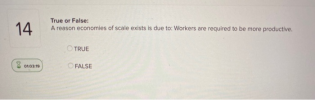 14 True or False: A reason economies of scale exists is due to: Workers are required to be more productive. TRUE 8 0103:19 FALSE
4. Capturing economies of scale is often offered as a reason for the consolidation of hospitals....
4. Capturing economies of scale is often offered as a reason for the consolidation of hospitals. In theory, if there are economics of scale, consolidation should result in cost savings for hospitals. What do the empirical studies mentioned in your text imply about consolidation for hospitals and cost savings? If not for cost savings, what other benefits are there for consolidations of hospitals.?
5. If a hospital has economies of scale with respect to production, then: a. it cannot...
 5. If a hospital has economies of scale with respect to production, then: a. it cannot have economies of scope. b. it must have economies of scope. c. it may or may not have economies of scope. d. it can only have economies of scope for those activities for which it has economies of scale. it can only have economies of scope for those activities for which it does not have economies of scale.
1. How does the economies of scope concept differ from the economies of scale concept? 2....
1. How does the economies of scope concept differ from the economies of scale concept? 2. Related diversification causes bureaucratic costs to increase more than unrelated diversification. Explain why that is the case.
Question 17 Which of the following is NOT a reason why a firm may experience economies of scale? O productive specia...
 Question 17 Which of the following is NOT a reason why a firm may experience economies of scale? O productive specialization o dimensional factors O improved productive equipment o increased layers of management
Economies of scale refers to when: In the long run when average total cost does not...
 Economies of scale refers to when:
In the long run when average total cost does not depend on the
quantity of output, this is called:
Commodities:
We assume that in the long run in a perfectly competitive
market:
Multiple Choice an increase in the quantity of output increases average total cost in the long run. None are correct. average total cost does not depend on the quantity of output in the long run. an increase in the quantity of output...
Economies of scale refers to when:
In the long run when average total cost does not depend on the
quantity of output, this is called:
Commodities:
We assume that in the long run in a perfectly competitive
market:
Multiple Choice an increase in the quantity of output increases average total cost in the long run. None are correct. average total cost does not depend on the quantity of output in the long run. an increase in the quantity of output...
What are economies of scale and diseconomies of scale? How are economies of scale different from...
What are economies of scale and diseconomies of scale? How are economies of scale different from economies of scope? Summarize the different cost-cutting methods employed by firms in their business. What is unique about the business practices and strategy of the company Li and Fung? Visit their website for more current information at www.lifung.com
Since economies of scale are achieved when a company is able to produce a large volume...
Since economies of scale are achieved when a company is able to produce a large volume of products (as you stated), does that mean that smaller companies can't ever have economies of scale? Why or why not? Can a company grow so large that they move out of economies of scale and into diseconomies of scale? Why or why not?
 19. Which sections of the curve does the firm have economies of scale? Diseconomies of scale? Neither economies nor diseconomies of scale? LRAC cost pel unit faverage cost) n A. B
 14 True or False: A reason economies of scale exists is due to: Workers are required to be more productive. TRUE 8 0103:19 FALSE
 5. If a hospital has economies of scale with respect to production, then: a. it cannot have economies of scope. b. it must have economies of scope. c. it may or may not have economies of scope. d. it can only have economies of scope for those activities for which it has economies of scale. it can only have economies of scope for those activities for which it does not have economies of scale.
 Question 17 Which of the following is NOT a reason why a firm may experience economies of scale? O productive specialization o dimensional factors O improved productive equipment o increased layers of management
 Economies of scale refers to when:
In the long run when average total cost does not depend on the
quantity of output, this is called:
Commodities:
We assume that in the long run in a perfectly competitive
market:
Multiple Choice an increase in the quantity of output increases average total cost in the long run. None are correct. average total cost does not depend on the quantity of output in the long run. an increase in the quantity of output...
Economies of scale refers to when:
In the long run when average total cost does not depend on the
quantity of output, this is called:
Commodities:
We assume that in the long run in a perfectly competitive
market:
Multiple Choice an increase in the quantity of output increases average total cost in the long run. None are correct. average total cost does not depend on the quantity of output in the long run. an increase in the quantity of output...
Most questions answered within 3 hours.
-
Where is the error in this code sequence?
String s1 = "Hello";
String s2 = "ello";...
asked 10 months ago -
Financial data for Joel de Paris, Inc., for last year
follow:
Joel de Paris, Inc.
Balance...
asked 10 months ago -
Consider this reaction:
Al2(SO4)3 (aq)+ BaCl3
(aq) Al2Cl6 (aq)- +
3BaSO4(s) . What is the...
asked 10 months ago -
Suppose that Savneet is considering increasing her
recent random sample from 20 car rentals to 40...
asked 10 months ago -
Trucks arrive at an unloading terminal at an average rate of 120
per hour.
Trucks arrive...
asked 10 months ago -
Why are methanol and ethanol completely soluble in water while
octanol is not very little soluble....
asked 10 months ago -
A facilities manager at a university reads in a research report
that the mean amount of...
asked 10 months ago -
When the CuSO4 is rehydrated by adding water to the anhydrous
compound, is this an endothermic...
asked 10 months ago -
A ray of sunlight is passing from diamond into crown glass; the
angle of incidence is...
asked 10 months ago -
A block of mass 0.249 kg is placed on top of a light, vertical
spring of...
asked 10 months ago -
how do the kidneys compensate in the presences of acidosis
a) trigger hyperventilate
b) reserve acid...
asked 10 months ago -
Question 501 pts
The rental rate of capital to the firm increases. Which of the
following...
asked 10 months ago