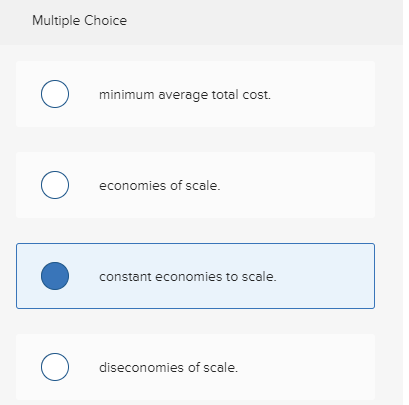
Economies of scale refers to when:
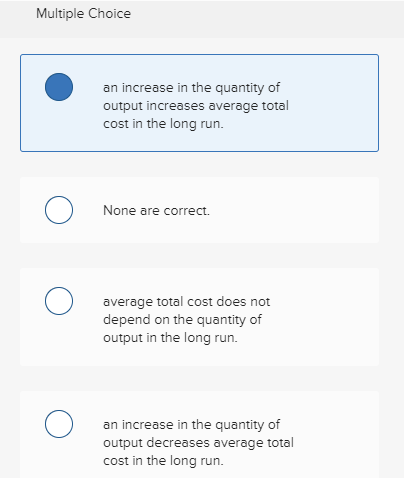
In the long run when average total cost does not depend on the quantity of output, this is called:
Commodities:

We assume that in the long run in a perfectly competitive market:

Homework Answers
Answer : 1) The answer is option D.
When quantity increase, if long-run average total cost decrease then the situation is called increasing returns to scale. Increasing returns to scale is also known as economies of scale. Therefore, option D is correct.
2) The answer is option C.
If quantity does not depend on long-run average total cost then the situation is called constant returns to scale. Constant returns to scale is also known as constant economies of scale. Therefore, option C is correct.
3) The answer is option B.
Commodities are a special standardized goods and homogeneous. No matter who are producing commodities. As options A, C and D are correct hence the answer is option B.
4) The answer is option B.
In perfectly competitive market in long-run many firms enter or exit from the market. This is an assumption of perfectly competitive market. Therefore, option B is correct.
Add Answer to:
Economies of scale refers to when:
In the long run when average total cost does not...
(Click to select) economies of scale a. Long-run average total cost falls as the firm realize: rises when the firm...
 (Click to select) economies of scale a. Long-run average total cost falls as the firm realize: rises when the firm experiences [ (Click to select) diseconomies of scale diminishing marginal returns increasing marginal returns b. The minimum efficient scale is the level of output produced by the smallest firm in the industry. smallest level of output at which a firm can produce. only level of output where long-run average total costs are minimized. smallest level of output needed to attain...
If the long-run average total cost curve for a firm is horizontal in a relevant range...
If the long-run average total cost curve for a firm is horizontal in a relevant range of production, then it indicates that there rev: 06_26_2018 Multiple Choice isn’t a minimum efficiency scale. are diseconomies of scale. are economies of scale. are constant returns to scale.
13. As output (plant size) increases, economies of scale occur when the A) long-run average cost...
 13. As output (plant size) increases, economies of scale occur when the A) long-run average cost increases. B) long-run average cost decreases. C) short-run average total cost decreases. D) long-run average cost stays constant 14. Economies of scale can occur as a result of which of the following? A) increasing marginal costs as the firm increases its size B) higher fixed cost as the firm increases its size C) management difficulties as the firm increases its size D) greater specialization...
Economies of scale occur when a firm's long-run average total cost curve is: Multiple Choice a....
Economies of scale occur when a firm's long-run average total cost curve is: Multiple Choice a. upward-sloping. b. vertical. c. downward-sloping. d. horizontal.
2. Economies of scale refers to when: 6. Suppose Winston's annual salary as an accountant is...
 2. Economies of scale refers to when:
6. Suppose Winston's annual salary as an accountant is $60,000,
and his financial assets generate $4,000 per year in interest. One
day, after deciding to be his own boss, he quits his job and uses
his financial assets to establish a consulting business, which he
runs out of his home. To run the business, he outlays $8,000 in
cash to cover all the costs involved with running the business, and
earns revenues of...
2. Economies of scale refers to when:
6. Suppose Winston's annual salary as an accountant is $60,000,
and his financial assets generate $4,000 per year in interest. One
day, after deciding to be his own boss, he quits his job and uses
his financial assets to establish a consulting business, which he
runs out of his home. To run the business, he outlays $8,000 in
cash to cover all the costs involved with running the business, and
earns revenues of...
Increasing returns to scale is characterized by: a. economies of scale; that is, the average cost...
Increasing returns to scale is characterized by: a. economies of scale; that is, the average cost rises as output rises. b. economies of scale; that is, the average cost falls as output rises. c. diseconomies of scale; that is, the average cost is constant as output rises. d. diseconomies of scale; that is, the average cost falls as output rises. e. constantly declining fixed costs. Because in many industries the cost of generating new ideas is so high, firms must...
Economies of scale occur when: Select one: a. the long-run average cost rises as output increases. ...
Economies of scale occur when: Select one: a. the long-run average cost rises as output increases. b. the marginal cost falls as output increases. c. average fixed costs are constant. d. the long-run average cost falls as output increases
Increasing returns to scale is characterized by: a. economies of scale; that is, the average cost...
Increasing returns to scale is characterized by: a. economies of scale; that is, the average cost falls as output rises. b. constantly declining fixed costs. c. diseconomies of scale; that is, the average cost is constant as output rises. d. diseconomies of scale; that is, the average cost falls as output rises. e. economies of scale; that is, the average cost rises as output rises.
QUESTION 30 A downward-sloping portion of a long-run average total cost curve is the result of:...
QUESTION 30 A downward-sloping portion of a long-run average total cost curve is the result of: economies of scale. diseconomies of scale. diminishing returns. the existence of fixed resources. 2.5 points QUESTION 31 In the long run, firms in many industries often experience a falling average total cost curve as a result of: gains through trade. increasing marginal returns. economies of scale. lower fixed costs. 2.5 points QUESTION 32 A large aircraft manufacturer, like Boeing, may have a...
1. The long-run average cost curve slopes upward if there are: A. economies of scale B....
1. The long-run average cost curve slopes upward if there are: A. economies of scale B. diseconomies of scope in the management of multiplant operates C. Some factors without diminishing marginal returns D. diseconomies of scale E. no factor without diminishing marginal returns
 (Click to select) economies of scale a. Long-run average total cost falls as the firm realize: rises when the firm experiences [ (Click to select) diseconomies of scale diminishing marginal returns increasing marginal returns b. The minimum efficient scale is the level of output produced by the smallest firm in the industry. smallest level of output at which a firm can produce. only level of output where long-run average total costs are minimized. smallest level of output needed to attain...
 13. As output (plant size) increases, economies of scale occur when the A) long-run average cost increases. B) long-run average cost decreases. C) short-run average total cost decreases. D) long-run average cost stays constant 14. Economies of scale can occur as a result of which of the following? A) increasing marginal costs as the firm increases its size B) higher fixed cost as the firm increases its size C) management difficulties as the firm increases its size D) greater specialization...
 2. Economies of scale refers to when:
6. Suppose Winston's annual salary as an accountant is $60,000,
and his financial assets generate $4,000 per year in interest. One
day, after deciding to be his own boss, he quits his job and uses
his financial assets to establish a consulting business, which he
runs out of his home. To run the business, he outlays $8,000 in
cash to cover all the costs involved with running the business, and
earns revenues of...
2. Economies of scale refers to when:
6. Suppose Winston's annual salary as an accountant is $60,000,
and his financial assets generate $4,000 per year in interest. One
day, after deciding to be his own boss, he quits his job and uses
his financial assets to establish a consulting business, which he
runs out of his home. To run the business, he outlays $8,000 in
cash to cover all the costs involved with running the business, and
earns revenues of...
Most questions answered within 3 hours.
-
Where is the error in this code sequence?
String s1 = "Hello";
String s2 = "ello";...
asked 11 months ago -
Financial data for Joel de Paris, Inc., for last year
follow:
Joel de Paris, Inc.
Balance...
asked 11 months ago -
Consider this reaction:
Al2(SO4)3 (aq)+ BaCl3
(aq) Al2Cl6 (aq)- +
3BaSO4(s) . What is the...
asked 11 months ago -
Suppose that Savneet is considering increasing her
recent random sample from 20 car rentals to 40...
asked 11 months ago -
Trucks arrive at an unloading terminal at an average rate of 120
per hour.
Trucks arrive...
asked 11 months ago -
Why are methanol and ethanol completely soluble in water while
octanol is not very little soluble....
asked 11 months ago -
A facilities manager at a university reads in a research report
that the mean amount of...
asked 11 months ago -
When the CuSO4 is rehydrated by adding water to the anhydrous
compound, is this an endothermic...
asked 11 months ago -
A ray of sunlight is passing from diamond into crown glass; the
angle of incidence is...
asked 11 months ago -
A block of mass 0.249 kg is placed on top of a light, vertical
spring of...
asked 11 months ago -
how do the kidneys compensate in the presences of acidosis
a) trigger hyperventilate
b) reserve acid...
asked 11 months ago -
Question 501 pts
The rental rate of capital to the firm increases. Which of the
following...
asked 11 months ago