During mitophagy (autophagy of mitochondria), how many lipid bilayers separate the mitochondrial matrix from the cytosol?...
During mitophagy (autophagy of mitochondria), how many lipid bilayers separate the mitochondrial matrix from the cytosol?
a.0
b. 1
c. 2
d. 3
e. 4
Homework Answers

Add Answer to:
During mitophagy (autophagy of mitochondria), how many lipid
bilayers separate the mitochondrial matrix from the cytosol?...
Question 3 1 pts During mitophagy (autophagy of mitochondria), how many lipid bilayers separate the mitochondrial...
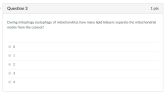 Question 3 1 pts During mitophagy (autophagy of mitochondria), how many lipid bilayers separate the mitochondrial matrix from the cytosol? 0) 0 2 03
1- In animal mitochondria, H+ protons are actively pumped from ___ to ____. a. the cytosol;...
1- In animal mitochondria, H+ protons are actively pumped from ___ to ____. a. the cytosol; the intermembrane space b. the matrix; the intermembrane space c. the matrix; the cytosol d. the intermembrane space; the cytosol e. the intermembrane space; the matrix 2- Which of the following characteristics of the human mitochondrial genome is FALSE? a. Circular form b. Inherited primarily from mother c. Encodes all necessary proteins the mitochondria needs, including enzymes for transcription and translation d. Genetically similar...
Part H In eukaryotes, the trasnport of reduced coenzyme from the cytosol to the mitochondrial matrix...
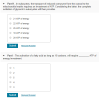 Part H In eukaryotes, the trasnport of reduced coenzyme from the cytosol to the mitochondrial matrix requires an investment of ATP. Considering the latter, the complete oxidation of glycerol in eukaryotes will then provides 21 ATP of energy O 22 ATP of energy O 25 ATP of energy O 18 ATP of energy O 20 ATP of energy Submit Request Answer Part - The activation of a fatty acid as long as 18 carbons, will require energy investment ATP of...
1. Which of the following proteins are unlikely the precursors of the inner mitochondrial protein? A.proteins...
1. Which of the following proteins are unlikely the precursors of the inner mitochondrial protein? A.proteins initially located in the lumen of the endoplasmic reticulum B.proteins synthesized in the cytosol C.proteins synthesized in the mitochondrial matrix D.proteins synthesized in the cytosol and are first transported into the mitochondrial matrix 2. Which of the following proteins whose syntheses are completed in the rough ER? A. pyruvate kinase located in the cytosol B. enzymes located in the lysosomes C. histone H3 D....
4) During Reperfusion there is both an influx of calcium into the mitochondrial matrix and an...
4) During Reperfusion there is both an influx of calcium into the mitochondrial matrix and an increased generation of Reactive oxygen species by the mitochondria. How do these 2 events collectively contribute to mitochondrial rupture and ultimately apoptosis (cell death) of those myocardial cells. Please refer to specific channels, etc. in your response. 5) Exercise training can minimize the amount of damage to the myocardium if an ischemia-reperfusion occurs. Based on evidence (largely from rodent models), how much exercise is...
2. The process of protein localization/trafficking into the mitochondria is very complicated! a. How many membranes...
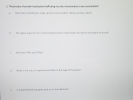 2. The process of protein localization/trafficking into the mitochondria is very complicated! a. How many membranes make up the mitochondria? What are they called? b. The signal sequence for mitochondrial protein import folds into which secondary structure? C. What are TIMs and TOMS? d. What is the role of chaperone proteins in this type of transport? e. Is mitochondrial transport post or co-translational?
Loss of mitochondrial function during apoptosis is caused by cytochrome c release from the mitochondria, which...
Loss of mitochondrial function during apoptosis is caused by cytochrome c release from the mitochondria, which disrupts the flow of electrons to oxygen in the electron transport chain. A. True B. False
8. The movement of protons out of the mitochondrial matrix establishes an electrochemical H gradient across...
 8. The movement of protons out of the mitochondrial matrix establishes an electrochemical H gradient across the inner mitochondrial membrane. The electrochemical potential of this gradient is harnessed to synthesize ATP. This is known as the (A) Hydrophobic effect IqChemiosmotic theory (B) Acid catalysis (0) Michaelis-Menten mechanism _9. Which of the following statements about mitochondria and their lon and metabolite transporters is FALSE? (A) Controlled impermeability of the inner mitochondrial membrane to most ions and metabolites allows for the generation...
How many membranes does the chloroplast have? 30. How many membranes doos the mitochondria have? 31....
 How many membranes does the chloroplast have? 30. How many membranes doos the mitochondria have? 31. A stack of thylakoids are known as d, 4 e, 3 a. Thylakoid dises b, c. thy lakoid lumen 32. The products produced in the light independent reaction are used to drive the light dependent reac a. True b, False 33. The ATP and NADPH produces in the light reaction are used to drive the synthesis of sugars from CO2 a. True b. False...
1. All the following statements about mitochondria are true except: A. protons are concentrated in the...
1. All the following statements about mitochondria are true except: A. protons are concentrated in the mitochondrial matrix. B. the inner membrane contains proteins for the electron transport chain. C. ATP is produced in the mitochondrial matrix. D. ATP synthase allows the proton gradient to dissipate. E. pyruvate is found in the mitochondria.
 Question 3 1 pts During mitophagy (autophagy of mitochondria), how many lipid bilayers separate the mitochondrial matrix from the cytosol? 0) 0 2 03
 Part H In eukaryotes, the trasnport of reduced coenzyme from the cytosol to the mitochondrial matrix requires an investment of ATP. Considering the latter, the complete oxidation of glycerol in eukaryotes will then provides 21 ATP of energy O 22 ATP of energy O 25 ATP of energy O 18 ATP of energy O 20 ATP of energy Submit Request Answer Part - The activation of a fatty acid as long as 18 carbons, will require energy investment ATP of...
 2. The process of protein localization/trafficking into the mitochondria is very complicated! a. How many membranes make up the mitochondria? What are they called? b. The signal sequence for mitochondrial protein import folds into which secondary structure? C. What are TIMs and TOMS? d. What is the role of chaperone proteins in this type of transport? e. Is mitochondrial transport post or co-translational?
 8. The movement of protons out of the mitochondrial matrix establishes an electrochemical H gradient across the inner mitochondrial membrane. The electrochemical potential of this gradient is harnessed to synthesize ATP. This is known as the (A) Hydrophobic effect IqChemiosmotic theory (B) Acid catalysis (0) Michaelis-Menten mechanism _9. Which of the following statements about mitochondria and their lon and metabolite transporters is FALSE? (A) Controlled impermeability of the inner mitochondrial membrane to most ions and metabolites allows for the generation...
 How many membranes does the chloroplast have? 30. How many membranes doos the mitochondria have? 31. A stack of thylakoids are known as d, 4 e, 3 a. Thylakoid dises b, c. thy lakoid lumen 32. The products produced in the light independent reaction are used to drive the light dependent reac a. True b, False 33. The ATP and NADPH produces in the light reaction are used to drive the synthesis of sugars from CO2 a. True b. False...
Most questions answered within 3 hours.
-
Where is the error in this code sequence?
String s1 = "Hello";
String s2 = "ello";...
asked 11 months ago -
Financial data for Joel de Paris, Inc., for last year
follow:
Joel de Paris, Inc.
Balance...
asked 11 months ago -
Consider this reaction:
Al2(SO4)3 (aq)+ BaCl3
(aq) Al2Cl6 (aq)- +
3BaSO4(s) . What is the...
asked 11 months ago -
Suppose that Savneet is considering increasing her
recent random sample from 20 car rentals to 40...
asked 11 months ago -
Trucks arrive at an unloading terminal at an average rate of 120
per hour.
Trucks arrive...
asked 11 months ago -
Why are methanol and ethanol completely soluble in water while
octanol is not very little soluble....
asked 11 months ago -
A facilities manager at a university reads in a research report
that the mean amount of...
asked 11 months ago -
When the CuSO4 is rehydrated by adding water to the anhydrous
compound, is this an endothermic...
asked 11 months ago -
A ray of sunlight is passing from diamond into crown glass; the
angle of incidence is...
asked 11 months ago -
A block of mass 0.249 kg is placed on top of a light, vertical
spring of...
asked 11 months ago -
how do the kidneys compensate in the presences of acidosis
a) trigger hyperventilate
b) reserve acid...
asked 11 months ago -
Question 501 pts
The rental rate of capital to the firm increases. Which of the
following...
asked 11 months ago