Part A Background Information; Solution already found!! Calculate the change in enthalpy (ΔH) for 1.0 mol...
Homework Answers
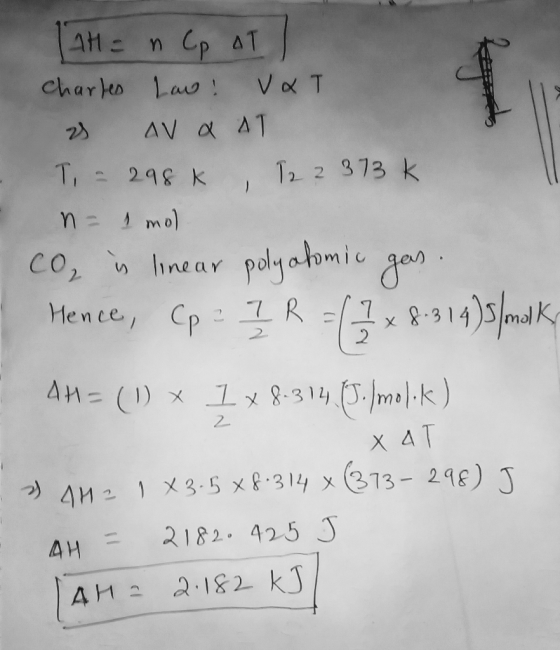
The change in enthalpy at constant pressure can be calculated using the following formulas
Solution for Part B: Illustrating Path Independence of Enthalpy Change
Objective:
Calculate the change in enthalpy (ΔH) for the expansion of CO₂ (from 5.00 L at 298 K → 10.00 L at 373 K) using a different thermodynamic path than in Part A, demonstrating that ΔH is a state function (path-independent).
Key Assumptions (Same as Part A):
CO₂ behaves as an ideal gas: Valid at moderate pressures and temperatures.
Constant heat capacity (): for CO₂ ≈ 37.1 J/mol·K (assumed independent of temperature).
Isenthalpic process for expansion: No work is done against external pressure in free expansion (Joule-Thomson effect negligible for ideal gases).
Alternative Path:
Path 2 (Two-Step Process):
Step 1: Isothermal Expansion (298 K, 5.00 L → 10.00 L)
For an ideal gas, ΔU = 0 in isothermal processes (no temperature change).
Work done () = :
Heat added () = (to maintain ΔU = 0).
ΔH₁ = 0 (since ΔH = ΔU + Δ(PV), and Δ(PV) = 0 for isothermal ideal gas).
Step 2: Isochoric Heating (10.00 L, 298 K → 373 K)
At constant volume, .
Heat added () = :
ΔH₂ = nC_pΔT:
Total ΔH for Path 2:
Comparison with Part A (Direct Path):
In Part A, ΔH was calculated directly using:
Result:
Both paths yield identical ΔH values, proving that enthalpy is a state function.
Answer:
The change in enthalpy (ΔH) for the process via the alternative path is:
Add Answer to:
Part A Background Information; Solution already found!! Calculate
the change in enthalpy (ΔH) for 1.0 mol...
Calculate the change in enthalpy (ΔH) for 1.0 mol of carbon dioxide (CO2) initially at a...
Calculate the change in enthalpy (ΔH) for 1.0 mol of carbon dioxide (CO2) initially at a volume of 5.00 L and a temperature of 298 K to a final volume of 10.00 L and a temperature of 373 K. Explicitly state all assumptions along with a justification for any and all assumptions made. Express your answer in units of kilojoules per mole (kJ/mol)
Calculate the change in enthalpy (ΔH) for 1.0 mol of carbon dioxide (CO2) initially at a...
Calculate the change in enthalpy (ΔH) for 1.0 mol of carbon dioxide (CO2) initially at a volume of 5.00 L and a temperature of 298 K to a final volume of 10.00 L and a temperature of 373 K. Explicitly state all assumptions along with a justification for any and all assumptions made. Express your answer in units of kilojoules per mole (kJ/mol). Assume an ideal gas.
Part A Calculate the enthalpy change, ΔH, for the process in which 42.4 g of water...
Part A Calculate the enthalpy change, ΔH, for the process in which 42.4 g of water is converted from liquid at 15.3 ∘C to vapor at 25.0 ∘C . For water, ΔHvap = 44.0 kJ/mol at 25.0 ∘C and Cs = 4.18 J/(g⋅∘C) for H2O(l). How many grams of ice at -16.2 ∘C can be completely converted to liquid at 25.5 ∘C if the available heat for this process is 4.77×10³ kJ ? For ice, use a specific heat of...
1. Calculate the enthalpy change, ΔH, for the process in which 31.6 g of water is...
1. Calculate the enthalpy change, ΔH, for the process in which 31.6 g of water is converted from liquid at 0.4 ∘C to vapor at 25.0 ∘C . For water, ΔHvap = 44.0 kJ/mol at 25.0 ∘C and Cs = 4.18 J/(g⋅∘C) for H2O(l). 2. How many grams of ice at -16.2 ∘C can be completely converted to liquid at 10.2 ∘C if the available heat for this process is 4.27×10³ kJ ? For ice, use a specific heat of 2.01...
7. Calculate the enthalpy change, ΔH, for the process in which 36.2 g of water is...
7. Calculate the enthalpy change, ΔH, for the process in which 36.2 g of water is converted from liquid at 3.2 ∘C to vapor at 25.0 ∘C . For water, ΔHvap = 44.0 kJ/mol at 25.0 ∘C and Cs = 4.18 J/(g⋅∘C) for H2O(l). 9. The instruction booklet for your pressure cooker indicates that its highest setting is 13.4 psi . You know that standard atmospheric pressure is 14.7 psi, so the booklet must mean 13.4 psi above atmospheric pressure. At...
Part A; Calculate the standard enthalpy change for the reaction 2A+B⇌2C+2D where the heats of formation...
Part A; Calculate the standard enthalpy change for the reaction 2A+B⇌2C+2D where the heats of formation are given in the following table: Substance ΔH∘f (kJ/mol) A -251 B -375 C 191 D -519 Answer to Part A- 221kJ FIND PART B & C PART B- For the reaction given in Part A, how much heat is absorbed when 3.40 mol of A reacts? Express your answer numerically in kilojoules. PART C- For the reaction given in Part A, ΔS∘rxn is...
Typical Math Problems 1) What is the pH of a buffer solution which is 0.12M in...
 Typical Math Problems 1) What is the pH of a buffer solution which is 0.12M in benzoic acid, pKa 4.19, and is 0.11M in sodium benzoate? 2) Find the %-diss of a buffer if the pKa 7.10 and the pH of the buffer is 7.50. 3) A weak monoprotic acid has a pKa 6.15. 50.00 mL of an 0.1250M aqueous solution of this weak acid is titrated with 0.1000M Na0H. a) What is the equivalence point volume and ½ equivalence...
Question 11: (1 point) One mole of N2(g) undergoes the following change in state. N2(g, 309...
Question 11: (1 point) One mole of N2(g) undergoes the following change in state. N2(g, 309 K, 4.03 bar) ⟶ N2(g, 259 K, 6.57 bar) What is ΔS for the gas? Assume ideal gas behaviour. The constant pressure molar heat capacity for N2(g) is Cp,m = 29.10 J K−1 mol−1. Enter your answers in the specified units with three or more significant figures . Do not include units as part of your answer. ΔS = ____________ J K−1 Question 12: (1...
One mole of H20( is supercooled to-5.00°C at 1 bar pressure before freezing at that temperature....
 One mole of H20( is supercooled to-5.00°C at 1 bar pressure before freezing at that temperature. Calculate ASys, ASum, and ASeotal for this process. Is it spontaneous? CPm (H20, 1)- 75.3 J/mol.K CPm (H20, s)-37.7 J/mol.K AHfusion 6.008 kJ/mol Hint: remember that ASs is computed using q along a reversible path, while ASur is computed using the actual heat transfer during the freezing. For the following equilibrium reaction: Here is an ICE table, starting from no moles of pure 0z...
Please answer all the blanks (volume if H2 and everything in analysis). TIA! Data 5 1...
 Please answer all the blanks (volume if H2 and
everything in analysis). TIA!
Data 5 1 oong 0.00 10.5ml 2 o.olag 0.00 11.0 Trial 3 o.org 0.00 12.00 o Daag o.albg 0.00 10.0 ml 11.5ml Mass of Mg (g) Initial volume of Syringe (mL) Final volume of Syringe (mL) Volume of H (mL) Barometric pressure (torr) Ambient temperature (°C) Vapor pressure of H2O (torr) 779.314har 23. Oi 21.0 forr TA.314tar 23.0c 179.3 14ton 23.0¢ 779.314 ton 23.0c 779.31472 23.0c 21.0...
Please answer all the blanks (volume if H2 and
everything in analysis). TIA!
Data 5 1 oong 0.00 10.5ml 2 o.olag 0.00 11.0 Trial 3 o.org 0.00 12.00 o Daag o.albg 0.00 10.0 ml 11.5ml Mass of Mg (g) Initial volume of Syringe (mL) Final volume of Syringe (mL) Volume of H (mL) Barometric pressure (torr) Ambient temperature (°C) Vapor pressure of H2O (torr) 779.314har 23. Oi 21.0 forr TA.314tar 23.0c 179.3 14ton 23.0¢ 779.314 ton 23.0c 779.31472 23.0c 21.0...
 Typical Math Problems 1) What is the pH of a buffer solution which is 0.12M in benzoic acid, pKa 4.19, and is 0.11M in sodium benzoate? 2) Find the %-diss of a buffer if the pKa 7.10 and the pH of the buffer is 7.50. 3) A weak monoprotic acid has a pKa 6.15. 50.00 mL of an 0.1250M aqueous solution of this weak acid is titrated with 0.1000M Na0H. a) What is the equivalence point volume and ½ equivalence...
 One mole of H20( is supercooled to-5.00°C at 1 bar pressure before freezing at that temperature. Calculate ASys, ASum, and ASeotal for this process. Is it spontaneous? CPm (H20, 1)- 75.3 J/mol.K CPm (H20, s)-37.7 J/mol.K AHfusion 6.008 kJ/mol Hint: remember that ASs is computed using q along a reversible path, while ASur is computed using the actual heat transfer during the freezing. For the following equilibrium reaction: Here is an ICE table, starting from no moles of pure 0z...
 Please answer all the blanks (volume if H2 and
everything in analysis). TIA!
Data 5 1 oong 0.00 10.5ml 2 o.olag 0.00 11.0 Trial 3 o.org 0.00 12.00 o Daag o.albg 0.00 10.0 ml 11.5ml Mass of Mg (g) Initial volume of Syringe (mL) Final volume of Syringe (mL) Volume of H (mL) Barometric pressure (torr) Ambient temperature (°C) Vapor pressure of H2O (torr) 779.314har 23. Oi 21.0 forr TA.314tar 23.0c 179.3 14ton 23.0¢ 779.314 ton 23.0c 779.31472 23.0c 21.0...
Please answer all the blanks (volume if H2 and
everything in analysis). TIA!
Data 5 1 oong 0.00 10.5ml 2 o.olag 0.00 11.0 Trial 3 o.org 0.00 12.00 o Daag o.albg 0.00 10.0 ml 11.5ml Mass of Mg (g) Initial volume of Syringe (mL) Final volume of Syringe (mL) Volume of H (mL) Barometric pressure (torr) Ambient temperature (°C) Vapor pressure of H2O (torr) 779.314har 23. Oi 21.0 forr TA.314tar 23.0c 179.3 14ton 23.0¢ 779.314 ton 23.0c 779.31472 23.0c 21.0...
Most questions answered within 3 hours.
-
Where is the error in this code sequence?
String s1 = "Hello";
String s2 = "ello";...
asked 10 months ago -
Financial data for Joel de Paris, Inc., for last year
follow:
Joel de Paris, Inc.
Balance...
asked 10 months ago -
Consider this reaction:
Al2(SO4)3 (aq)+ BaCl3
(aq) Al2Cl6 (aq)- +
3BaSO4(s) . What is the...
asked 10 months ago -
Suppose that Savneet is considering increasing her
recent random sample from 20 car rentals to 40...
asked 10 months ago -
Trucks arrive at an unloading terminal at an average rate of 120
per hour.
Trucks arrive...
asked 10 months ago -
Why are methanol and ethanol completely soluble in water while
octanol is not very little soluble....
asked 10 months ago -
A facilities manager at a university reads in a research report
that the mean amount of...
asked 10 months ago -
When the CuSO4 is rehydrated by adding water to the anhydrous
compound, is this an endothermic...
asked 10 months ago -
A ray of sunlight is passing from diamond into crown glass; the
angle of incidence is...
asked 10 months ago -
A block of mass 0.249 kg is placed on top of a light, vertical
spring of...
asked 10 months ago -
how do the kidneys compensate in the presences of acidosis
a) trigger hyperventilate
b) reserve acid...
asked 10 months ago -
Question 501 pts
The rental rate of capital to the firm increases. Which of the
following...
asked 10 months ago