A bottle rocket is shot with a velocity of 12.0 m/s at an angle of 60-deg....
A bottle rocket is shot with a velocity of 12.0 m/s at an angle of 60-deg. If the bottle rocket undergoes a 1.2 m/s/s acceleration upward for 4.5 s. What is the maximum height of the bottle rocket?
Homework Answers

Add Answer to:
A bottle rocket is shot with a velocity of 12.0 m/s at an angle
of 60-deg....
a rocket is shot upward. its motor burns for ten seconds giving an acceleration of 15m/s/s,...
a rocket is shot upward. its motor burns for ten seconds giving an acceleration of 15m/s/s, but after it burns it is in free fall. draw the velocity v. time graph, acceleration v. time graph and the position v. time graph. how high above the ground is the rocket once the motor runs out, how fast is the rocket traveling once its motor runs out, how fast is the rocket traveling when it reaches its maximum height, and what is...
A. a rocket is projected upward with a velocity of 53.2 m/s. how many metres will...
A. a rocket is projected upward with a velocity of 53.2 m/s. how many metres will it pass over in the third second of its upward travel? gravitational acceleration is 9.81 B. A bullet it shot vertically into the air with an initial velocity of 106.34 m/s. Calculate the maximum vertical distance (in metres) reached before the bullet begins to fall back to earth. Take gravitational acceleration to be 9.81 m/s2.
A ball is thrown with a velocity of 9.0 m/s at an angle of 35-deg above...
A ball is thrown with a velocity of 9.0 m/s at an angle of 35-deg above the horizontal. What is the maximum height of the ball? Solve x and y component first, please give as much detailed explanation as possible, thanks
Liner motion A) A projectile has an initial horizontal velocity of 20 m/s at the edge...
Liner motion A) A projectile has an initial horizontal velocity of 20 m/s at the edge of a rooftop. Find the horizontal and vertical components of its velocity after 2 s. B) A truck traveling at 60 km/h brakes to a stop in 50 m. What were the average acceleration and stopping time? C) An arrow is shot vertically upward with an initial velocity of 80 25 m/s. What is its maximum height? D) A hammer is thrown vertically upward...
25) ject is shot upward from the earth's surface with an initial velocity of 60 m/s....
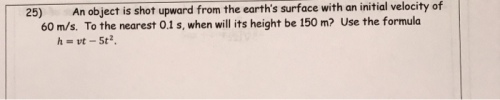 25) ject is shot upward from the earth's surface with an initial velocity of 60 m/s. To the nearest 0.1 s, when will its height be 150 m? Use the formula
Download An object is launched from the origin with a velocity of 12.0 m/s at an...
 Download An object is launched from the origin with a velocity of 12.0 m/s at an angle of 42.0 degrees above the horizontal. How long after launch does the object reach its maximum height? (use g=9.80 m/s) A. 0.63 s B. 0.75 s C. 0.82 s D. 1.2 s E. 1.5 s
A rocket is fired at an initial speed v0 = 141.0 m/s from ground level, at...
A rocket is fired at an initial speed v0 = 141.0 m/s from ground level, at an angle θ = 33 degrees above the horizontal. Ignore air resistance. The magnitude of the gravitational acceleration is 9.8 m/s2. Choose the RIGHT as positive x-direction. Choose UPWARD as psotitive y-direction. Keep 2 decimal places in all answers (a) Find v0x, the x component of the initial velocity (in m/s) (b) Find v0y, the y component of the initial velocity (in m/s) (c)...
A model rocket is launched straight upward with an initial speed of 54.7 m/s. It accelerates...
A model rocket is launched straight upward with an initial speed of 54.7 m/s. It accelerates with a constant upward acceleration of 1.94 m/s2 until its engines stop at an altitude of 131 m. What is the maximum height reached by the rocket? How long after lift off does the rocket reach its maximum height? How long is the rocket in the air?
A model rocket is launched straight upward with an initial speed of 54.7 m/s. It accelerates...
A model rocket is launched straight upward with an initial speed of 54.7 m/s. It accelerates with a constant upward acceleration of 1.94 m/s2 until its engines stop at an altitude of 131 m. What is the maximum height reached by the rocket? How long after lift off does the rocket reach its maximum height? How long is the rocket in the air?
27. A ball is kicked with a velocity of 30m/s at an angle of 60 degrees...
 27. A ball is kicked with a velocity of 30m/s at an angle of 60 degrees relative to the horizontal. Assuming no air resistance ) What are the initial Vx and Vy components of the projectile shot? b) What will be the maximum vertical height the ball reaches in meters? c) How long in seconds will it stay in the air (hang time)? d) What will its velocity be at its maximum height? e) Calculate the total horizontal distance( range)...
 25) ject is shot upward from the earth's surface with an initial velocity of 60 m/s. To the nearest 0.1 s, when will its height be 150 m? Use the formula
 Download An object is launched from the origin with a velocity of 12.0 m/s at an angle of 42.0 degrees above the horizontal. How long after launch does the object reach its maximum height? (use g=9.80 m/s) A. 0.63 s B. 0.75 s C. 0.82 s D. 1.2 s E. 1.5 s
 27. A ball is kicked with a velocity of 30m/s at an angle of 60 degrees relative to the horizontal. Assuming no air resistance ) What are the initial Vx and Vy components of the projectile shot? b) What will be the maximum vertical height the ball reaches in meters? c) How long in seconds will it stay in the air (hang time)? d) What will its velocity be at its maximum height? e) Calculate the total horizontal distance( range)...
Most questions answered within 3 hours.
-
Where is the error in this code sequence?
String s1 = "Hello";
String s2 = "ello";...
asked 11 months ago -
Financial data for Joel de Paris, Inc., for last year
follow:
Joel de Paris, Inc.
Balance...
asked 11 months ago -
Consider this reaction:
Al2(SO4)3 (aq)+ BaCl3
(aq) Al2Cl6 (aq)- +
3BaSO4(s) . What is the...
asked 11 months ago -
Suppose that Savneet is considering increasing her
recent random sample from 20 car rentals to 40...
asked 11 months ago -
Trucks arrive at an unloading terminal at an average rate of 120
per hour.
Trucks arrive...
asked 11 months ago -
Why are methanol and ethanol completely soluble in water while
octanol is not very little soluble....
asked 11 months ago -
A facilities manager at a university reads in a research report
that the mean amount of...
asked 11 months ago -
When the CuSO4 is rehydrated by adding water to the anhydrous
compound, is this an endothermic...
asked 11 months ago -
A ray of sunlight is passing from diamond into crown glass; the
angle of incidence is...
asked 11 months ago -
A block of mass 0.249 kg is placed on top of a light, vertical
spring of...
asked 11 months ago -
how do the kidneys compensate in the presences of acidosis
a) trigger hyperventilate
b) reserve acid...
asked 11 months ago -
Question 501 pts
The rental rate of capital to the firm increases. Which of the
following...
asked 11 months ago