Reynolds number is a dimensionless number that is used in Fluid Mechanics to distinguish between the...
Reynolds number is a dimensionless number that is used in Fluid Mechanics to distinguish between the
laminar and turbulent flows particularly in pipes. Consider a pipe where the flowing fluid has the
following properties:
ρ is the density of the fluid (SI units: kg/m^3)
u is the velocity of the fluid with respect to the object (m/s)
D is pipe diameter (m)
μ is the dynamic viscosity of the fluid (Pa·s or N·s/m^2 or kg/m·s)
m is he mass of fluid in kg
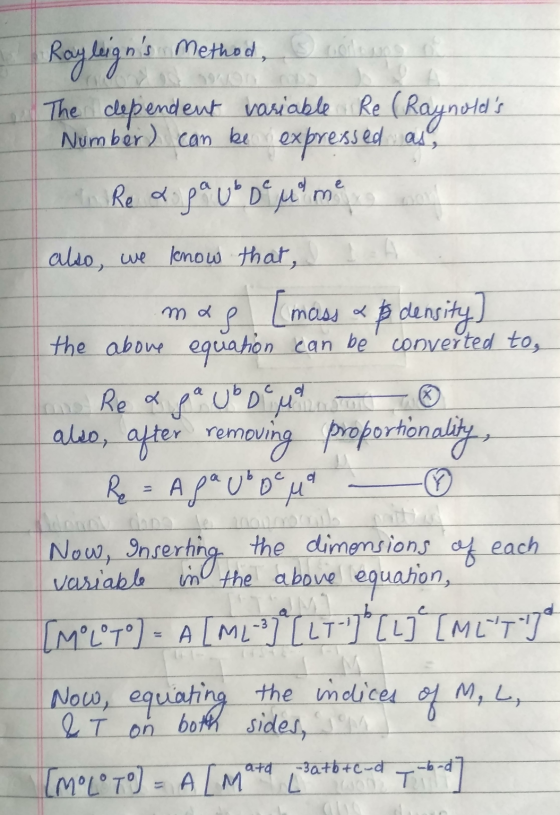
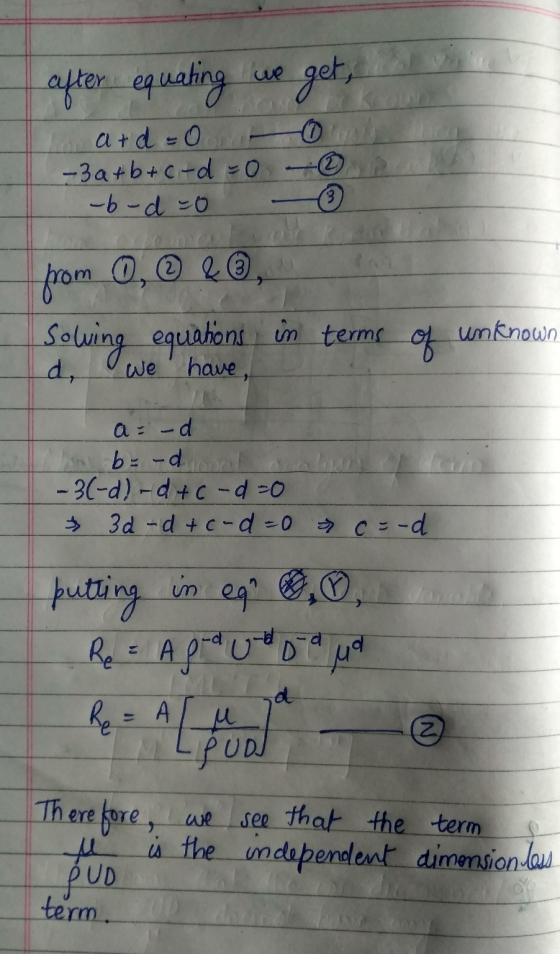
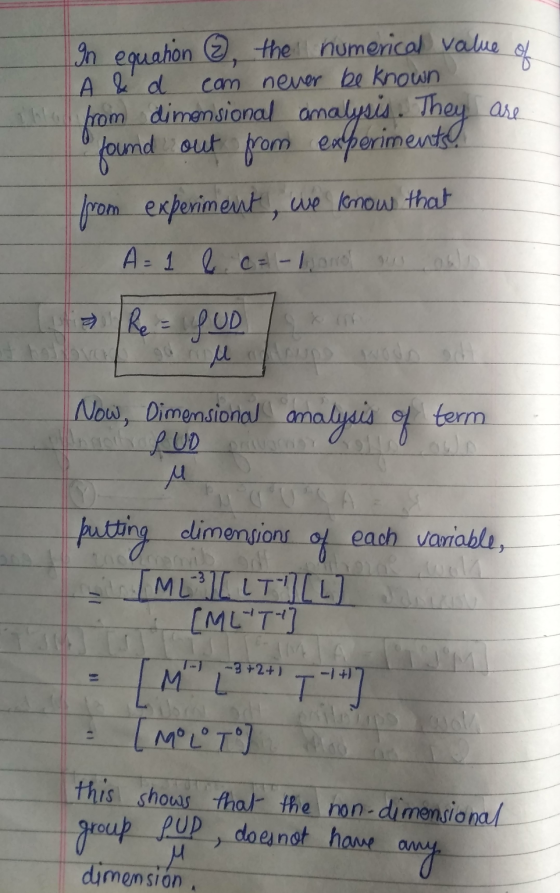
Use Rayleigh’s method to derive the nondimensionalized group (called Reynold’s number) and show
that the non-dimensional group does not have any dimension.
Homework Answers
Rayleigh's indicial Method is based on the fundamental principle of dimensional homogeneity of physical variables in a problem. In RIM, the dependent variable is expressed as a product of all the independent variables raised to sn unknown integer exponent.
I have solved this question for you in which i explained the method.
For any other query related to the question, you can ask me in the comment section.
Add Answer to:
Reynolds number is a dimensionless number that is used in Fluid
Mechanics to distinguish between the...
The Reynolds Number, Re, is of great importance in Chemical Engineering. This dimensionless quantity is used...
The Reynolds Number, Re, is of great importance in Chemical Engineering. This dimensionless quantity is used to describe fluid flow patterns. If Re is over 2,100 the flow regime is considered turbulent and below 2,100 the flow regime is laminar. Re is defined as the ratio of inertial forces to viscous forces. And is represented mathematically as: ?? = ??? ? , where D is the pipe diameter (length), u is the fluid velocity (length/time), ? is the fluid density...
Recall that the Reynolds number is a dimensionless number that we use to discuss the flow...
 Recall that the Reynolds number is a dimensionless number that we use to discuss the flow charecteristics of moving fluids. Generally speaking it is the ratio of momentum forces to viscous forces, and it depends on the diameter of the pipe, the density of the fluid, the velocity of the moving fluid, and the viscosity of the moving fluid. It is normally given by Re Where Re - Reynolds number [dimensionless) p- fuid density v- fud velocity D- pipe diameter...
Need help creating a program from C++ for engineers 4th edition. Pg 200 #8 (Fluid Mechanics)...
Need help creating a program from C++ for engineers 4th edition. Pg 200 #8 (Fluid Mechanics) A fluid particles following through a pipe can flow in a smooth, constant manner, called laminar flow; in a chaotic manner, called turbulent flow; or in an intermediate transitional stage between smooth and turbulent flow. As a practical design parametter, the Reyolds number can be used to determined the type of flow. For reynolds number below 2000, the flow is laminar and for reynolds...
3. A Newtonian fluid with a dynamic or absolute viscosity of 0.38 Ns/m” and a Density...
 3. A Newtonian fluid with a dynamic or absolute viscosity of 0.38 Ns/m” and a Density of 910 kg/m flows through a 25 mm diameter pipe with a velocity of 2.6 m/s. Find out Reynolds number of the fluid. Is the fluid flow lamina, transient, or turbulent?
Fluid mechanics
Calculate the viscosity of a fluid that would allow a pressure drop of 35kpa over a 5m length of 0.75_in stainless steel sanitary pipe, if the fluid is flowing at 0.12m^3/h and has a density of 1010 kg/m^3. Assume laminar flow
Vid 15. One expression for the Reynolds number is Rem a. Since the Reynolds number must...
 Vid 15. One expression for the Reynolds number is Rem a. Since the Reynolds number must be dimensionless, what are the units of the v term in the denominator? b. Does the v term represent the kinematic or dynamic viscosity? c. Find the coefficient of drag of a sphere (d=0.5m) if cold air, with a density of 1.29 kg/m' is blowing on it with a velocity of 35 m/s and a dynamic viscosity of 1.72d0N s/m?.
applied fluid mechanics Please answer these questions 5) Express the Reynolds number in terms of mass...
 applied fluid mechanics
Please answer these questions
5) Express the Reynolds number in terms of mass flowrate . a. Explain why chemical engineers would usually use this definition for analysis to compare with experiments 6) Why does the diverge to infinity as . this is where a pipe meets a reservoir in the entrance region? 7) Explain why Turbulent flows have larger entrance lengths?
applied fluid mechanics
Please answer these questions
5) Express the Reynolds number in terms of mass flowrate . a. Explain why chemical engineers would usually use this definition for analysis to compare with experiments 6) Why does the diverge to infinity as . this is where a pipe meets a reservoir in the entrance region? 7) Explain why Turbulent flows have larger entrance lengths?
1. What is the Reynolds number of a bacterium of diameter 1.2 micrometers, swimming at 17...
 1. What is the Reynolds number of a bacterium of diameter 1.2 micrometers, swimming at 17 micrometers per second? Water has viscosity 8.9x 10PaS and density 1000 kg/m'. Is it laminar, transitional or turbulent? (4 points)
Calculate the Reynolds number, Re- (2rpv)/ n, for the following situations and decide whether the flow...
 Calculate the Reynolds number, Re- (2rpv)/ n, for the following situations and decide whether the flow of fluid around them is laminar or turbulent. Then calculate the frag force using the appropriate formula. For the radius, use r 2(Area/perimeter) which, for a circle, gives the radius. Densities and viscosities are in the table on page 2. Also, to keep things uniform, we will use the boundaries for laminar and turbulent flow from Engineer's Toolbox, also on pg. 2 [1] A...
EDIT: The fluid in the system is water. There is no data regarding the inclination of...
 EDIT: The fluid in the system is water. There is no data
regarding the inclination of the pipe. It's known that the
equipment used includes a fluid flow piping system (AFT), hydraulic
bench (FME00), barometer, and psychrometer. Also added an appendix
that has recommended equations.
Need help on a fluid mechanics friction problem
Given:
Pipe Diameter=23mm
Length=1000mm
Temperature = 70 Celsius
Flow rate = 1400 L/hr
Water column LP1= 330mm
Water column LP2=90mm
Find:
Flow rate m^3/s, Velocity m/s, Temp...
EDIT: The fluid in the system is water. There is no data
regarding the inclination of the pipe. It's known that the
equipment used includes a fluid flow piping system (AFT), hydraulic
bench (FME00), barometer, and psychrometer. Also added an appendix
that has recommended equations.
Need help on a fluid mechanics friction problem
Given:
Pipe Diameter=23mm
Length=1000mm
Temperature = 70 Celsius
Flow rate = 1400 L/hr
Water column LP1= 330mm
Water column LP2=90mm
Find:
Flow rate m^3/s, Velocity m/s, Temp...
 Recall that the Reynolds number is a dimensionless number that we use to discuss the flow charecteristics of moving fluids. Generally speaking it is the ratio of momentum forces to viscous forces, and it depends on the diameter of the pipe, the density of the fluid, the velocity of the moving fluid, and the viscosity of the moving fluid. It is normally given by Re Where Re - Reynolds number [dimensionless) p- fuid density v- fud velocity D- pipe diameter...
 3. A Newtonian fluid with a dynamic or absolute viscosity of 0.38 Ns/m” and a Density of 910 kg/m flows through a 25 mm diameter pipe with a velocity of 2.6 m/s. Find out Reynolds number of the fluid. Is the fluid flow lamina, transient, or turbulent?
 Vid 15. One expression for the Reynolds number is Rem a. Since the Reynolds number must be dimensionless, what are the units of the v term in the denominator? b. Does the v term represent the kinematic or dynamic viscosity? c. Find the coefficient of drag of a sphere (d=0.5m) if cold air, with a density of 1.29 kg/m' is blowing on it with a velocity of 35 m/s and a dynamic viscosity of 1.72d0N s/m?.
 applied fluid mechanics
Please answer these questions
5) Express the Reynolds number in terms of mass flowrate . a. Explain why chemical engineers would usually use this definition for analysis to compare with experiments 6) Why does the diverge to infinity as . this is where a pipe meets a reservoir in the entrance region? 7) Explain why Turbulent flows have larger entrance lengths?
applied fluid mechanics
Please answer these questions
5) Express the Reynolds number in terms of mass flowrate . a. Explain why chemical engineers would usually use this definition for analysis to compare with experiments 6) Why does the diverge to infinity as . this is where a pipe meets a reservoir in the entrance region? 7) Explain why Turbulent flows have larger entrance lengths?
 1. What is the Reynolds number of a bacterium of diameter 1.2 micrometers, swimming at 17 micrometers per second? Water has viscosity 8.9x 10PaS and density 1000 kg/m'. Is it laminar, transitional or turbulent? (4 points)
 Calculate the Reynolds number, Re- (2rpv)/ n, for the following situations and decide whether the flow of fluid around them is laminar or turbulent. Then calculate the frag force using the appropriate formula. For the radius, use r 2(Area/perimeter) which, for a circle, gives the radius. Densities and viscosities are in the table on page 2. Also, to keep things uniform, we will use the boundaries for laminar and turbulent flow from Engineer's Toolbox, also on pg. 2 [1] A...
 EDIT: The fluid in the system is water. There is no data
regarding the inclination of the pipe. It's known that the
equipment used includes a fluid flow piping system (AFT), hydraulic
bench (FME00), barometer, and psychrometer. Also added an appendix
that has recommended equations.
Need help on a fluid mechanics friction problem
Given:
Pipe Diameter=23mm
Length=1000mm
Temperature = 70 Celsius
Flow rate = 1400 L/hr
Water column LP1= 330mm
Water column LP2=90mm
Find:
Flow rate m^3/s, Velocity m/s, Temp...
EDIT: The fluid in the system is water. There is no data
regarding the inclination of the pipe. It's known that the
equipment used includes a fluid flow piping system (AFT), hydraulic
bench (FME00), barometer, and psychrometer. Also added an appendix
that has recommended equations.
Need help on a fluid mechanics friction problem
Given:
Pipe Diameter=23mm
Length=1000mm
Temperature = 70 Celsius
Flow rate = 1400 L/hr
Water column LP1= 330mm
Water column LP2=90mm
Find:
Flow rate m^3/s, Velocity m/s, Temp...
Most questions answered within 3 hours.
-
Where is the error in this code sequence?
String s1 = "Hello";
String s2 = "ello";...
asked 11 months ago -
Financial data for Joel de Paris, Inc., for last year
follow:
Joel de Paris, Inc.
Balance...
asked 11 months ago -
Consider this reaction:
Al2(SO4)3 (aq)+ BaCl3
(aq) Al2Cl6 (aq)- +
3BaSO4(s) . What is the...
asked 11 months ago -
Suppose that Savneet is considering increasing her
recent random sample from 20 car rentals to 40...
asked 11 months ago -
Trucks arrive at an unloading terminal at an average rate of 120
per hour.
Trucks arrive...
asked 11 months ago -
Why are methanol and ethanol completely soluble in water while
octanol is not very little soluble....
asked 11 months ago -
A facilities manager at a university reads in a research report
that the mean amount of...
asked 11 months ago -
When the CuSO4 is rehydrated by adding water to the anhydrous
compound, is this an endothermic...
asked 11 months ago -
A ray of sunlight is passing from diamond into crown glass; the
angle of incidence is...
asked 11 months ago -
A block of mass 0.249 kg is placed on top of a light, vertical
spring of...
asked 11 months ago -
how do the kidneys compensate in the presences of acidosis
a) trigger hyperventilate
b) reserve acid...
asked 11 months ago -
Question 501 pts
The rental rate of capital to the firm increases. Which of the
following...
asked 11 months ago