When a car rolls uphill (with friction), what energy transformation takes place (not using the motor)?...
When a car rolls uphill (with friction), what energy transformation takes place (not using the motor)? (K = kinetic energy, Ug = potential energy, Eth = thermal energy) select all that apply
A. Ug → Eth B. K → Eth C. Eth → K D. K → Ug E. Eth → Ug F. Ug→ K
Homework Answers
When the car is in motion it has Kinetic energy[(mv^2)/2]. While going uphill car is doing work against the gravity and gaining height that means kinetic energy is getting converted into potential energy(mgh).
Add Answer to:
When a car rolls uphill (with friction), what energy
transformation takes place (not using the motor)?...
What energy transformation takes place when the skater rolls uphill with friction? A. kinetic energy to...
What energy transformation takes place when the skater rolls uphill with friction? A. kinetic energy to potential energy and thermal energy B. Potential energy to kinetic energy and thermal energy C. kinetic energy to thermal energy D. Potential energy to kinetic energy E. kinetic energy to potential energy
What kind of energy transformation occurs when a rock falls, including air resistance? a. Kinetic energy...
 What kind of energy transformation occurs when a rock falls, including air resistance? a. Kinetic energy is converted to gravitational energy and thermal energy: energy is conserved. b. Gravitational potential energy is converted to kinetic energy: energy is not conserved. OC. Gravitational potential energy is converted to kinetic energy and thermal energy: energy is conserved. d. Thermal energy is converted to gravitational energy: energy is not conserved.
At an amusement park, a car of mass m rolls without friction around a track as...
At an amusement park, a car of mass m rolls without friction around a track as shown. The car starts from rest at point A, a height h = 3R above the bottom of the loop (R is the radius of the loop). Treat the car as a point-like particle. (a) Draw the free body diagram for the car and find the car’s kinetic energy and normal force acting on the car at the top of the loop (point B)....
t View History Bookmarks People Window Help YS 1315 MW: × GATurning Fork Oscillates A ×...
 t View History Bookmarks People Window Help YS 1315 MW: × GATurning Fork Oscillates A × bike.dvi /tracs.txstate.edu/portal/site/081c75c uiz Ch 10: Energy Transformations 5-913a-4722-9c84-08433aaea16f/tool/87e46ed1 ew unanswered or marked questions art 1 of 1- 1.0 Points Question 1 of 3 Use the PHET simulation Energy Skate Park: Basics which is embedded in this lesson. use the Friction app in the middle . in the right menu check the box for Bar Graph in the right menu vary the friction a) What...
A coin falling through a vacuum loses no energy to friction, and yet after it hits...
A coin falling through a vacuum loses no energy to friction, and yet after it hits the ground it has lost all its potential and kinetic energy. Which statement best explains why the law of conservation of energy is still valid in this case? A.) When the coin hits the ground, the ground gains potential energy that quickly changes to thermal energy. B.) When the coin hits the ground, the ground gains kinetic energy that quickly changes to thermal energy....
In the Energy Transformation experiment, suppose that you launch the cart uphill from the bottom of...
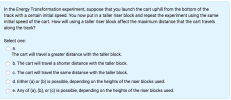 In the Energy Transformation experiment, suppose that you launch the cart uphill from the bottom of the track with a certain initial speed. You now put in a taller riser block and repeat the experiment using the same initial speed of the cart. How will using a taller riser block affect the maximum distance that the cart travels along the track? Select one: a. The cart will travel a greater distance with the taller block O b. The cart will...
1a) What is the kinetic energy (in J) of a 2610-pound automobile traveling at 62.5 km...
1a) What is the kinetic energy (in J) of a 2610-pound automobile traveling at 62.5 km per hour? b) What energy transformations take place when a moving car brakes and skids to a stop? Select all that apply. Total energy is conserved. The kinetic energy of the car is converted into thermal energy. The brakes and tires are cooler after the car stops then just before the brakes were applied. Total energy is not conserved.
5. A 1000-kg car is at the top of a hill as shown, where its elevation...
 5. A 1000-kg car is at the top of a hill as shown, where its elevation above the bottom of the hill is 120 m. a. What is its gravitational potential energy? 120 m b. If the cart starts from rest and rolls down the hill with negligible friction and air resistance, what will its kinetic energy be when it reaches the bottom? c. What will be its speed when it reaches the bottom? Suppose instead that there is noticeable...
A car of mass 500. kg on a roller coaster ride is raised from the ground...
 A car of mass 500. kg on a roller coaster ride is raised from
the ground (horizontal dotted line) to point A as shown in the
diagram above. When the car passes point A, its speed is 5.0 m/s,
and then it rolls freely through the rest of the ride with
negligible friction, passing points B, C, D and E. Note that point
D is the highest portion of a circular loop, and point E is the
lowest portion of...
A car of mass 500. kg on a roller coaster ride is raised from
the ground (horizontal dotted line) to point A as shown in the
diagram above. When the car passes point A, its speed is 5.0 m/s,
and then it rolls freely through the rest of the ride with
negligible friction, passing points B, C, D and E. Note that point
D is the highest portion of a circular loop, and point E is the
lowest portion of...
Question 4 -Work-Energy Theorem Roller coasters operate on the principle of energy transformation Inbaly the system is at down the track a) What is the energy stored in the system? e the Potenti...
 Question 4 -Work-Energy Theorem Roller coasters operate on the principle of energy transformation Inbaly the system is at down the track a) What is the energy stored in the system? e the Potential Energy? Kinetic Energy, and Total Mechanical Energy, for each poghon A B. C. D. E.F. Gin the toure Postion Ais a height H above the ground,postion D is at a height t c) Use the conservation of energy to determine t d) White the equation for the...
 What kind of energy transformation occurs when a rock falls, including air resistance? a. Kinetic energy is converted to gravitational energy and thermal energy: energy is conserved. b. Gravitational potential energy is converted to kinetic energy: energy is not conserved. OC. Gravitational potential energy is converted to kinetic energy and thermal energy: energy is conserved. d. Thermal energy is converted to gravitational energy: energy is not conserved.
 t View History Bookmarks People Window Help YS 1315 MW: × GATurning Fork Oscillates A × bike.dvi /tracs.txstate.edu/portal/site/081c75c uiz Ch 10: Energy Transformations 5-913a-4722-9c84-08433aaea16f/tool/87e46ed1 ew unanswered or marked questions art 1 of 1- 1.0 Points Question 1 of 3 Use the PHET simulation Energy Skate Park: Basics which is embedded in this lesson. use the Friction app in the middle . in the right menu check the box for Bar Graph in the right menu vary the friction a) What...
 In the Energy Transformation experiment, suppose that you launch the cart uphill from the bottom of the track with a certain initial speed. You now put in a taller riser block and repeat the experiment using the same initial speed of the cart. How will using a taller riser block affect the maximum distance that the cart travels along the track? Select one: a. The cart will travel a greater distance with the taller block O b. The cart will...
 5. A 1000-kg car is at the top of a hill as shown, where its elevation above the bottom of the hill is 120 m. a. What is its gravitational potential energy? 120 m b. If the cart starts from rest and rolls down the hill with negligible friction and air resistance, what will its kinetic energy be when it reaches the bottom? c. What will be its speed when it reaches the bottom? Suppose instead that there is noticeable...
 A car of mass 500. kg on a roller coaster ride is raised from
the ground (horizontal dotted line) to point A as shown in the
diagram above. When the car passes point A, its speed is 5.0 m/s,
and then it rolls freely through the rest of the ride with
negligible friction, passing points B, C, D and E. Note that point
D is the highest portion of a circular loop, and point E is the
lowest portion of...
A car of mass 500. kg on a roller coaster ride is raised from
the ground (horizontal dotted line) to point A as shown in the
diagram above. When the car passes point A, its speed is 5.0 m/s,
and then it rolls freely through the rest of the ride with
negligible friction, passing points B, C, D and E. Note that point
D is the highest portion of a circular loop, and point E is the
lowest portion of...
 Question 4 -Work-Energy Theorem Roller coasters operate on the principle of energy transformation Inbaly the system is at down the track a) What is the energy stored in the system? e the Potential Energy? Kinetic Energy, and Total Mechanical Energy, for each poghon A B. C. D. E.F. Gin the toure Postion Ais a height H above the ground,postion D is at a height t c) Use the conservation of energy to determine t d) White the equation for the...
Most questions answered within 3 hours.
-
Where is the error in this code sequence?
String s1 = "Hello";
String s2 = "ello";...
asked 10 months ago -
Financial data for Joel de Paris, Inc., for last year
follow:
Joel de Paris, Inc.
Balance...
asked 10 months ago -
Consider this reaction:
Al2(SO4)3 (aq)+ BaCl3
(aq) Al2Cl6 (aq)- +
3BaSO4(s) . What is the...
asked 10 months ago -
Suppose that Savneet is considering increasing her
recent random sample from 20 car rentals to 40...
asked 10 months ago -
Trucks arrive at an unloading terminal at an average rate of 120
per hour.
Trucks arrive...
asked 10 months ago -
Why are methanol and ethanol completely soluble in water while
octanol is not very little soluble....
asked 10 months ago -
A facilities manager at a university reads in a research report
that the mean amount of...
asked 10 months ago -
When the CuSO4 is rehydrated by adding water to the anhydrous
compound, is this an endothermic...
asked 10 months ago -
A ray of sunlight is passing from diamond into crown glass; the
angle of incidence is...
asked 10 months ago -
A block of mass 0.249 kg is placed on top of a light, vertical
spring of...
asked 10 months ago -
how do the kidneys compensate in the presences of acidosis
a) trigger hyperventilate
b) reserve acid...
asked 10 months ago -
Question 501 pts
The rental rate of capital to the firm increases. Which of the
following...
asked 10 months ago