1. explain how atoms can share electrons and form covalent bonds. 2. explain how water disassociates...
1. explain how atoms can share electrons and form covalent bonds. 2. explain how water disassociates ions. 3. explain how the siassociation of an acid and a base changes pH.
Homework Answers
1. Covalent bonds will be formed when an atom does not have complete octet i.e. required electron count in its valence shell. Covalent bonds are formed by sharing of electrons between two atoms, to complete its octet. In covalent bond, both atoms share there valence electron to form covalent bond.
.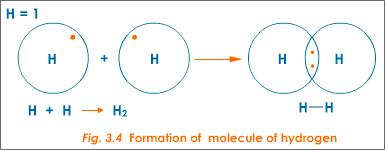
This is ex. of formation of H2 molecule. Since H atom has only one valence electron so two hydrogen atoms combine and form covalent bond by sharing.
2. H2O it has a bent structure. It will dissociates in two ions, one will be positive and other negative. Since oxygen is more electronegative, it will form negative ion and one of the two hydrogen will form positive ion.
H2O  H+ + OH-
this is the equation of dissociation of water.
3. According to Arrhenius concept, Acid is a species which dissociate to give H+ ions, and Base is dissociate to give OH- ions.
So when an acid dissociate, there will be increase of protons and thus it increase acidity of the solution. on the other hand if a base is dissociates, there will be increase of Hydroxide ions, hence it will increase basicity of the solution.
eg. HCl(aq)⟶H+(aq)+Cl−(aq) hence HCl is an acid
NaOH(s) Na+(aq) +
OH-(aq) hence NaOH is an base
Na+(aq) +
OH-(aq) hence NaOH is an base
Add Answer to:
1. explain how atoms can share electrons and form covalent
bonds. 2. explain how water disassociates...
Question 3 1 pts Ionic bonds form due to of electrons between bonded atoms. Covalent bonds...
 Question 3 1 pts Ionic bonds form due to of electrons between bonded atoms. Covalent bonds form due to of electrons between bonded atoms. Question 4 1 pts Polar covalent bonds have a difference in electronegativity between and
20. How do atoms achieve noble-gas electron configurations in single covalent bonds? a. One atom completely...
 20. How do atoms achieve noble-gas electron configurations in single covalent bonds? a. One atom completely loses two electrons to the other atom in the bond. b. Two atoms share two pairs of electrons. C. Two atoms share two electrons. d. Two atoms share one electron 21. Why do atoms share electrons in covalent bonds? a to become ions and attract each other b. to attain a noble-gas electron configuration c. to become more polar d. to increase their atomic...
Covalent and non-covalent bonds. Hydrogen bonds: what type of interaction, which atoms are involved. Covalent bonds,...
Covalent and non-covalent bonds. Hydrogen bonds: what type of interaction, which atoms are involved. Covalent bonds, hydrogen bonds, Van der Waals forces, electrostatic interactions. Polarity of water What is the maximum number of hydrogen bonds that one water molecule can have with neighboring water molecules? Hydrophobic and hydrophilic molecules. Colligative properties of water Osmosis: water flow Isotonic, hypertonic and hypotonic cells: describe Amphipathic molecules. What is the molecular structure of water? Water as a universal solvent Define and describe cohesion...
Covalent bonds form between hydrogen, carbon, and oxygen atoms when valence electrons are shared between the...
Covalent bonds form between hydrogen, carbon, and oxygen atoms when valence electrons are shared between the atoms valence electrons are subsituted between the atoms electrons are attracted to the nucleus protons are shared between the atoms
Determine if each of the statements is true or false. 1) K2SO4 contains both polar covalent bonds and ionic bonds....
 Determine if each of the statements is true or false. 1) K2SO4 contains both polar covalent bonds and ionic bonds. [ Select ] 2) A covalent bond is formed through the transfer of electrons from one atom to another. True 3) When two atoms form a chemical bond, they lower the potential energy between the bonding atoms or ions. (Select]
34) Which type of covalent bond is the strongest? A) double B) all covalent bonds are...
 34) Which type of covalent bond is the strongest? A) double B) all covalent bonds are equal in strength C) single D) triple 34) 35) Halogens ae salt formers and can be found in group A) 17 B) 1 C) 2 35). D) 18 36) Anything that has mass and takes up space is defined as A) properties B) atoms C) molecules D) matter 37) The are A) 92 naturally occurring elements. B) 33 C) 18 D) 1 38) 38)...
Explain why hydrogen atoms can form a covalent bond but helium atoms cannot.
Explain why hydrogen atoms can form a covalent bond but helium atoms cannot.
Molecular compounds consist of: a. atoms of nonmetals bonded together by covalent bonds. b. ions held together...
Molecular compounds consist of: a. atoms of nonmetals bonded together by covalent bonds. b. ions held together by electrostatic forces. c. metal atoms in a crystalline network that share electrons among many atoms. d. both b and c
Question 1 A covalent bond is best described as the sharing of electrons between atoms. the...
Question 1 A covalent bond is best described as the sharing of electrons between atoms. the transfer of electrons. a bond between a metal and a nonmetal. a bond between a metal and a polyatomic ion. a bond between two polyatomic ions. Question 2 Which of the following is a molecular compound? CuCl2 KCl NaNO3 CH3Cl RbBr Question 3 Give the name for H2SO4. sulfuric acid persulfurous acid sulfurous acid hyposulfurous acid persulfuric acid Question 4 What is the molar...
1. Draw the Lewis structure of water showing all valence electrons with lines for covalent bonds...
 1. Draw the Lewis structure of water showing all valence electrons with lines for covalent bonds and dots for unshared electrons. Add a box around each hydrogen- bonding donor site and add a circle around any hydrogen- bonding acceptor sites in your structure. (Hint: there are two of each. The equal number of donors and acceptors is why water hydrogen-bonds so well with other waters.) Draw the Lewis structure of hydrofluoric acid, HF, showing all valence electrons with lines for...
 Question 3 1 pts Ionic bonds form due to of electrons between bonded atoms. Covalent bonds form due to of electrons between bonded atoms. Question 4 1 pts Polar covalent bonds have a difference in electronegativity between and
 20. How do atoms achieve noble-gas electron configurations in single covalent bonds? a. One atom completely loses two electrons to the other atom in the bond. b. Two atoms share two pairs of electrons. C. Two atoms share two electrons. d. Two atoms share one electron 21. Why do atoms share electrons in covalent bonds? a to become ions and attract each other b. to attain a noble-gas electron configuration c. to become more polar d. to increase their atomic...
 Determine if each of the statements is true or false. 1) K2SO4 contains both polar covalent bonds and ionic bonds. [ Select ] 2) A covalent bond is formed through the transfer of electrons from one atom to another. True 3) When two atoms form a chemical bond, they lower the potential energy between the bonding atoms or ions. (Select]
 34) Which type of covalent bond is the strongest? A) double B) all covalent bonds are equal in strength C) single D) triple 34) 35) Halogens ae salt formers and can be found in group A) 17 B) 1 C) 2 35). D) 18 36) Anything that has mass and takes up space is defined as A) properties B) atoms C) molecules D) matter 37) The are A) 92 naturally occurring elements. B) 33 C) 18 D) 1 38) 38)...
 1. Draw the Lewis structure of water showing all valence electrons with lines for covalent bonds and dots for unshared electrons. Add a box around each hydrogen- bonding donor site and add a circle around any hydrogen- bonding acceptor sites in your structure. (Hint: there are two of each. The equal number of donors and acceptors is why water hydrogen-bonds so well with other waters.) Draw the Lewis structure of hydrofluoric acid, HF, showing all valence electrons with lines for...
Most questions answered within 3 hours.
-
Where is the error in this code sequence?
String s1 = "Hello";
String s2 = "ello";...
asked 10 months ago -
Financial data for Joel de Paris, Inc., for last year
follow:
Joel de Paris, Inc.
Balance...
asked 10 months ago -
Consider this reaction:
Al2(SO4)3 (aq)+ BaCl3
(aq) Al2Cl6 (aq)- +
3BaSO4(s) . What is the...
asked 10 months ago -
Suppose that Savneet is considering increasing her
recent random sample from 20 car rentals to 40...
asked 10 months ago -
Trucks arrive at an unloading terminal at an average rate of 120
per hour.
Trucks arrive...
asked 10 months ago -
Why are methanol and ethanol completely soluble in water while
octanol is not very little soluble....
asked 10 months ago -
A facilities manager at a university reads in a research report
that the mean amount of...
asked 10 months ago -
When the CuSO4 is rehydrated by adding water to the anhydrous
compound, is this an endothermic...
asked 10 months ago -
A ray of sunlight is passing from diamond into crown glass; the
angle of incidence is...
asked 10 months ago -
A block of mass 0.249 kg is placed on top of a light, vertical
spring of...
asked 10 months ago -
how do the kidneys compensate in the presences of acidosis
a) trigger hyperventilate
b) reserve acid...
asked 10 months ago -
Question 501 pts
The rental rate of capital to the firm increases. Which of the
following...
asked 10 months ago