lactic acidosis has a pKa of 3.86. At pH 3.60, the % of lattice acid that...
lactic acidosis has a pKa of 3.86. At pH 3.60, the % of lattice acid that remain undissociated is
Homework Answers
Ans.
Given that,
pKa = 3.86
pH = 3.60
Henderson Hasselbalch equation is given by
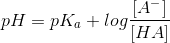
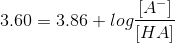
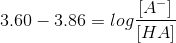
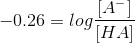
Therefore,
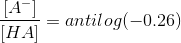

SInce lactic acid is a monoacid, the no. of mol of H+ and that of the conjugate base A- will be the same. So, the concentration of H+ and A- will be the same.
Therefore,
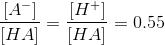
The percentage of dissociated acid is given by
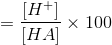

 %
%
So, the percentage of undissociated acid is given by

 %
%
Therefore, the percentage of undissociated lactic acid = 45%
Add Answer to:
lactic acidosis has a pKa of 3.86. At pH 3.60, the % of lattice
acid that...
A. Calculate the pH of a solution containing 0.2M lactic acid (pKa = 3.86) B. Calculate...
A. Calculate the pH of a solution containing 0.2M lactic acid (pKa = 3.86) B. Calculate the pH of a solution of 1x10^-9 M HCl (strong acid) in distilled water. Show your work.
What is the predominant form of pyruvic acid (pKa =2.50) and lactic acid (pKa = 3.86)...
What is the predominant form of pyruvic acid (pKa =2.50) and lactic acid (pKa = 3.86) at physiological pH (7.4)? Draw the predominant structure of each. In which amino acid does the R group bond to the amino group?
Given stocks of 1 M Lactic Acid (pKa 3.86) at pH 3.5, 2 M naOH, 2...
 Given stocks of 1 M Lactic Acid (pKa 3.86) at pH 3.5, 2 M naOH, 2 M HCl and water: how would you prepare 4 liters of 0.05 M Lactic Acid at pH 3.25? Give 2 M Tris, pH 7.1 (pKa 8.0), 5 M NaOH, 5 M HCl, and water: how would you prepare 2 L of 0.2 M Tris, pH 7.4?
A mixture of lactic acid (pKa 3.86) and ascorbic acid (pKa 11.80) are dissolved in an...
A mixture of lactic acid (pKa 3.86) and ascorbic acid (pKa 11.80) are dissolved in an organic solvent. Which acid can be extracted with solutions of NaOH and NaHCO3? Explain. Which base, NaOH or NaHCO3, should be added first. Explain.
Consider a 8×10⁻² M solution of the weak acid lactic acid , for which pKa = 3.86 ....
Consider a 8×10⁻² M solution of the weak acid lactic acid , for which pKa = 3.86 . 1. Calculate the concentration of lactate ions. 2. Calculate the concentration of lactic acid in equilibrium.
A buffer contains 0.020 mol of lactic acid (pKa = 3.86) and 0.100 mol sodium lactate...
A buffer contains 0.020 mol of lactic acid (pKa = 3.86) and 0.100 mol sodium lactate per liter of aqueous solution. a. Calculate the pH of this buffer. b. Calculate the pH after 8.0 mL of 1.00 M NaOH is added to 1 liter of the buffer (assume the total volume will be 1008 mL).
A buffer contains 0.010 mol of lactic acid (pKa = 3.86) and 0.050 mol of sodium...
A buffer contains 0.010 mol of lactic acid (pKa = 3.86) and 0.050 mol of sodium lactate per liter. (a) Calculate the pH of the buffer. (b) Calculate the change in pH when 5.0 mL of 0.50 M HCl is added to 1.0 L of the buffer. (c) What pH change would you expect if you added the same quantity of HCl to 1.0 L of pure water?
If equal volumes of 0.8M sodium lactate and 0.4M lactic acid are mixed, and the pKa...
If equal volumes of 0.8M sodium lactate and 0.4M lactic acid are mixed, and the pKa of lactic acid is 3.86, the final of the solution pH should be
10 ml containing 1.0 mmole of lactic acid solution, CH3CH(OH)COOH, (pKa=3.86) was titrated with NaOH solution...
10 ml containing 1.0 mmole of lactic acid solution, CH3CH(OH)COOH, (pKa=3.86) was titrated with NaOH solution up to a total volume of 100 ml a. what is the concentration of the base solution required for a full neutralization of the lactic acid? b. what is the pH at the equivalent point? c. what will be the pH of the solution obtained after adding 0.2 mmole of NaOH(S) (SOLID!)
What is the pH of a 1.00 L solution containing 0.295 M lactic acid, HC3H5O3 (pKa...
What is the pH of a 1.00 L solution containing 0.295 M lactic acid, HC3H5O3 (pKa = 3.86) and 0.295 M sodium lactate, NaC3H5O3, upon the addition of 0.055 mol HCl? Assume no significant volume change occurs.
 Given stocks of 1 M Lactic Acid (pKa 3.86) at pH 3.5, 2 M naOH, 2 M HCl and water: how would you prepare 4 liters of 0.05 M Lactic Acid at pH 3.25? Give 2 M Tris, pH 7.1 (pKa 8.0), 5 M NaOH, 5 M HCl, and water: how would you prepare 2 L of 0.2 M Tris, pH 7.4?
Most questions answered within 3 hours.
-
Where is the error in this code sequence?
String s1 = "Hello";
String s2 = "ello";...
asked 11 months ago -
Financial data for Joel de Paris, Inc., for last year
follow:
Joel de Paris, Inc.
Balance...
asked 11 months ago -
Consider this reaction:
Al2(SO4)3 (aq)+ BaCl3
(aq) Al2Cl6 (aq)- +
3BaSO4(s) . What is the...
asked 11 months ago -
Suppose that Savneet is considering increasing her
recent random sample from 20 car rentals to 40...
asked 11 months ago -
Trucks arrive at an unloading terminal at an average rate of 120
per hour.
Trucks arrive...
asked 11 months ago -
Why are methanol and ethanol completely soluble in water while
octanol is not very little soluble....
asked 11 months ago -
A facilities manager at a university reads in a research report
that the mean amount of...
asked 11 months ago -
When the CuSO4 is rehydrated by adding water to the anhydrous
compound, is this an endothermic...
asked 11 months ago -
A ray of sunlight is passing from diamond into crown glass; the
angle of incidence is...
asked 11 months ago -
A block of mass 0.249 kg is placed on top of a light, vertical
spring of...
asked 11 months ago -
how do the kidneys compensate in the presences of acidosis
a) trigger hyperventilate
b) reserve acid...
asked 11 months ago -
Question 501 pts
The rental rate of capital to the firm increases. Which of the
following...
asked 11 months ago