For two travelling waves denoted as A sin(kx – աt) and A sin(kx – ᴨ –...
For two travelling waves denoted as A sin(kx – աt) and A sin(kx – ᴨ – աt)
Draw the resultant displacements obtained by combined them.
Y is in meters. X is in seconds.
Homework Answers

Add Answer to:
For two travelling waves denoted as A sin(kx – աt) and
A sin(kx – ᴨ –...
Two traveling sinusoidal waves are described by the wave functions y1 = 4.80 sin [π(4.10x −...
Two traveling sinusoidal waves are described by the wave functions y1 = 4.80 sin [π(4.10x − 1125t)] y2 = 4.80 sin [π(4.10x − 1125t − 0.250)] where x, y1, and y2 are in meters and t is in seconds. (a) What is the amplitude of the resultant wave function y1 + y2?
show the graphical shape of two traveling wave and displacements obtained by combining them..Use the two...
show the graphical shape of two traveling wave and displacements obtained by combining them..Use the two following waves: A sin(2kx − ωt) and A sin(kx + π/2 − ωt).
A cos(kx - wt) and y2 = A cos(kx - wt - 6) represent two waves...
 A cos(kx - wt) and y2 = A cos(kx - wt - 6) represent two waves traveling in the same direction with the same amplitude A, frequency w, and wave number k, but with a phase difference . Here, A = 14.0 m, w = 3.95 s1, and k 15.5 m-1 y, (a) Write the expression for the resultant of the two waves using the numerical values given above for A, w, and k. Do not enter units for the...
7-17 The following two waves in a medium are superposed: A sin(6x 10t) sin(4x 9t) 2= where x is in meters and t in seco...
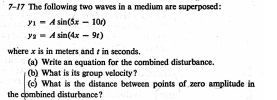 7-17 The following two waves in a medium are superposed: A sin(6x 10t) sin(4x 9t) 2= where x is in meters and t in seconds. (a) Write an equation for the combined disturbance. (b) What is its group velocity ? (c) What is the distance between points of zero amplitude in the combined disturbance?
Two waves are traveling in opposite directions on the same string. The displacements caused by the...
 Two waves are traveling in opposite directions on the same string. The displacements caused by the individual waves are given by yi (27.0 mm)sin(7.35nt 1.95nx) and y2 (34.0 mm)sin(2.88nt+0.488nx). Note that the phase angles (7.35nt 1.95nx) and (2.88nt+0.488nx) are in radians, t is in seconds, and x is in meters. At t = 3.10 s, what is the net displacement (in mm) of the string at (a) x- 2.26 m and (b) x- 2.67 m? Be sure to include the...
Two waves are traveling in opposite directions on the same string. The displacements caused by the...
Two waves are traveling in opposite directions on the same string. The displacements caused by the individiual waves are given by y1=(25.0 mm)sin(8.50πt - 1.24πx) and y2=(38.0 mm)sin(3.43πt + 0.267πx). Note that the phase angles (8.50πt - 1.24πx) and (3.43πt + 0.267πx) are in radians, t is in seconds, and x is in meters. At t = 5.80 s, what is the net displacement (in mm) of the string at (a) x = 2.02 m and (b) x = 2.85...
Two waves are traveling in opposite directions on the same string. The displacements caused by the...
Two waves are traveling in opposite directions on the same string. The displacements caused by the individiual waves are given by y1=(22.0 mm)sin(9.86πt - 1.52πx) and y2=(36.0 mm)sin(2.53πt + 0.330πx). Note that the phase angles (9.86πt - 1.52πx) and (2.53πt + 0.330πx) are in radians, t is in seconds, and x is in meters. At t = 3.20 s, what is the net displacement (in mm) of the string at (a) x = 2.31 m and (b) x = 2.93...
how to solve it ? .47. The form of a sound wave travelling through air is...
 how to solve it ?
.47. The form of a sound wave travelling through air is S(x,t) = S" cos (kx + 3000t +の, where x is in meters and t in seconds. What is the shortest time interval that any air molecule takes along the path to move between displacements SS/ and SSm/3? (Ans: 0.23 ms)
how to solve it ?
.47. The form of a sound wave travelling through air is S(x,t) = S" cos (kx + 3000t +の, where x is in meters and t in seconds. What is the shortest time interval that any air molecule takes along the path to move between displacements SS/ and SSm/3? (Ans: 0.23 ms)
Two sinusoidal waves, identical except for phase, travel in the same direction along a string, producing...
Two sinusoidal waves, identical except for phase, travel in the same direction along a string, producing a net wave y´(x, t) = (3.50 mm) sin(14.0x - 3.50t + 0.840 rad), with x in meters and t in seconds. What are (a) the wavelength λ of the two waves, (b) the phase difference between them, and (c) their amplitude ym?
Two sinusoidal waves, identical except for phase, travel in the same direction along a string, producing...
Two sinusoidal waves, identical except for phase, travel in the same direction along a string, producing the net wave: y(x,t) = (11.4 cm) * sin(3.9*x - 53.6 s-1*t + 0.11 rad); with x in meters and t in seconds. What is the phase difference between them?What is their amplitude? What is their period?
 A cos(kx - wt) and y2 = A cos(kx - wt - 6) represent two waves traveling in the same direction with the same amplitude A, frequency w, and wave number k, but with a phase difference . Here, A = 14.0 m, w = 3.95 s1, and k 15.5 m-1 y, (a) Write the expression for the resultant of the two waves using the numerical values given above for A, w, and k. Do not enter units for the...
 7-17 The following two waves in a medium are superposed: A sin(6x 10t) sin(4x 9t) 2= where x is in meters and t in seconds. (a) Write an equation for the combined disturbance. (b) What is its group velocity ? (c) What is the distance between points of zero amplitude in the combined disturbance?
 Two waves are traveling in opposite directions on the same string. The displacements caused by the individual waves are given by yi (27.0 mm)sin(7.35nt 1.95nx) and y2 (34.0 mm)sin(2.88nt+0.488nx). Note that the phase angles (7.35nt 1.95nx) and (2.88nt+0.488nx) are in radians, t is in seconds, and x is in meters. At t = 3.10 s, what is the net displacement (in mm) of the string at (a) x- 2.26 m and (b) x- 2.67 m? Be sure to include the...
 how to solve it ?
.47. The form of a sound wave travelling through air is S(x,t) = S" cos (kx + 3000t +の, where x is in meters and t in seconds. What is the shortest time interval that any air molecule takes along the path to move between displacements SS/ and SSm/3? (Ans: 0.23 ms)
how to solve it ?
.47. The form of a sound wave travelling through air is S(x,t) = S" cos (kx + 3000t +の, where x is in meters and t in seconds. What is the shortest time interval that any air molecule takes along the path to move between displacements SS/ and SSm/3? (Ans: 0.23 ms)
Most questions answered within 3 hours.
-
Where is the error in this code sequence?
String s1 = "Hello";
String s2 = "ello";...
asked 11 months ago -
Financial data for Joel de Paris, Inc., for last year
follow:
Joel de Paris, Inc.
Balance...
asked 11 months ago -
Consider this reaction:
Al2(SO4)3 (aq)+ BaCl3
(aq) Al2Cl6 (aq)- +
3BaSO4(s) . What is the...
asked 11 months ago -
Suppose that Savneet is considering increasing her
recent random sample from 20 car rentals to 40...
asked 11 months ago -
Trucks arrive at an unloading terminal at an average rate of 120
per hour.
Trucks arrive...
asked 11 months ago -
Why are methanol and ethanol completely soluble in water while
octanol is not very little soluble....
asked 11 months ago -
A facilities manager at a university reads in a research report
that the mean amount of...
asked 11 months ago -
When the CuSO4 is rehydrated by adding water to the anhydrous
compound, is this an endothermic...
asked 11 months ago -
A ray of sunlight is passing from diamond into crown glass; the
angle of incidence is...
asked 11 months ago -
A block of mass 0.249 kg is placed on top of a light, vertical
spring of...
asked 11 months ago -
how do the kidneys compensate in the presences of acidosis
a) trigger hyperventilate
b) reserve acid...
asked 11 months ago -
Question 501 pts
The rental rate of capital to the firm increases. Which of the
following...
asked 11 months ago