What kinematic equation is t=2*u/g derived from and can you explain it please..
What kinematic equation is t=2*u/g derived from and can you explain it please..
Homework Answers

Add Answer to:
What kinematic equation is t=2*u/g derived from and can you
explain it please..
Kinematic equation 1: Vi=V; + gt Kinematic equation 2: Y=V;.t + 12 gt? Kinematic equation 3:...
 Kinematic equation 1: Vi=V; + gt Kinematic equation 2: Y=V;.t + 12 gt? Kinematic equation 3: 2aY=V7-V21 22. A stone is thrown in a vertically upward direction with a velocity of Vi= 5 m/s. If the acceleration(g) of the stone during its motion is 10 m/s2 in the downward direction, A) what will be the height (Y) attained by the stone? B) how much time (t) will it take to reach there? Take g=-10 m/s2. [2] - [Hint: stone thrown...
Please explain in slow steps how MRS can be derived directly from the definition. I am...
 Please explain in slow steps how MRS can be derived directly
from the definition. I am not too strong on this topic and I am
confused what to do. Ignore class formulas thank you!
6) For each of the following utility functions derive directly from the definition not using the formula(s) from class or the tert - the MRS (marginal rate of substitution) of y for r at (2,4) (a) ua(z, y)= 1/2y1/2 (b) uo(x, y) 2y/2 (b) u(r, y)4y4...
Please explain in slow steps how MRS can be derived directly
from the definition. I am not too strong on this topic and I am
confused what to do. Ignore class formulas thank you!
6) For each of the following utility functions derive directly from the definition not using the formula(s) from class or the tert - the MRS (marginal rate of substitution) of y for r at (2,4) (a) ua(z, y)= 1/2y1/2 (b) uo(x, y) 2y/2 (b) u(r, y)4y4...
Please use kinematic equation t cases Make sure to show all work in complete detail, NO...
 Please use kinematic equation
t cases Make sure to show all work in complete detail, NO CREDIT will be given if no work is 1. A ball rolls off a table and falls 1.0 m to the floor, landing with a speed of 5.0 m/s. a) What was the initial speed of the ball when it rolls off the table? shown!l (10 pts) b) Calculate how far away from the base of the table does the ball hit the floor...
Please use kinematic equation
t cases Make sure to show all work in complete detail, NO CREDIT will be given if no work is 1. A ball rolls off a table and falls 1.0 m to the floor, landing with a speed of 5.0 m/s. a) What was the initial speed of the ball when it rolls off the table? shown!l (10 pts) b) Calculate how far away from the base of the table does the ball hit the floor...
Please explain in slow steps how MRS can be derived using definition of MRS from the...
 Please explain in slow steps how MRS can be derived using
definition of MRS from the ratio of partial derivatives. No
specific information is needed about class formulas.
6) For each of the following utility functions derive directly from the definition not using the formula(s) from class or the tert - the MRS (marginal rate of substitution) of y for r at (2,4) (a) ua(z, y)= 1/2y1/2 (b) uo(x, y) 2y/2 (b) u(r, y)4y4 (d) udr,y)-1/ 1/y
Please explain in slow steps how MRS can be derived using
definition of MRS from the ratio of partial derivatives. No
specific information is needed about class formulas.
6) For each of the following utility functions derive directly from the definition not using the formula(s) from class or the tert - the MRS (marginal rate of substitution) of y for r at (2,4) (a) ua(z, y)= 1/2y1/2 (b) uo(x, y) 2y/2 (b) u(r, y)4y4 (d) udr,y)-1/ 1/y
can u solve it asap please with explain 14. Write an equation of the line with...
 can u solve it asap please with explain
14. Write an equation of the line with slope -2 and passes through the point (5.-7).
can u solve it asap please with explain
14. Write an equation of the line with slope -2 and passes through the point (5.-7).
when u answer can u please write clear and explain in detail. thank you 2. Natural...
 when u answer can u please write clear and explain in detail.
thank you
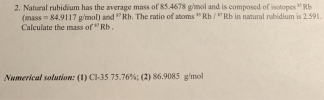
2. Natural rubidium has the average mass of 85.4678 g/mol and is composed of isotopes Rb (mass = 84.9117 g/mol) and 7 Rb. The ratio of atoms *S Rb/87 Rb in natural rubidium is 2.591. Calculate the mass of Rb. Numerical solution: (1) C1-35 75.76%; (2) 86.9085 g/mol
when u answer can u please write clear and explain in detail.
thank you
2. Natural rubidium has the average mass of 85.4678 g/mol and is composed of isotopes Rb (mass = 84.9117 g/mol) and 7 Rb. The ratio of atoms *S Rb/87 Rb in natural rubidium is 2.591. Calculate the mass of Rb. Numerical solution: (1) C1-35 75.76%; (2) 86.9085 g/mol
Can anyone help to answer this question(from Modern Physics)? Pls explain every derived equation, thanks! A...
Can anyone help to answer this question(from Modern Physics)? Pls explain every derived equation, thanks! A photon has an initial wavelength of 2 nm and collides head-on with an electron, which is initially at rest. Following the collision, both the photon and electron move forward exactly along the x-axis. If the photon has a final wavelength of 8 nm, what is the electron’s final momentum in units of keV/c ?
Show that equation 2 (denoted as ... (2) below) can be derived from equation 1 (denoted...
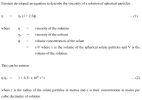 Show that equation 2 (denoted as ... (2) below) can be
derived from equation 1 (denoted with ... (1) below). Show full
steps of derivations.
Einstein developed an equation to describe the viscosity of a solution of spherical particles Πο (1 + 2.54) η wheren nviscosity of the solution viscosity of the solvent Πο 0p-volume concentration of the solute v/V where v is the volume of the spherical solute particles and V is the volume of the solution. This can...
Show that equation 2 (denoted as ... (2) below) can be
derived from equation 1 (denoted with ... (1) below). Show full
steps of derivations.
Einstein developed an equation to describe the viscosity of a solution of spherical particles Πο (1 + 2.54) η wheren nviscosity of the solution viscosity of the solvent Πο 0p-volume concentration of the solute v/V where v is the volume of the spherical solute particles and V is the volume of the solution. This can...
The internal energy of an ideal gas can be derived using statistical mechanics as U=U(S,V)=αNkB(N/V)2/3 e2S/3NkB...
The internal energy of an ideal gas can be derived using statistical mechanics as U=U(S,V)=αNkB(N/V)2/3 e2S/3NkB where α is a constant. Show that this expression leads to the equation of state for an ideal gas pV = NkBT. (What is dU?)
So the time domain for this is v(t) = (1-cos(10pi))[u(t) - u(t-0.1)] + 2[u(t-0.1) - u(t-0.15)] + ...
 So the time domain for this is
v(t) = (1-cos(10pi))[u(t) - u(t-0.1)] + 2[u(t-0.1) - u(t-0.15)] +
(-40t+0.2)[u(t-0.15) - u(t-0.25)] + (-2)[u(t-0.25)-u(t-0.3)] +
(2e^(-5(t-0.3)))[u(t-0.3)]
but the equation was reduced before converting into S-domain and
it was reduced to :
v(t) = (-cos(10pi))u(t) + u(t) + cos(10pi)u(t-0.1) + u(t-0.1) -
40(t-0.1))u(t-0.15) + 40(t-0.25)u(t-0.25) + 2u(t-0.3) +
2e^(-5(t-0.3))u(t-0.3)
How do you adjust the time delay? Not sure if I understand how
it was done, if you can show and explain step by...
So the time domain for this is
v(t) = (1-cos(10pi))[u(t) - u(t-0.1)] + 2[u(t-0.1) - u(t-0.15)] +
(-40t+0.2)[u(t-0.15) - u(t-0.25)] + (-2)[u(t-0.25)-u(t-0.3)] +
(2e^(-5(t-0.3)))[u(t-0.3)]
but the equation was reduced before converting into S-domain and
it was reduced to :
v(t) = (-cos(10pi))u(t) + u(t) + cos(10pi)u(t-0.1) + u(t-0.1) -
40(t-0.1))u(t-0.15) + 40(t-0.25)u(t-0.25) + 2u(t-0.3) +
2e^(-5(t-0.3))u(t-0.3)
How do you adjust the time delay? Not sure if I understand how
it was done, if you can show and explain step by...
 Kinematic equation 1: Vi=V; + gt Kinematic equation 2: Y=V;.t + 12 gt? Kinematic equation 3: 2aY=V7-V21 22. A stone is thrown in a vertically upward direction with a velocity of Vi= 5 m/s. If the acceleration(g) of the stone during its motion is 10 m/s2 in the downward direction, A) what will be the height (Y) attained by the stone? B) how much time (t) will it take to reach there? Take g=-10 m/s2. [2] - [Hint: stone thrown...
 Please explain in slow steps how MRS can be derived directly
from the definition. I am not too strong on this topic and I am
confused what to do. Ignore class formulas thank you!
6) For each of the following utility functions derive directly from the definition not using the formula(s) from class or the tert - the MRS (marginal rate of substitution) of y for r at (2,4) (a) ua(z, y)= 1/2y1/2 (b) uo(x, y) 2y/2 (b) u(r, y)4y4...
Please explain in slow steps how MRS can be derived directly
from the definition. I am not too strong on this topic and I am
confused what to do. Ignore class formulas thank you!
6) For each of the following utility functions derive directly from the definition not using the formula(s) from class or the tert - the MRS (marginal rate of substitution) of y for r at (2,4) (a) ua(z, y)= 1/2y1/2 (b) uo(x, y) 2y/2 (b) u(r, y)4y4...
 Please use kinematic equation
t cases Make sure to show all work in complete detail, NO CREDIT will be given if no work is 1. A ball rolls off a table and falls 1.0 m to the floor, landing with a speed of 5.0 m/s. a) What was the initial speed of the ball when it rolls off the table? shown!l (10 pts) b) Calculate how far away from the base of the table does the ball hit the floor...
Please use kinematic equation
t cases Make sure to show all work in complete detail, NO CREDIT will be given if no work is 1. A ball rolls off a table and falls 1.0 m to the floor, landing with a speed of 5.0 m/s. a) What was the initial speed of the ball when it rolls off the table? shown!l (10 pts) b) Calculate how far away from the base of the table does the ball hit the floor...
 Please explain in slow steps how MRS can be derived using
definition of MRS from the ratio of partial derivatives. No
specific information is needed about class formulas.
6) For each of the following utility functions derive directly from the definition not using the formula(s) from class or the tert - the MRS (marginal rate of substitution) of y for r at (2,4) (a) ua(z, y)= 1/2y1/2 (b) uo(x, y) 2y/2 (b) u(r, y)4y4 (d) udr,y)-1/ 1/y
Please explain in slow steps how MRS can be derived using
definition of MRS from the ratio of partial derivatives. No
specific information is needed about class formulas.
6) For each of the following utility functions derive directly from the definition not using the formula(s) from class or the tert - the MRS (marginal rate of substitution) of y for r at (2,4) (a) ua(z, y)= 1/2y1/2 (b) uo(x, y) 2y/2 (b) u(r, y)4y4 (d) udr,y)-1/ 1/y
 can u solve it asap please with explain
14. Write an equation of the line with slope -2 and passes through the point (5.-7).
can u solve it asap please with explain
14. Write an equation of the line with slope -2 and passes through the point (5.-7).
 when u answer can u please write clear and explain in detail.
thank you
2. Natural rubidium has the average mass of 85.4678 g/mol and is composed of isotopes Rb (mass = 84.9117 g/mol) and 7 Rb. The ratio of atoms *S Rb/87 Rb in natural rubidium is 2.591. Calculate the mass of Rb. Numerical solution: (1) C1-35 75.76%; (2) 86.9085 g/mol
when u answer can u please write clear and explain in detail.
thank you
2. Natural rubidium has the average mass of 85.4678 g/mol and is composed of isotopes Rb (mass = 84.9117 g/mol) and 7 Rb. The ratio of atoms *S Rb/87 Rb in natural rubidium is 2.591. Calculate the mass of Rb. Numerical solution: (1) C1-35 75.76%; (2) 86.9085 g/mol
 Show that equation 2 (denoted as ... (2) below) can be
derived from equation 1 (denoted with ... (1) below). Show full
steps of derivations.
Einstein developed an equation to describe the viscosity of a solution of spherical particles Πο (1 + 2.54) η wheren nviscosity of the solution viscosity of the solvent Πο 0p-volume concentration of the solute v/V where v is the volume of the spherical solute particles and V is the volume of the solution. This can...
Show that equation 2 (denoted as ... (2) below) can be
derived from equation 1 (denoted with ... (1) below). Show full
steps of derivations.
Einstein developed an equation to describe the viscosity of a solution of spherical particles Πο (1 + 2.54) η wheren nviscosity of the solution viscosity of the solvent Πο 0p-volume concentration of the solute v/V where v is the volume of the spherical solute particles and V is the volume of the solution. This can...
 So the time domain for this is
v(t) = (1-cos(10pi))[u(t) - u(t-0.1)] + 2[u(t-0.1) - u(t-0.15)] +
(-40t+0.2)[u(t-0.15) - u(t-0.25)] + (-2)[u(t-0.25)-u(t-0.3)] +
(2e^(-5(t-0.3)))[u(t-0.3)]
but the equation was reduced before converting into S-domain and
it was reduced to :
v(t) = (-cos(10pi))u(t) + u(t) + cos(10pi)u(t-0.1) + u(t-0.1) -
40(t-0.1))u(t-0.15) + 40(t-0.25)u(t-0.25) + 2u(t-0.3) +
2e^(-5(t-0.3))u(t-0.3)
How do you adjust the time delay? Not sure if I understand how
it was done, if you can show and explain step by...
So the time domain for this is
v(t) = (1-cos(10pi))[u(t) - u(t-0.1)] + 2[u(t-0.1) - u(t-0.15)] +
(-40t+0.2)[u(t-0.15) - u(t-0.25)] + (-2)[u(t-0.25)-u(t-0.3)] +
(2e^(-5(t-0.3)))[u(t-0.3)]
but the equation was reduced before converting into S-domain and
it was reduced to :
v(t) = (-cos(10pi))u(t) + u(t) + cos(10pi)u(t-0.1) + u(t-0.1) -
40(t-0.1))u(t-0.15) + 40(t-0.25)u(t-0.25) + 2u(t-0.3) +
2e^(-5(t-0.3))u(t-0.3)
How do you adjust the time delay? Not sure if I understand how
it was done, if you can show and explain step by...
Most questions answered within 3 hours.
-
Where is the error in this code sequence?
String s1 = "Hello";
String s2 = "ello";...
asked 10 months ago -
Financial data for Joel de Paris, Inc., for last year
follow:
Joel de Paris, Inc.
Balance...
asked 10 months ago -
Consider this reaction:
Al2(SO4)3 (aq)+ BaCl3
(aq) Al2Cl6 (aq)- +
3BaSO4(s) . What is the...
asked 10 months ago -
Suppose that Savneet is considering increasing her
recent random sample from 20 car rentals to 40...
asked 10 months ago -
Trucks arrive at an unloading terminal at an average rate of 120
per hour.
Trucks arrive...
asked 10 months ago -
Why are methanol and ethanol completely soluble in water while
octanol is not very little soluble....
asked 10 months ago -
A facilities manager at a university reads in a research report
that the mean amount of...
asked 10 months ago -
When the CuSO4 is rehydrated by adding water to the anhydrous
compound, is this an endothermic...
asked 10 months ago -
A ray of sunlight is passing from diamond into crown glass; the
angle of incidence is...
asked 10 months ago -
A block of mass 0.249 kg is placed on top of a light, vertical
spring of...
asked 10 months ago -
how do the kidneys compensate in the presences of acidosis
a) trigger hyperventilate
b) reserve acid...
asked 10 months ago -
Question 501 pts
The rental rate of capital to the firm increases. Which of the
following...
asked 10 months ago