a) A super ball of mass 0.05kg is dropped from a height of 10 cm above...
a) A super ball of mass 0.05kg is dropped from a height of 10 cm above a table top. It bounces off the table and rises to the same height. Sketch the shape of the force exerted on the ball by the table as a function of time. (time vs force). If the superball was in contact with the table for 30 ms, what is the average force exerted on the ball by the table?
b) The superball is replaced with a clay ball of the same size and mass. The ball is released from the same height and sticks to the table. Again, sketch the shape of the force exerted on the ball by the table as a function of time.
c) Calculate the impulse exerted on the clay ball and on the superball and compare the two. Which is larger, or are they both the same? Explain
d) If the collision of the clay ball with the table takes the same time as the collision of the superball, compare the average force exerted by the table on the clay ball to that exerted on the superball. Which is larger or are they the same?
e) Suppose that the clay has twice the mass and is dropped from the same height. Compare the impulse exerted on the ball by the table to that with the smaller clay ball.
f. Suppose that the original clay ball is dropped from twice the height. Compare the impulse exerted on the ball by the table to that for the smaller height.
Homework Answers

Add Answer to:
a) A super ball of mass 0.05kg is dropped from a height of 10 cm
above...
A superball and a clay ball are droped from a height of 10cm above a table...
A superball and a clay ball are droped from a height of 10cm above a table top. They have the same mass 0.05kg and the same size. The superball bounces off the table and rises back to the same height. The clay ball sticks to the table. Match the shapes of the forces exerted on the superball and the clay ball by the table as a function of time. For the superball in the previous question, if it was in...
A superball and a clay ball are droped from a height of 10cm above a table...
A superball and a clay ball are droped from a height of 10cm above a table top. They have the same mass 0.05kg and the same size. The superball bounces off the table and rises back to the same height. The clay ball sticks to the table. Match the shapes of the forces exerted on the superball and the clay ball by the table as a function of time. For the superball in the previous question, if it was in...
L10.7 A 0.250-kg lump of clay is dropped from a height of 1.45 m onto the...
 L10.7
A 0.250-kg lump of clay is dropped from a height of 1.45 m onto the floor. It sticks to the floor and does not bounce. What is the magnitude of the impulse J imparted to the clay by the floor during the impact? The force exerted by the floor on the clay is plotted as a function of time in the figure to the right. What must have been the maximum force F-max exerted by the floor on the...
L10.7
A 0.250-kg lump of clay is dropped from a height of 1.45 m onto the floor. It sticks to the floor and does not bounce. What is the magnitude of the impulse J imparted to the clay by the floor during the impact? The force exerted by the floor on the clay is plotted as a function of time in the figure to the right. What must have been the maximum force F-max exerted by the floor on the...
A 0.150 kg lump of clay is dropped from a height of 115 m onto the...
 A 0.150 kg lump of clay is dropped from a height of 115 m onto the floor. It sticks to the floor and does not bounce. What is the magnitude of the impulse J imparted to the clay by the floor during the impact? Assume that the acceleration due to gravity is g = 9.81 m/s? Force (N) JE kg. m/s The force exerted by the floor on the clay is plotted as a function of time in the figure....
ay sticks to the wall. The tennis ball bounces of of the wall Sul C) The...
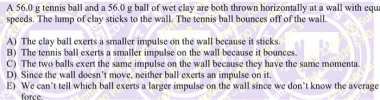 ay sticks to the wall. The tennis ball bounces of of the wall Sul C) The two balls exert the same impulse on the wall because they have the same mon 2230 A 56.0 g tennis ball and a 56.0 g ball of wet clay are both thrown horizontally at a wall with equa speeds. The lump of clay A) The clay ball exerts a smaller impulse on the wall because it sticks. B) The tennis ball exerts a smaller...
A 0.250 kg lump of clay is dropped from a height of 1.75 m onto the...
 A 0.250 kg lump of clay is dropped from a height of 1.75 m onto the floor. It sticks to the floor and does not bounce F mar What is the magnitude of the impulse J imparted to the clay by the floor during the impact? Assume that the acceleration due to gravity is g = 9.81 m/s? Force (N) JE kg. m/s The force exerted by the floor on the clay is plotted as a function of time in...
A 0.250 kg lump of clay is dropped from a height of 1.15 m onto the...
 A 0.250 kg lump of clay is dropped from a height of 1.15 m onto the floor. It sticks to the floor and does not bounce. F What is the magnitude of the impulse J imparted to the clay by the floor during the impact? Assume that the acceleration due to gravity is g = 9.81 m/s2. Force (N) J = 1.19 kg. m/s The force exerted by the floor on the clay is plotted as a function of time...
A 0.350 kg lump of clay is dropped from a height of 1.15 m onto the floor. It sticks to the floor and does not bounce.
 A 0.350 kg lump of clay is dropped from a height of 1.15 m onto the floor. It sticks to the floor and does not bounce. What is the magnitude of the impulse J imparted to the clay by the floor during the impact? Assume that the acceleration due to gravity is g = 9.81 m/s?. The force exerted by the floor on the clay is plotted as a function of time in the figure. What must have been the maximum force...
A ball with mass of 0.050 kg is dropped from a height of 2.0 m. It...
A ball with mass of 0.050 kg is dropped from a height of 2.0 m. It collides with the floor, then sticks to the table. The Collison takes 0.020 s. a) Use the conservation of mechanical energy (Ei = Ef) to calculate the velocity of the ball before collision with the floor
A 0.350-kg lump of clay is dropped from a height of 1.45 m onto the floor....
 A 0.350-kg lump of clay is dropped from a height of 1.45 m onto the floor. It sticks to the floor and does not bounce. What is the magnitude of the impulse J imparted to the clay by the floor during the impact? y no h hnolkelo J1.87 kg m/s The force exerted by the floor on the clay is plotted as a function of time in the figure to the right. What must have been the maximum force Fmax...
 L10.7
A 0.250-kg lump of clay is dropped from a height of 1.45 m onto the floor. It sticks to the floor and does not bounce. What is the magnitude of the impulse J imparted to the clay by the floor during the impact? The force exerted by the floor on the clay is plotted as a function of time in the figure to the right. What must have been the maximum force F-max exerted by the floor on the...
L10.7
A 0.250-kg lump of clay is dropped from a height of 1.45 m onto the floor. It sticks to the floor and does not bounce. What is the magnitude of the impulse J imparted to the clay by the floor during the impact? The force exerted by the floor on the clay is plotted as a function of time in the figure to the right. What must have been the maximum force F-max exerted by the floor on the...
 A 0.150 kg lump of clay is dropped from a height of 115 m onto the floor. It sticks to the floor and does not bounce. What is the magnitude of the impulse J imparted to the clay by the floor during the impact? Assume that the acceleration due to gravity is g = 9.81 m/s? Force (N) JE kg. m/s The force exerted by the floor on the clay is plotted as a function of time in the figure....
 ay sticks to the wall. The tennis ball bounces of of the wall Sul C) The two balls exert the same impulse on the wall because they have the same mon 2230 A 56.0 g tennis ball and a 56.0 g ball of wet clay are both thrown horizontally at a wall with equa speeds. The lump of clay A) The clay ball exerts a smaller impulse on the wall because it sticks. B) The tennis ball exerts a smaller...
 A 0.250 kg lump of clay is dropped from a height of 1.75 m onto the floor. It sticks to the floor and does not bounce F mar What is the magnitude of the impulse J imparted to the clay by the floor during the impact? Assume that the acceleration due to gravity is g = 9.81 m/s? Force (N) JE kg. m/s The force exerted by the floor on the clay is plotted as a function of time in...
 A 0.250 kg lump of clay is dropped from a height of 1.15 m onto the floor. It sticks to the floor and does not bounce. F What is the magnitude of the impulse J imparted to the clay by the floor during the impact? Assume that the acceleration due to gravity is g = 9.81 m/s2. Force (N) J = 1.19 kg. m/s The force exerted by the floor on the clay is plotted as a function of time...
 A 0.350-kg lump of clay is dropped from a height of 1.45 m onto the floor. It sticks to the floor and does not bounce. What is the magnitude of the impulse J imparted to the clay by the floor during the impact? y no h hnolkelo J1.87 kg m/s The force exerted by the floor on the clay is plotted as a function of time in the figure to the right. What must have been the maximum force Fmax...
Most questions answered within 3 hours.
-
Where is the error in this code sequence?
String s1 = "Hello";
String s2 = "ello";...
asked 11 months ago -
Financial data for Joel de Paris, Inc., for last year
follow:
Joel de Paris, Inc.
Balance...
asked 11 months ago -
Consider this reaction:
Al2(SO4)3 (aq)+ BaCl3
(aq) Al2Cl6 (aq)- +
3BaSO4(s) . What is the...
asked 11 months ago -
Suppose that Savneet is considering increasing her
recent random sample from 20 car rentals to 40...
asked 11 months ago -
Trucks arrive at an unloading terminal at an average rate of 120
per hour.
Trucks arrive...
asked 11 months ago -
Why are methanol and ethanol completely soluble in water while
octanol is not very little soluble....
asked 11 months ago -
A facilities manager at a university reads in a research report
that the mean amount of...
asked 11 months ago -
When the CuSO4 is rehydrated by adding water to the anhydrous
compound, is this an endothermic...
asked 11 months ago -
A ray of sunlight is passing from diamond into crown glass; the
angle of incidence is...
asked 11 months ago -
A block of mass 0.249 kg is placed on top of a light, vertical
spring of...
asked 11 months ago -
how do the kidneys compensate in the presences of acidosis
a) trigger hyperventilate
b) reserve acid...
asked 11 months ago -
Question 501 pts
The rental rate of capital to the firm increases. Which of the
following...
asked 11 months ago