Full Mechanism of Tollen's Test with the following compounds: 1. Heptaldehyde (heptanal) 2. Acetone (dimethyl ketone)...
Full Mechanism of Tollen's Test with the following compounds:
1. Heptaldehyde (heptanal)
2. Acetone (dimethyl ketone)
3. Benzaldehyde
4. Ethyl acetate
5. Benzoic acid
Homework Answers
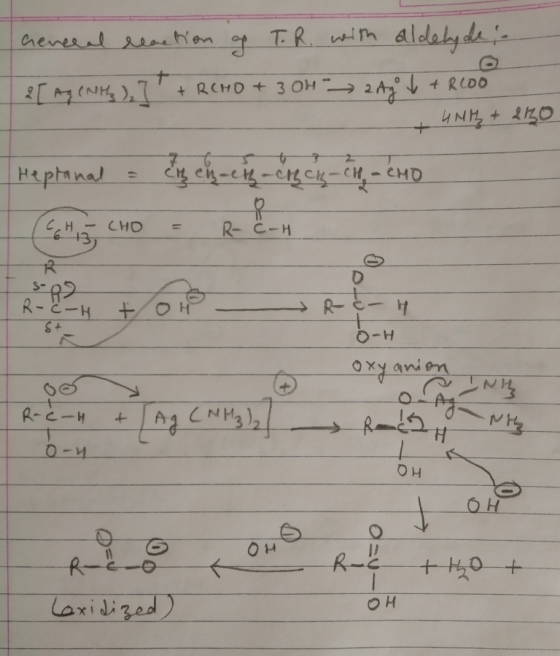
Tollen's reagent is mild oxidizing agent, it oxidizes aldehydes, terminal alkykne, alpha-hydroxy ketone because hydrogen is active easily replace and oxidizes even with mild ox. agent.
But ketones do not oxidize by mildox. agent due to low reactivity =, 2 alkyl groups are attached (+I effect).
ester and benzoic acid do not give this test.
1. Heptanal oxidizes to its acid.
Acetone does not react with this.
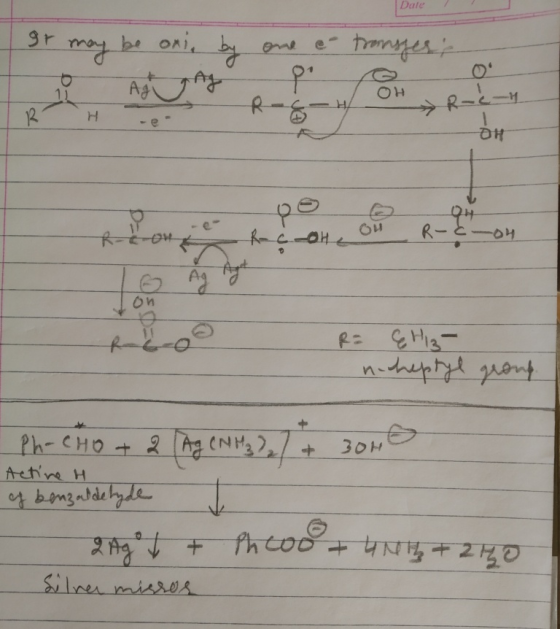
3. Benzaldehyde also oxidizes to benzoic acid.
4. ethyl acetate do not give this test.
5. benzoic acid do not give this test.
Aldehyde treats with T.R., forms silver mirror means silver ion is reduced to silver precipitate (Grey-silver)
same mechanism occurs for heptanal and benzaldehyde, redox reaction both oxidizes and T.R. will be reduced.
Here R= -C6H13 for heptanal
R= -C6H5 phenyl for benzaldehyde
Add Answer to:
Full Mechanism of Tollen's Test with the following
compounds:
1. Heptaldehyde (heptanal)
2. Acetone (dimethyl ketone)...
Test Performed Observations Conclusion for Particular Test: Aldehyde/Ketone/Inconclusive (1 pt) Shiff's reagent (1 pt) Tollen's reagent...
 Test Performed Observations Conclusion for Particular Test: Aldehyde/Ketone/Inconclusive (1 pt) Shiff's reagent (1 pt) Tollen's reagent appearance of a dark pink color in solution formation of a silver/grey precipitate formation of a red precipitate fcmation of a bright orange / red precipitate Fehling reagent (1 pt) 2,4-DNP (3 pt) Melting point range of 232 - 235°C 2,4-DNP derivative ID of unknown: pts) 24. Based on the observations / results given in the table below, and by consulting Table 1 on...
Question 1 Not yet answered Points out of 3.00 Consider two compounds shown below. For each compo...
 Answer all questions please. Not due until April 3rd.
--------------------------------------------------------------------------------
Question 1 Not yet answered Points out of 3.00 Consider two compounds shown below. For each compound identify which group is the most acidic, the least acidic, or has mid acidity value (pKa value) он он 1 HO 0H3 Flag question NH3 OH 2 group 1 Choose... group 2 Choose group 3 Chse... group I group IIChoose group III Choose... Choose. Question 2 Not yet answered Points out of 3.00...
Answer all questions please. Not due until April 3rd.
--------------------------------------------------------------------------------
Question 1 Not yet answered Points out of 3.00 Consider two compounds shown below. For each compound identify which group is the most acidic, the least acidic, or has mid acidity value (pKa value) он он 1 HO 0H3 Flag question NH3 OH 2 group 1 Choose... group 2 Choose group 3 Chse... group I group IIChoose group III Choose... Choose. Question 2 Not yet answered Points out of 3.00...
QUESTION 1 Which of the following compounds is an ester? a. Acetone Ob.Ethyl acetate C. Benzoic...
 QUESTION 1 Which of the following compounds is an ester? a. Acetone Ob.Ethyl acetate C. Benzoic acid O d Diethyl ether QUESTION 2 Click Save ad Submit to save and submit Cliek Save 4ll Answe on of O to search
3. Tollen's Test Result + or- Functional Group Compound Observations/Conclusions acetone propanal unknown 4. Lucas Test...
 3. Tollen's Test Result + or- Functional Group Compound Observations/Conclusions acetone propanal unknown 4. Lucas Test Functional Group Alcohol Result Compound Observations Conclusions 1-butanol 2-butanol 2-methyl-2-propanol unknown 5. Iodoform Test Result +or-) Active Methyl? Compound Observations/Conclusions 2-pentanone 3-pentanone 1-butanol 2-butanol unknown
Aldehydes and Ketones C. Solubility, lodoform Test, and Benedict's Test 1. Soluble? 2. Iodoform 3. Methyl...
 Aldehydes and Ketones C. Solubility, lodoform Test, and Benedict's Test 1. Soluble? 2. Iodoform 3. Methyl 4. Color Test Ketone? Propanol S.Oxidation (yesno) Benzaldehyde Acetone Cyclohexanone Unknown 6. Identify the unknown as propanal, benzaldehyde, acetone, or cyclohexanone. Give your reasoning. Questions and Problems 01 Indicate the test results for each of the following compounds in the iodoform test and in the Benedict's test: Idoform Test Benedict's Test CHỊ C-CH, CHỊ CH, - - CH-CH2-C-CH2-CH CHỊ C-CH-CH
Oxidation Tests Compound Jones Todoform Butanal Greon cloudy (-) White Benzaldehyde SLIGHTLY yellow White precipitate Acetone...
 Oxidation Tests Compound Jones Todoform Butanal Greon cloudy (-) White Benzaldehyde SLIGHTLY yellow White precipitate Acetone NO CHanse yellow (+) 2-butanone (methyl ethyl ketone) NO Change yellow (+) Cyclohexanone Dark yellow clear (-) Questions 2. For the Jones test did any compounds tested not react as expected? Explain. 3. For the lodoform test did any compounds tested not react as expected? Explain.
276 Laborary Awwal w Generator and logical Chemistry C. Solubility, lodoform Test, and Benedict's Test 1....
 276 Laborary Awwal w Generator and logical Chemistry C. Solubility, lodoform Test, and Benedict's Test 1. Soluble? 2. lodoform 3. Methyl 4. Color Test Ketone? Propanol 5. Oxidation? (yes/no) Benzaldehyde Acetone Cyclohexanone Unknown 6. Identify the unknown as propanal, benzaldehyde, acetone, or cyclohexanone. Give your reasoning. Questions and Problems Q1 Indicate the test results for each of the following compounds in the iodoform test and in the Benedict's test: Idoform Test Benedict's Test - CH₂ - CHI CH, --C-CH2 o...
Answer the following questions using these molecules: diethyl ether, chloroacetone, methyl ethyl ketone, xylene, 2-butene, 2,2-dimethyl...
Answer the following questions using these molecules: diethyl ether, chloroacetone, methyl ethyl ketone, xylene, 2-butene, 2,2-dimethyl propane, acetic acid a) Which compounds would show only singlets in the proton spectrum, in the region of chemical shift less than/equal to 6? b) Which methyl group among all the compounds will give a proton signal at highest field? c) Which compound(s) will give a proton shift at lowest field? d) Which compound(s) will give a carbon signal at lowest field? e) Which...
only question # 2 a. using anhydrous ether b. not rinsing glassware with acetone before the...
 only question # 2
a. using anhydrous ether b. not rinsing glassware with acetone before the experiment c. using magnesium filings instead of "chunk" magnesium d. initiating the reaction in a test tube e. using an ammonium chloride/hydrochloric acid mixture to acidity the reaction mixture instead of using concentrated sulfuric acid. 2. Give the products of the reaction of methylmagnesium chloride with a. acetaldehyde me mac b. acetone c. ethyl acetate (1 equivalent per Grignard) d. ethyl acetate (2 equivalents...
only question # 2
a. using anhydrous ether b. not rinsing glassware with acetone before the experiment c. using magnesium filings instead of "chunk" magnesium d. initiating the reaction in a test tube e. using an ammonium chloride/hydrochloric acid mixture to acidity the reaction mixture instead of using concentrated sulfuric acid. 2. Give the products of the reaction of methylmagnesium chloride with a. acetaldehyde me mac b. acetone c. ethyl acetate (1 equivalent per Grignard) d. ethyl acetate (2 equivalents...
What is the decreasing reactivity order of the following compounds A) Acetone B) Ethanal C) 2,2-dimethyl-2-butanone...
 What is the decreasing reactivity order of the following compounds A) Acetone B) Ethanal C) 2,2-dimethyl-2-butanone D) 2,2,4-trimethyl-3-petanone E) 2-methylpropanal O B, E, A, C, D O E, B, C, A, D O D, C, A, E,B O E, B,A,C,D OD,A,C,BE
 Test Performed Observations Conclusion for Particular Test: Aldehyde/Ketone/Inconclusive (1 pt) Shiff's reagent (1 pt) Tollen's reagent appearance of a dark pink color in solution formation of a silver/grey precipitate formation of a red precipitate fcmation of a bright orange / red precipitate Fehling reagent (1 pt) 2,4-DNP (3 pt) Melting point range of 232 - 235°C 2,4-DNP derivative ID of unknown: pts) 24. Based on the observations / results given in the table below, and by consulting Table 1 on...
 Answer all questions please. Not due until April 3rd.
--------------------------------------------------------------------------------
Question 1 Not yet answered Points out of 3.00 Consider two compounds shown below. For each compound identify which group is the most acidic, the least acidic, or has mid acidity value (pKa value) он он 1 HO 0H3 Flag question NH3 OH 2 group 1 Choose... group 2 Choose group 3 Chse... group I group IIChoose group III Choose... Choose. Question 2 Not yet answered Points out of 3.00...
Answer all questions please. Not due until April 3rd.
--------------------------------------------------------------------------------
Question 1 Not yet answered Points out of 3.00 Consider two compounds shown below. For each compound identify which group is the most acidic, the least acidic, or has mid acidity value (pKa value) он он 1 HO 0H3 Flag question NH3 OH 2 group 1 Choose... group 2 Choose group 3 Chse... group I group IIChoose group III Choose... Choose. Question 2 Not yet answered Points out of 3.00...
 QUESTION 1 Which of the following compounds is an ester? a. Acetone Ob.Ethyl acetate C. Benzoic acid O d Diethyl ether QUESTION 2 Click Save ad Submit to save and submit Cliek Save 4ll Answe on of O to search
 3. Tollen's Test Result + or- Functional Group Compound Observations/Conclusions acetone propanal unknown 4. Lucas Test Functional Group Alcohol Result Compound Observations Conclusions 1-butanol 2-butanol 2-methyl-2-propanol unknown 5. Iodoform Test Result +or-) Active Methyl? Compound Observations/Conclusions 2-pentanone 3-pentanone 1-butanol 2-butanol unknown
 Aldehydes and Ketones C. Solubility, lodoform Test, and Benedict's Test 1. Soluble? 2. Iodoform 3. Methyl 4. Color Test Ketone? Propanol S.Oxidation (yesno) Benzaldehyde Acetone Cyclohexanone Unknown 6. Identify the unknown as propanal, benzaldehyde, acetone, or cyclohexanone. Give your reasoning. Questions and Problems 01 Indicate the test results for each of the following compounds in the iodoform test and in the Benedict's test: Idoform Test Benedict's Test CHỊ C-CH, CHỊ CH, - - CH-CH2-C-CH2-CH CHỊ C-CH-CH
 Oxidation Tests Compound Jones Todoform Butanal Greon cloudy (-) White Benzaldehyde SLIGHTLY yellow White precipitate Acetone NO CHanse yellow (+) 2-butanone (methyl ethyl ketone) NO Change yellow (+) Cyclohexanone Dark yellow clear (-) Questions 2. For the Jones test did any compounds tested not react as expected? Explain. 3. For the lodoform test did any compounds tested not react as expected? Explain.
 276 Laborary Awwal w Generator and logical Chemistry C. Solubility, lodoform Test, and Benedict's Test 1. Soluble? 2. lodoform 3. Methyl 4. Color Test Ketone? Propanol 5. Oxidation? (yes/no) Benzaldehyde Acetone Cyclohexanone Unknown 6. Identify the unknown as propanal, benzaldehyde, acetone, or cyclohexanone. Give your reasoning. Questions and Problems Q1 Indicate the test results for each of the following compounds in the iodoform test and in the Benedict's test: Idoform Test Benedict's Test - CH₂ - CHI CH, --C-CH2 o...
 only question # 2
a. using anhydrous ether b. not rinsing glassware with acetone before the experiment c. using magnesium filings instead of "chunk" magnesium d. initiating the reaction in a test tube e. using an ammonium chloride/hydrochloric acid mixture to acidity the reaction mixture instead of using concentrated sulfuric acid. 2. Give the products of the reaction of methylmagnesium chloride with a. acetaldehyde me mac b. acetone c. ethyl acetate (1 equivalent per Grignard) d. ethyl acetate (2 equivalents...
only question # 2
a. using anhydrous ether b. not rinsing glassware with acetone before the experiment c. using magnesium filings instead of "chunk" magnesium d. initiating the reaction in a test tube e. using an ammonium chloride/hydrochloric acid mixture to acidity the reaction mixture instead of using concentrated sulfuric acid. 2. Give the products of the reaction of methylmagnesium chloride with a. acetaldehyde me mac b. acetone c. ethyl acetate (1 equivalent per Grignard) d. ethyl acetate (2 equivalents...
 What is the decreasing reactivity order of the following compounds A) Acetone B) Ethanal C) 2,2-dimethyl-2-butanone D) 2,2,4-trimethyl-3-petanone E) 2-methylpropanal O B, E, A, C, D O E, B, C, A, D O D, C, A, E,B O E, B,A,C,D OD,A,C,BE
Most questions answered within 3 hours.
-
Where is the error in this code sequence?
String s1 = "Hello";
String s2 = "ello";...
asked 11 months ago -
Financial data for Joel de Paris, Inc., for last year
follow:
Joel de Paris, Inc.
Balance...
asked 11 months ago -
Consider this reaction:
Al2(SO4)3 (aq)+ BaCl3
(aq) Al2Cl6 (aq)- +
3BaSO4(s) . What is the...
asked 11 months ago -
Suppose that Savneet is considering increasing her
recent random sample from 20 car rentals to 40...
asked 11 months ago -
Trucks arrive at an unloading terminal at an average rate of 120
per hour.
Trucks arrive...
asked 11 months ago -
Why are methanol and ethanol completely soluble in water while
octanol is not very little soluble....
asked 11 months ago -
A facilities manager at a university reads in a research report
that the mean amount of...
asked 11 months ago -
When the CuSO4 is rehydrated by adding water to the anhydrous
compound, is this an endothermic...
asked 11 months ago -
A ray of sunlight is passing from diamond into crown glass; the
angle of incidence is...
asked 11 months ago -
A block of mass 0.249 kg is placed on top of a light, vertical
spring of...
asked 11 months ago -
how do the kidneys compensate in the presences of acidosis
a) trigger hyperventilate
b) reserve acid...
asked 11 months ago -
Question 501 pts
The rental rate of capital to the firm increases. Which of the
following...
asked 11 months ago