can help me writing a summary please Chromosomal Aberrations and Human Disorders In addition to mutations...
can help me writing a summary please
Chromosomal Aberrations and Human Disorders
In addition to mutations that alter the information content of a single gene, chromosomes may be subjected to more extensive alterations that occur most commonly during cell division. Pieces of a chromosome may be lost or segments may be exchanged between different chromosomes. Because these chromosomal aberrations follow chromosomal breakage, their incidence is increased by exposure to agents that damage DNA, such as viral infection, X‐rays, or reactive chemicals. In addition, the chromosomes of some individuals contain “fragile” sites that are particularly susceptible to breakage. Persons with certain rare inherited conditions, such as Bloom syndrome, Fanconi anemia, and ataxia‐telangiectasia, have unstable chromosomes that exhibit a greatly increased tendency toward breakage.
The consequences of a chromosomal aberration depend on the genes that are affected and the type of cell in which it occurs. If the aberration occurs in a somatic (nonreproductive) cell, the consequences are generally minimal because only a few cells of the body are usually affected. On rare occasions, however, a somatic cell carrying an aberration may be trans- formed into a malignant cell, which can grow into a cancerous tumor. Chromosomal aberrations that occur during meiosis— particularly as a result of abnormal crossing over—can be trans- mitted to the next generation. When an aberrant chromosome is inherited through a gamete, all cells of the embryo will have the aberration, which generally proves lethal during development. There are several types of chromosomal aberrations, including the following:
● Inversions. Sometimes a chromosome breaks in two places, and the segment between the breaks becomes resealed into the chromosome in reverse orientation. This aberration is called an inversion. More than 1 percent of humans carry an inversion that can be detected during chromosome karyotyp- ing (see Figure 10.30b). A chromosome bearing an inversion usually contains all the genes of a normal chromosome, and therefore, the individual is not adversely affected. However, if a cell with a chromosome inversion enters meiosis, the aberrant chromosome cannot pair properly with its normal homologue because of differences in the order of their genes. In such cases, chromosome pairing is usually accompanied by a loop (FIGURE 1). If crossing over occurs within the loop, as shown in the figure, the gametes generated by meiosis either pos- sess an additional copy of certain genes (a duplication) or are missing those genes (a deletion). When a gamete containing an altered chromosome fuses with a normal gamete at fertiliza- tion, the resulting zygote has a chromosome imbalance and is often nonviable. ranslocations. When all or a piece of one chromosome becomes attached to another chromosome, the aberration is called a translocation (FIGURE 2). Like inversions, a translocation that occurs in a somatic cell generally has little effect on the functions of that cell or its progeny. However, certain trans- locations increase the likelihood that the cell will become malignant. The best studied example is the Philadelphia chromosome, which is found in the malignant cells (but not the normal cells) of individuals with certain forms of leukemia. The Philadelphia chromosome, which is named for the city in which it was discovered in 1960, is a shortened version of human chromosome number 22. For years, it was thought that the missing segment represented a simple deletion, but with improved techniques for observing chromosomes, the missing genetic piece was found translocated to another chromosome (number 9). Chromosome number 9 contains a gene (ABL) that encodes a protein kinase that plays a role in cell proliferation. As a result of translocation, one small end of this protein is replaced by about 600 extra amino acids encoded by a gene (BCR) carried on the translocated piece of chromosome num- ber 22. This novel “fusion protein” retains the catalytic activity of the original ABL but is no longer subject to the cell’s normal regulatory mechanisms. As a result, the affected cell becomes malignant and causes chronic myelogenous leukemia (CML). It has generally been assumed that translocations occur following the random breakage of chromosomal DNA. Recent studies, however, suggest that such breaks in the DNA may occur at sites during the normal process of transcription, an activity that may make the DNA more susceptible for breakage. Prostate cancer, for example, is characterized by translocations affecting a number of genes that are transcribed in normal prostate cells in response to male hormones (androgens). Like inversions, translocations cause problems during meiosis. A chromosome altered by translocation has a different genetic content from its homologue. As a result, the gametes formed by meiosis will either contain extra copies of genes or be missing genes. Translocations have been shown to play an important role in evolution, generating large‐scale changes that may be pivotal in the branching of separate evolutionary lines from a common ancestor. Such a genetic incident prob- ably happened during our own recent evolutionary history. A comparison of the 23 pairs of chromosomes in human cells with the 24 pairs of chromosomes in the cells of chimpanzees, gorillas, and orangutans reveals a striking similarity. Close exam- ination of the two ape chromosomes that have no counterpart in humans reveals that together they are equivalent, band for band, to human chromosome number 2 (FIGURE 3). At some point during the evolution of humans, an entire chromosome was apparently translocated to another, creating a single fused chromosome and reducing the haploid number from 24 to 23.
● Deletions. A deletion occurs when a portion of a chromosome is missing. As noted above, zygotes containing a chromosomal deletion are produced when one of the gametes is the product of an abnormal meiosis. Forfeiting a portion of a chromosome often results in a loss of critical genes, producing severe con- sequences, even if the individual’s homologous chromosome is normal. Most human embryos that carry a significant deletion do not develop to term, and those that do exhibit a variety of malformations. The first correlation between a human disor- der and a chromosomal deletion was made in 1963 by Jerome Lejeune, a French geneticist who had earlier discovered the chromosomal basis of Down syndrome. Lejeune discovered that a baby born with a variety of facial malformations was missing a portion of chromosome 5. A defect in the larynx (voice box) caused the infant’s cry to resemble the sound of a suffering cat. Consequently, the scientists named the disorder cri‐du‐chat syndrome, meaning cry‐of‐the‐cat syndrome. ● Duplications. A duplication occurs when a portion of a chromosome is repeated. The role of duplications in the formation of multigene families was discussed on page 390. More substantial chromosome duplications create a condition in which a number of genes are present in three copies rather than the two copies normally present (a condition called partial trisomy). Cellular activities are very sensitive to the number of copies of genes, and thus extra copies of genes can have serious deleterious effects.
Homework Answers

Add Answer to:
can help me writing a summary please
Chromosomal Aberrations and Human Disorders
In addition to mutations...
Given two initial chromosomes ABCDEFGHI and LMNOPQRST, what chromosomal rearragements occured to produce the following chromosome?...
 Given two initial chromosomes ABCDEFGHI and LMNOPQRST, what chromosomal rearragements occured to produce the following chromosome? Check all that apply. LMNOSTEFGHI a. deletion O b. duplication O c. inversion Od translocation 1 points Given two initial chromosomes ABCDEFGHI and LMNOPQRST, what chromosomal rearragements occured to produce the following chromosome? Check all that apply. GHILONMPQPQT ♡ a translocation b. deletion c. duplication O d. inversion The diploid number of an organism is 24. How many chromosomes would be expected in H...
thumbs up for good answer! please help with my genetics, thank you!! heres a better quality...
 thumbs up for good answer! please help with my genetics, thank
you!!
heres a better quality photo
1. In the analysis of bacteriophage T4 rll locus mutants, a mixed infection experiment was eonducted. Complementation was ebierved for mutants 1 and 2, as well as for mutants 2 and 3 but mot between and 3. What can be concluded from the results? A-mutations 1 and 3 are on dferent genes B-all 3 mutations are in separate genes C-mutations 1 and 3...
thumbs up for good answer! please help with my genetics, thank
you!!
heres a better quality photo
1. In the analysis of bacteriophage T4 rll locus mutants, a mixed infection experiment was eonducted. Complementation was ebierved for mutants 1 and 2, as well as for mutants 2 and 3 but mot between and 3. What can be concluded from the results? A-mutations 1 and 3 are on dferent genes B-all 3 mutations are in separate genes C-mutations 1 and 3...
What are the different kinds of chromosomal duplication, and how do they differ from each other?...
 What are the different kinds of chromosomal duplication, and how do they differ from each other? What human disorder results from deletion of a region on chromosome 5 producing newborns that cry like a cat? If Dr. Obama wishes to reveal regions of the chromosomes that are rich in A-T base pairs in a karyotype preparation, she should use ___ to stain G bands on the chromosomes. A typical human karyotype has a total of ___ chromosomes and includes ___...
Can you guys please fix this for me. my project: Monosomy is the absence of one...
Can you guys please fix this for me. my project: Monosomy is the absence of one chromosome from a paired chromosome. For example, Down’s syndrome which has more one chromosome at nubmer21. It makes 47 chromosomes totally. The trisomy reflects the presence of an extra chromosome to the cell. For example, in Turner’s syndrome person has one less X chromosome. Non-disjunction is failure of cell division when chromosomes separation was occurring. If any chromosome get remains during the separation; means...
13,15 & 16 13. Deletion, Translocation, Inversion, Duplication, OR Mosaicism? Involved in 46, 5p- May result...
 13,15 & 16
13. Deletion, Translocation, Inversion, Duplication, OR Mosaicism? Involved in 46, 5p- May result in a position effect which affects gene expression May result in pseudodominance of allele normally recessive to a dominant allele Two genetically distinct populations of cells in a single individual Will result in abnormal gamete formation (more than one answer) Involved in familial Down syndrome Lethal if it occurs in the same region of two homologous chromosomes No loss or gain of genetic material...
13,15 & 16
13. Deletion, Translocation, Inversion, Duplication, OR Mosaicism? Involved in 46, 5p- May result in a position effect which affects gene expression May result in pseudodominance of allele normally recessive to a dominant allele Two genetically distinct populations of cells in a single individual Will result in abnormal gamete formation (more than one answer) Involved in familial Down syndrome Lethal if it occurs in the same region of two homologous chromosomes No loss or gain of genetic material...
I need answers for 13 to 15. Thank you 13. Deletion, Translocation, Inversion, Duplication, OR Mosaicism?...
 I need answers for 13 to 15. Thank you
13. Deletion, Translocation, Inversion, Duplication, OR Mosaicism? Involved in 46, 5p- May result in a position effect which affects gene expression May result in pseudodominance of allele normally recessive to a dominant allele Two genetically distinct populations of cells in a single individual Will result in abnormal gamete formation (more than one answer) Involved in familial Down syndrome Lethal if it occurs in the same region of two homologous chromosomes No...
I need answers for 13 to 15. Thank you
13. Deletion, Translocation, Inversion, Duplication, OR Mosaicism? Involved in 46, 5p- May result in a position effect which affects gene expression May result in pseudodominance of allele normally recessive to a dominant allele Two genetically distinct populations of cells in a single individual Will result in abnormal gamete formation (more than one answer) Involved in familial Down syndrome Lethal if it occurs in the same region of two homologous chromosomes No...
Hello! Can someone help me answer this please? 1. Answer the following questions about chromosomal and...
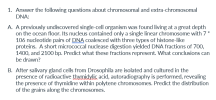 Hello! Can someone help me answer this please?
1. Answer the following questions about chromosomal and extra-chromosomal DNA: A. A previously undiscovered single-cell organism was found living at a great depth on the ocean floor. Its nucleus contained only a single linear chromosome with 7* 106 nucleotide pairs of DNA coalesced with three types of histone-like proteins. A short micrococcal nuclease digestion yielded DNA fractions of 700, 1400, and 2100 bp. Predict what these fractions represent. What conclusions can be...
Hello! Can someone help me answer this please?
1. Answer the following questions about chromosomal and extra-chromosomal DNA: A. A previously undiscovered single-cell organism was found living at a great depth on the ocean floor. Its nucleus contained only a single linear chromosome with 7* 106 nucleotide pairs of DNA coalesced with three types of histone-like proteins. A short micrococcal nuclease digestion yielded DNA fractions of 700, 1400, and 2100 bp. Predict what these fractions represent. What conclusions can be...
Unit 3 Study Resource Meiosis • Process by which diploid cells create haploid cells NOT part...
 Unit 3 Study Resource Meiosis • Process by which diploid cells create haploid cells NOT part of the cell cycle > only some cells ever undergo meiosis During meiosis I, homologous chromosomes line up to allow them to be separated into two new cells o They can become "tangled" during this phase, which leads to crossing-over (rearranging the alleles) O Result of meiosis I is two non-identical haploid cells Meiosis Il looks very similar to mitosis, in that sister chromatids...
can you please answer all the questions Gene therapy can best be described as the OA....
 can you please answer all the questions
Gene therapy can best be described as the OA. repair of a defect (mutation) in a gene B. insertion of normal genes to act in place of mutant genes Oc. insertion of human genes into other organisms D. cloning of genes to produce and purify therapeutically useful proteins E. mapping of all human genetic information Donot Selection Transmission genetics A. uses recombinant DNA technology to identify, isolate, and produce millions of copies of...
can you please answer all the questions
Gene therapy can best be described as the OA. repair of a defect (mutation) in a gene B. insertion of normal genes to act in place of mutant genes Oc. insertion of human genes into other organisms D. cloning of genes to produce and purify therapeutically useful proteins E. mapping of all human genetic information Donot Selection Transmission genetics A. uses recombinant DNA technology to identify, isolate, and produce millions of copies of...
Can anyone help me with this? Thank you. Lab 13. Mitosis and Meiosis Purpose The purpose...
 Can anyone help me with this? Thank you.
Lab 13. Mitosis and Meiosis Purpose The purpose of this lab is to understand the process of mitosis and melosis in animal and plant cells. Learning Objectives After completing this lab, you will be able to: 1. Describe the stages of mitosis. 2. Identify the stages of mitosis in an onion root or whitefish blastula using a light microscope. 3. Describe how cytokinesis differs in plant vs. animal cells. 4. Name and...
Can anyone help me with this? Thank you.
Lab 13. Mitosis and Meiosis Purpose The purpose of this lab is to understand the process of mitosis and melosis in animal and plant cells. Learning Objectives After completing this lab, you will be able to: 1. Describe the stages of mitosis. 2. Identify the stages of mitosis in an onion root or whitefish blastula using a light microscope. 3. Describe how cytokinesis differs in plant vs. animal cells. 4. Name and...
 Given two initial chromosomes ABCDEFGHI and LMNOPQRST, what chromosomal rearragements occured to produce the following chromosome? Check all that apply. LMNOSTEFGHI a. deletion O b. duplication O c. inversion Od translocation 1 points Given two initial chromosomes ABCDEFGHI and LMNOPQRST, what chromosomal rearragements occured to produce the following chromosome? Check all that apply. GHILONMPQPQT ♡ a translocation b. deletion c. duplication O d. inversion The diploid number of an organism is 24. How many chromosomes would be expected in H...
 thumbs up for good answer! please help with my genetics, thank
you!!
heres a better quality photo
1. In the analysis of bacteriophage T4 rll locus mutants, a mixed infection experiment was eonducted. Complementation was ebierved for mutants 1 and 2, as well as for mutants 2 and 3 but mot between and 3. What can be concluded from the results? A-mutations 1 and 3 are on dferent genes B-all 3 mutations are in separate genes C-mutations 1 and 3...
thumbs up for good answer! please help with my genetics, thank
you!!
heres a better quality photo
1. In the analysis of bacteriophage T4 rll locus mutants, a mixed infection experiment was eonducted. Complementation was ebierved for mutants 1 and 2, as well as for mutants 2 and 3 but mot between and 3. What can be concluded from the results? A-mutations 1 and 3 are on dferent genes B-all 3 mutations are in separate genes C-mutations 1 and 3...
 What are the different kinds of chromosomal duplication, and how do they differ from each other? What human disorder results from deletion of a region on chromosome 5 producing newborns that cry like a cat? If Dr. Obama wishes to reveal regions of the chromosomes that are rich in A-T base pairs in a karyotype preparation, she should use ___ to stain G bands on the chromosomes. A typical human karyotype has a total of ___ chromosomes and includes ___...
 13,15 & 16
13. Deletion, Translocation, Inversion, Duplication, OR Mosaicism? Involved in 46, 5p- May result in a position effect which affects gene expression May result in pseudodominance of allele normally recessive to a dominant allele Two genetically distinct populations of cells in a single individual Will result in abnormal gamete formation (more than one answer) Involved in familial Down syndrome Lethal if it occurs in the same region of two homologous chromosomes No loss or gain of genetic material...
13,15 & 16
13. Deletion, Translocation, Inversion, Duplication, OR Mosaicism? Involved in 46, 5p- May result in a position effect which affects gene expression May result in pseudodominance of allele normally recessive to a dominant allele Two genetically distinct populations of cells in a single individual Will result in abnormal gamete formation (more than one answer) Involved in familial Down syndrome Lethal if it occurs in the same region of two homologous chromosomes No loss or gain of genetic material...
 I need answers for 13 to 15. Thank you
13. Deletion, Translocation, Inversion, Duplication, OR Mosaicism? Involved in 46, 5p- May result in a position effect which affects gene expression May result in pseudodominance of allele normally recessive to a dominant allele Two genetically distinct populations of cells in a single individual Will result in abnormal gamete formation (more than one answer) Involved in familial Down syndrome Lethal if it occurs in the same region of two homologous chromosomes No...
I need answers for 13 to 15. Thank you
13. Deletion, Translocation, Inversion, Duplication, OR Mosaicism? Involved in 46, 5p- May result in a position effect which affects gene expression May result in pseudodominance of allele normally recessive to a dominant allele Two genetically distinct populations of cells in a single individual Will result in abnormal gamete formation (more than one answer) Involved in familial Down syndrome Lethal if it occurs in the same region of two homologous chromosomes No...
 Hello! Can someone help me answer this please?
1. Answer the following questions about chromosomal and extra-chromosomal DNA: A. A previously undiscovered single-cell organism was found living at a great depth on the ocean floor. Its nucleus contained only a single linear chromosome with 7* 106 nucleotide pairs of DNA coalesced with three types of histone-like proteins. A short micrococcal nuclease digestion yielded DNA fractions of 700, 1400, and 2100 bp. Predict what these fractions represent. What conclusions can be...
Hello! Can someone help me answer this please?
1. Answer the following questions about chromosomal and extra-chromosomal DNA: A. A previously undiscovered single-cell organism was found living at a great depth on the ocean floor. Its nucleus contained only a single linear chromosome with 7* 106 nucleotide pairs of DNA coalesced with three types of histone-like proteins. A short micrococcal nuclease digestion yielded DNA fractions of 700, 1400, and 2100 bp. Predict what these fractions represent. What conclusions can be...
 Unit 3 Study Resource Meiosis • Process by which diploid cells create haploid cells NOT part of the cell cycle > only some cells ever undergo meiosis During meiosis I, homologous chromosomes line up to allow them to be separated into two new cells o They can become "tangled" during this phase, which leads to crossing-over (rearranging the alleles) O Result of meiosis I is two non-identical haploid cells Meiosis Il looks very similar to mitosis, in that sister chromatids...
 can you please answer all the questions
Gene therapy can best be described as the OA. repair of a defect (mutation) in a gene B. insertion of normal genes to act in place of mutant genes Oc. insertion of human genes into other organisms D. cloning of genes to produce and purify therapeutically useful proteins E. mapping of all human genetic information Donot Selection Transmission genetics A. uses recombinant DNA technology to identify, isolate, and produce millions of copies of...
can you please answer all the questions
Gene therapy can best be described as the OA. repair of a defect (mutation) in a gene B. insertion of normal genes to act in place of mutant genes Oc. insertion of human genes into other organisms D. cloning of genes to produce and purify therapeutically useful proteins E. mapping of all human genetic information Donot Selection Transmission genetics A. uses recombinant DNA technology to identify, isolate, and produce millions of copies of...
 Can anyone help me with this? Thank you.
Lab 13. Mitosis and Meiosis Purpose The purpose of this lab is to understand the process of mitosis and melosis in animal and plant cells. Learning Objectives After completing this lab, you will be able to: 1. Describe the stages of mitosis. 2. Identify the stages of mitosis in an onion root or whitefish blastula using a light microscope. 3. Describe how cytokinesis differs in plant vs. animal cells. 4. Name and...
Can anyone help me with this? Thank you.
Lab 13. Mitosis and Meiosis Purpose The purpose of this lab is to understand the process of mitosis and melosis in animal and plant cells. Learning Objectives After completing this lab, you will be able to: 1. Describe the stages of mitosis. 2. Identify the stages of mitosis in an onion root or whitefish blastula using a light microscope. 3. Describe how cytokinesis differs in plant vs. animal cells. 4. Name and...
Most questions answered within 3 hours.
-
Where is the error in this code sequence?
String s1 = "Hello";
String s2 = "ello";...
asked 10 months ago -
Financial data for Joel de Paris, Inc., for last year
follow:
Joel de Paris, Inc.
Balance...
asked 10 months ago -
Consider this reaction:
Al2(SO4)3 (aq)+ BaCl3
(aq) Al2Cl6 (aq)- +
3BaSO4(s) . What is the...
asked 10 months ago -
Suppose that Savneet is considering increasing her
recent random sample from 20 car rentals to 40...
asked 10 months ago -
Trucks arrive at an unloading terminal at an average rate of 120
per hour.
Trucks arrive...
asked 10 months ago -
Why are methanol and ethanol completely soluble in water while
octanol is not very little soluble....
asked 10 months ago -
A facilities manager at a university reads in a research report
that the mean amount of...
asked 10 months ago -
When the CuSO4 is rehydrated by adding water to the anhydrous
compound, is this an endothermic...
asked 10 months ago -
A ray of sunlight is passing from diamond into crown glass; the
angle of incidence is...
asked 10 months ago -
A block of mass 0.249 kg is placed on top of a light, vertical
spring of...
asked 10 months ago -
how do the kidneys compensate in the presences of acidosis
a) trigger hyperventilate
b) reserve acid...
asked 10 months ago -
Question 501 pts
The rental rate of capital to the firm increases. Which of the
following...
asked 10 months ago