Assume the United States has the production possibilities to produce either 85 coconuts or 80 lemons...
Assume the United States has the production possibilities to produce either 85 coconuts or 80 lemons using 100 worker hours. If the U.S. produces 75 coconuts, how many lemons can it produce? Round your answer to the nearest 4 decimal places.
Homework Answers
Opportunity cost of 1 coconut = 80/85 Lemons
If 75 coconuts are produced, then 10 coconuts are forgone to produce lemons.
Hence,
No. of lemons produced = (80/85)*10
No. of lemons produced = 9.4118 lemons
Add Answer to:
Assume the United States has the production possibilities to
produce either 85 coconuts or 80 lemons...
Table: Production Possibilities in the United States and Colombia Colombia United States Quantity of coffee (tons...
 Table: Production Possibilities in the United States and Colombia Colombia United States Quantity of coffee (tons Quantity of computers uantity ofQuantity of coffee (tons) computers 100 80 60 40 20 10 a) Look at the table Production Possibilities in the United States and Colombia. Which country should export coffee and which country should export computers? Justify your answer b) Look at the table Production Possibilities in the United States and Colombia. Suppose that in autarky, Colombia produces 10 tons of...
Draw a country's production possibilities frontier Question Assume India has the production possibilities to produce either...
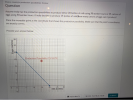 Draw a country's production possibilities frontier Question Assume India has the production possibilities to produce either 20 bottles of milk using 50 worker hours or 25 cartons of eggs using 50 worker hours. If India decides to produce 15 bottles of milk, how many cartons of eggs can it produce? Place the moveable point at the coordinate that shows this production possibility. Make sure that the point's coordinates are exactly correct. Provide your answer below: Eggs (cartons) Production Possibility(15.1875) Milk...
1. Below is production levels of lumber and oll for the United States and Canada. Country...
 1. Below is production levels of lumber and oll for the United States and Canada. Country Lumber Production (using 50 worker hours) 100 200 Oil Production (using 50 worker hours) 150 50 United States Canada a. Calculate the opportunity cost of producing 100 units of lumber for U.S. b. Calculate the opportunity cost of producing 200 units of lumber for Canada. C. Calculate the opportunity cost of producing 150 units of oil for U.S. d. Calculate the opportunity cost of...
Instructions: For the following questions, use the diagram of production possibilities for the United States a....
 Instructions: For the following questions, use the diagram of production possibilities for the United States a. Which point, A or B, best represents the combination of present and future goods in the United States? (Click to select) b. W ook int hich production possibilities curve best represents future growth in the United States? (Click to select) Instructions: For the following questions, use the diagram of production possibilities in China. c. Which point, A or B, best represents the combination of...
The following hypothetical production possibilities tables are for China and the United States. Assume that before...
The following hypothetical production possibilities tables are for China and the United States. Assume that before specialization and trade the optimal product mix for China is alternative D and for the United States is alternative S. China Production Possibilities Product A B C D E F Apparel 40,000 32,000 24,000 16,000 8,000 0 Chemicals(tons) 0 16 32 48 64 80 U.S. Production Possibilities Product R S T U V W Apparel 120,000 96,000 72,000 48,0000 24,000 0 Chemicals(tons) 0 24...
1. Table: Production Possibilities for the United States and Canada One Possibility U.S. Production Possibilities Another...
 1. Table: Production Possibilities for the United States and Canada One Possibility U.S. Production Possibilities Another Possibility Quantity of Cars (millions) Quantity of Lumber (millions of board feet) 10 0 10 Canada Production Possibilities One Possibility Another Possibility Quantity of Cars (millions) Quantity of Lumber (millions of board feet) 2 0 0 12 Reference: Ref 16-3 (Table: Production Possibilities for the United States and Canada) Examine the table Production Possibilities for the United States and Canada Both nations can produce...
T or F: If both Brazil and the United States have straight-line production-possibilities curves, the U.S....
T or F: If both Brazil and the United States have straight-line production-possibilities curves, the U.S. can use all its resources to produce either 10 tons of coffee or 10 tons of wheat per year, and Brazil can use all of its resources to produce either 4 tons of coffee or 2 tons of wheat per year, Brazil has a comparative advantage in coffee production.
The following hypothetical production possibilities tables are for China and the United States. Assume that before...
 The following hypothetical production possibilities tables are for China and the United States. Assume that before specialization and trade the optimal product mix for China is alternative D and for the United States is alternative S. Product China Production Possibilities A B DEF 80,000 64,000 48,000 32,000 16,000 0 32 64 96 128 160 Chemicals(tons) Product Apparel Chemicals(tons) U.S. Production Possibilities R S T U 240,000 192,000 144,000 96,0000 0 48 96 144 V 48,000 192 W 0 240 Instructions:...
2. Problems and Applications Q2 An American worker can produce either 5 cars or 9 tons...
 2. Problems and Applications Q2 An American worker can produce either 5 cars or 9 tons of grain a year. A Japanese worker can produce either 3 cars or 9 tons of grain a year. To keep things simple, assume that each country has 100 million workers. Complete the following table with the number of workers needed to make one car or 1 ton of grain in the United States and Japan. Workers Needed to Make 1 Car 1 Ton...
1. Each country has 10 workers who can produce either microchips or brooms. A worker in...
 1. Each country has 10 workers who can produce either microchips or brooms. A worker in U.S can produce 9 microchips a day or 1 broom a day. A worker in Mexico can produce 1 microchip or 9 brooms a day. 1. a) Draw the production possibilities frontier (PPF) of microchips and brooms for U.S. 1. b) Draw the production possibilities frontier (PPF) of microchips and brooms for Mexico 1. c) Explain how trade can benefit both the U.S and...
 Table: Production Possibilities in the United States and Colombia Colombia United States Quantity of coffee (tons Quantity of computers uantity ofQuantity of coffee (tons) computers 100 80 60 40 20 10 a) Look at the table Production Possibilities in the United States and Colombia. Which country should export coffee and which country should export computers? Justify your answer b) Look at the table Production Possibilities in the United States and Colombia. Suppose that in autarky, Colombia produces 10 tons of...
 Draw a country's production possibilities frontier Question Assume India has the production possibilities to produce either 20 bottles of milk using 50 worker hours or 25 cartons of eggs using 50 worker hours. If India decides to produce 15 bottles of milk, how many cartons of eggs can it produce? Place the moveable point at the coordinate that shows this production possibility. Make sure that the point's coordinates are exactly correct. Provide your answer below: Eggs (cartons) Production Possibility(15.1875) Milk...
 1. Below is production levels of lumber and oll for the United States and Canada. Country Lumber Production (using 50 worker hours) 100 200 Oil Production (using 50 worker hours) 150 50 United States Canada a. Calculate the opportunity cost of producing 100 units of lumber for U.S. b. Calculate the opportunity cost of producing 200 units of lumber for Canada. C. Calculate the opportunity cost of producing 150 units of oil for U.S. d. Calculate the opportunity cost of...
 Instructions: For the following questions, use the diagram of production possibilities for the United States a. Which point, A or B, best represents the combination of present and future goods in the United States? (Click to select) b. W ook int hich production possibilities curve best represents future growth in the United States? (Click to select) Instructions: For the following questions, use the diagram of production possibilities in China. c. Which point, A or B, best represents the combination of...
 1. Table: Production Possibilities for the United States and Canada One Possibility U.S. Production Possibilities Another Possibility Quantity of Cars (millions) Quantity of Lumber (millions of board feet) 10 0 10 Canada Production Possibilities One Possibility Another Possibility Quantity of Cars (millions) Quantity of Lumber (millions of board feet) 2 0 0 12 Reference: Ref 16-3 (Table: Production Possibilities for the United States and Canada) Examine the table Production Possibilities for the United States and Canada Both nations can produce...
 The following hypothetical production possibilities tables are for China and the United States. Assume that before specialization and trade the optimal product mix for China is alternative D and for the United States is alternative S. Product China Production Possibilities A B DEF 80,000 64,000 48,000 32,000 16,000 0 32 64 96 128 160 Chemicals(tons) Product Apparel Chemicals(tons) U.S. Production Possibilities R S T U 240,000 192,000 144,000 96,0000 0 48 96 144 V 48,000 192 W 0 240 Instructions:...
 2. Problems and Applications Q2 An American worker can produce either 5 cars or 9 tons of grain a year. A Japanese worker can produce either 3 cars or 9 tons of grain a year. To keep things simple, assume that each country has 100 million workers. Complete the following table with the number of workers needed to make one car or 1 ton of grain in the United States and Japan. Workers Needed to Make 1 Car 1 Ton...
 1. Each country has 10 workers who can produce either microchips or brooms. A worker in U.S can produce 9 microchips a day or 1 broom a day. A worker in Mexico can produce 1 microchip or 9 brooms a day. 1. a) Draw the production possibilities frontier (PPF) of microchips and brooms for U.S. 1. b) Draw the production possibilities frontier (PPF) of microchips and brooms for Mexico 1. c) Explain how trade can benefit both the U.S and...
Most questions answered within 3 hours.
-
Where is the error in this code sequence?
String s1 = "Hello";
String s2 = "ello";...
asked 11 months ago -
Financial data for Joel de Paris, Inc., for last year
follow:
Joel de Paris, Inc.
Balance...
asked 11 months ago -
Consider this reaction:
Al2(SO4)3 (aq)+ BaCl3
(aq) Al2Cl6 (aq)- +
3BaSO4(s) . What is the...
asked 11 months ago -
Suppose that Savneet is considering increasing her
recent random sample from 20 car rentals to 40...
asked 11 months ago -
Trucks arrive at an unloading terminal at an average rate of 120
per hour.
Trucks arrive...
asked 11 months ago -
Why are methanol and ethanol completely soluble in water while
octanol is not very little soluble....
asked 11 months ago -
A facilities manager at a university reads in a research report
that the mean amount of...
asked 11 months ago -
When the CuSO4 is rehydrated by adding water to the anhydrous
compound, is this an endothermic...
asked 11 months ago -
A ray of sunlight is passing from diamond into crown glass; the
angle of incidence is...
asked 11 months ago -
A block of mass 0.249 kg is placed on top of a light, vertical
spring of...
asked 11 months ago -
how do the kidneys compensate in the presences of acidosis
a) trigger hyperventilate
b) reserve acid...
asked 11 months ago -
Question 501 pts
The rental rate of capital to the firm increases. Which of the
following...
asked 11 months ago