In a typical cell, why are non-thermodynamically favorable reactions possible?
In a typical cell, why are non-thermodynamically favorable reactions possible?
Homework Answers
In a typical cell, non-thermodynamically favourable reactions are possible because those reactions are coupled with ATP hydrolysis. ATP is the energy currency of the cell. The breakdown of ATP into ADP releases energy and it can be used to carry non thermodynamically favourable reaction.
Add Answer to:
In a typical cell, why are non-thermodynamically
favorable reactions possible?
All exothermic reactions are favorable. Using your own words, explain why some exothermic reactions are non-spontaneous...
 All exothermic reactions are favorable. Using your own words, explain why some exothermic reactions are non-spontaneous even when they are all favorable. HTML Editor
1. In a cell, a thermodynamically unfavorable process can occur if the process is coupled to...
1. In a cell, a thermodynamically unfavorable process can occur if the process is coupled to a thermodynamically favorable process. the process is thermodynamically favorable outside the cell. an enzyme gives energy to the reacting substances. the cell as a whole is close to equilibrium. 2. In an active transport protein, ATP hydrolysis creates a channel through the membrane. ATP uses the protein to move across the membrane. ATP hydrolysis causes the protein to change shape. ATP carries a substance...
A thermodynamically unfavorable reaction can become favorable when coupled to a highly ________ reaction.
A thermodynamically unfavorable reaction can become favorable when coupled to a highly ________ reaction.
A thermodynamically unfavorable reaction can become favorable if the mass action ratio (Q) is ________ than...
A thermodynamically unfavorable reaction can become favorable if the mass action ratio (Q) is ________ than the equilibrium mass action ratio (K) Greater than Less than Equal to not enough information
Indicate which of these metallation reactions given below would be thermodynamically favourable on the basis of...
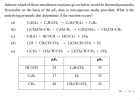 Indicate which of these metallation reactions given below would be thermodynamically favourable on the basis of the pKa data in non-aqueous media provided. What is the underlying principle that determines if the reaction occurs? pKa 24 37 48 pKa 35 35 43 C6HsCH3 C6H6 CH4 CH3CH-CH2 1.-1
Why does base stacking cause energetically favorable reactions in DNA?
Why does base stacking cause energetically favorable reactions in DNA?
In a quiz I got a reaction, not thermodynamically favorable: Cu₂S → 2Cu(s) + S(s) ∆G°...
In a quiz I got a reaction, not thermodynamically favorable: Cu₂S → 2Cu(s) + S(s) ∆G° = + 86kJ/mol The question said: 'We can force this to happen by using a battery'.. (i) Using ∆G°, calculate E°cell .... They then gave the reduction potential of Cu, and put the reduction reaction of sulfur with unknown reduction potential Cu2+ + 2e- → Cu E° = 0.34 S + 2e- → S2- E°= ??? (ii) Using your answer in part (i), calculate...
The half-cell reactions that occur in a typical flashlight battery are: Zn(s) -7 Zn²+ (aq) +...
 The half-cell reactions that occur in a typical flashlight battery are: Zn(s) -7 Zn²+ (aq) + 2 e 2 MnOz(s) + Zn2+ (aq) + 2 e -7 ZnMn20_(5) Write a chemical equation describing the net cell reaction
CHEM-1220: hemical Thermodynamics Coupled Reactions Resources « previous| 10 of 13 next >» Coupled Reactions Part...
 CHEM-1220:
hemical Thermodynamics Coupled Reactions Resources « previous| 10 of 13 next >» Coupled Reactions Part A Consider these hypothetical chemical reactions In nature, one common strategy to make thermodynamically unfavorable reactions proceed is to couple them chemically to reactions that are thermodynamically favorable. As long as the overall reaction is thermodynamically favorable even the unfavorable reaction will proceed 1. A-B, 2.B-C, 3, C D, ΔG= 13.0 kJ/mol ΔG=-26.2 kJ/mol ΔG= 7.70 kJ/mol What is the free energy, ΔG, for...
CHEM-1220:
hemical Thermodynamics Coupled Reactions Resources « previous| 10 of 13 next >» Coupled Reactions Part A Consider these hypothetical chemical reactions In nature, one common strategy to make thermodynamically unfavorable reactions proceed is to couple them chemically to reactions that are thermodynamically favorable. As long as the overall reaction is thermodynamically favorable even the unfavorable reaction will proceed 1. A-B, 2.B-C, 3, C D, ΔG= 13.0 kJ/mol ΔG=-26.2 kJ/mol ΔG= 7.70 kJ/mol What is the free energy, ΔG, for...
Why are the non-standard state cell potentials the same as the standard state cell potentials ?...
Why are the non-standard state cell potentials the same as the standard state cell potentials ? Please help me explain why this occurs.
 All exothermic reactions are favorable. Using your own words, explain why some exothermic reactions are non-spontaneous even when they are all favorable. HTML Editor
 Indicate which of these metallation reactions given below would be thermodynamically favourable on the basis of the pKa data in non-aqueous media provided. What is the underlying principle that determines if the reaction occurs? pKa 24 37 48 pKa 35 35 43 C6HsCH3 C6H6 CH4 CH3CH-CH2 1.-1
 The half-cell reactions that occur in a typical flashlight battery are: Zn(s) -7 Zn²+ (aq) + 2 e 2 MnOz(s) + Zn2+ (aq) + 2 e -7 ZnMn20_(5) Write a chemical equation describing the net cell reaction
 CHEM-1220:
hemical Thermodynamics Coupled Reactions Resources « previous| 10 of 13 next >» Coupled Reactions Part A Consider these hypothetical chemical reactions In nature, one common strategy to make thermodynamically unfavorable reactions proceed is to couple them chemically to reactions that are thermodynamically favorable. As long as the overall reaction is thermodynamically favorable even the unfavorable reaction will proceed 1. A-B, 2.B-C, 3, C D, ΔG= 13.0 kJ/mol ΔG=-26.2 kJ/mol ΔG= 7.70 kJ/mol What is the free energy, ΔG, for...
CHEM-1220:
hemical Thermodynamics Coupled Reactions Resources « previous| 10 of 13 next >» Coupled Reactions Part A Consider these hypothetical chemical reactions In nature, one common strategy to make thermodynamically unfavorable reactions proceed is to couple them chemically to reactions that are thermodynamically favorable. As long as the overall reaction is thermodynamically favorable even the unfavorable reaction will proceed 1. A-B, 2.B-C, 3, C D, ΔG= 13.0 kJ/mol ΔG=-26.2 kJ/mol ΔG= 7.70 kJ/mol What is the free energy, ΔG, for...
Most questions answered within 3 hours.
-
Where is the error in this code sequence?
String s1 = "Hello";
String s2 = "ello";...
asked 10 months ago -
Financial data for Joel de Paris, Inc., for last year
follow:
Joel de Paris, Inc.
Balance...
asked 10 months ago -
Consider this reaction:
Al2(SO4)3 (aq)+ BaCl3
(aq) Al2Cl6 (aq)- +
3BaSO4(s) . What is the...
asked 10 months ago -
Suppose that Savneet is considering increasing her
recent random sample from 20 car rentals to 40...
asked 10 months ago -
Trucks arrive at an unloading terminal at an average rate of 120
per hour.
Trucks arrive...
asked 10 months ago -
Why are methanol and ethanol completely soluble in water while
octanol is not very little soluble....
asked 10 months ago -
A facilities manager at a university reads in a research report
that the mean amount of...
asked 10 months ago -
When the CuSO4 is rehydrated by adding water to the anhydrous
compound, is this an endothermic...
asked 10 months ago -
A ray of sunlight is passing from diamond into crown glass; the
angle of incidence is...
asked 10 months ago -
A block of mass 0.249 kg is placed on top of a light, vertical
spring of...
asked 10 months ago -
how do the kidneys compensate in the presences of acidosis
a) trigger hyperventilate
b) reserve acid...
asked 10 months ago -
Question 501 pts
The rental rate of capital to the firm increases. Which of the
following...
asked 10 months ago