What is the correct general equation for cellular respiration? a)6 CO2 + 6 H2O + ATP...
What is the correct general equation for cellular respiration?
a)6 CO2 + 6 H2O + ATP -> C6H12O6 + 6O2
b)C6H12O6 + 6 CO2 -> 6O2 + 6 H2O + ATP
c)6O2 + 6 H2O + ATP -> C6H12O6 + 6 CO2
d)C6H12O6 + 6 O2 -> 6 CO2 + 6 H2O + ATP
Homework Answers
D is correct answer because in cellular respiration , glucose is breakdown in presence of oxygen to produce CO2 and water and also energy for working of cells.
Add Answer to:
What is the correct general equation for cellular
respiration?
a)6 CO2 + 6 H2O + ATP...
The electron transport chain in cellular respiration converts electrical energy to the transport of_ Select one:...
 The electron transport chain in cellular respiration converts electrical energy to the transport of_ Select one: a. H+ b. O2 c. CO2 d. OH- e. glucose The process of glycolysis converts one molecule of glucose to two molecules of pyruvate. Select one: a. 2 carbon X b. 3 carbon c. 4 carbon d. 5 carbon e. 6 carbon ATP synthesis during cellular respiration depends on a gradient of Select one: a. NaCI b. electrons c. 02 d. pyruvate e. Hydrogen...
Explain how cellular respiration (O2 consumption and CO2 production) is linked to ATP production. Is the...
Explain how cellular respiration (O2 consumption and CO2 production) is linked to ATP production. Is the coupling of these two processes perfect? Why or why not?
Question 2 20 pts What is the general equation of photosynthesis? CO2 + H2O + photons...
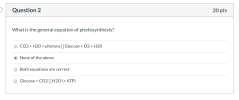 Question 2 20 pts What is the general equation of photosynthesis? CO2 + H2O + photons Glucose + O2 + H20 None of the above Both equations are correct Glucose + CO2 [H20 (+ ATP)
Where is oxygen used? Where’s CO2 released in cellular respiration? 6.Where is most of the ATP...
Where is oxygen used? Where’s CO2 released in cellular respiration? 6.Where is most of the ATP made? 7.What is the point/purpose of fermentation? 8.Why does bread have holes? 9.How is beer/wine made? What is the live organism that does this? 10.Do humans do fermentation? Why? 11.What limits us from doing cellular respiration?
1. What is the importance of NAD+/NADH to cellular respiration? 2. Be able to write out...
1. What is the importance of NAD+/NADH to cellular respiration? 2. Be able to write out the biochemical equations for glucose respiration and photosynthesis AND label the oxidizing and reducing agents in each reaction. 3. What are the three stages of cellular respiration and where does each occur in the cell? 4. During cellular respiration, what is the role of each of these molecules: glucose, pyruvate, ATP, NAD+, FAD, NADH, FADH2, acetyl CoA, CO2, H2O, and O2? 5. For each...
Place the cellular respiration pathways in their correct locations. Place the cellular respiration pathways in their...
 Place the cellular respiration pathways in their correct
locations.
Place the cellular respiration pathways in their correct locations. Breakdown of pyruvate Glycolysis Oxidative phosphorylation Citric acid cycle 1 OOOOOO Outer mitochondrial membrane Cytosol 2pYYSC Mitochondrial matrix Inner mitochondrial membrane 2 NADH 2 NADH 2 pyruvate 6 NADH 2 FADH Pyruvate | 2000 2 acetyl 2 CO 2002+2 acetyl 2 CO 2 acetyl 2 CO2 +2 ATP +2 ATP +30-34 ATP MAS Via substrate-level phosphorylation Via chemiosmosis Va substrate-level phosphorylation
Place the cellular respiration pathways in their correct
locations.
Place the cellular respiration pathways in their correct locations. Breakdown of pyruvate Glycolysis Oxidative phosphorylation Citric acid cycle 1 OOOOOO Outer mitochondrial membrane Cytosol 2pYYSC Mitochondrial matrix Inner mitochondrial membrane 2 NADH 2 NADH 2 pyruvate 6 NADH 2 FADH Pyruvate | 2000 2 acetyl 2 CO 2002+2 acetyl 2 CO 2 acetyl 2 CO2 +2 ATP +2 ATP +30-34 ATP MAS Via substrate-level phosphorylation Via chemiosmosis Va substrate-level phosphorylation
Which is a true statement about the molecules in the summary reaction for cellular respiration? Group...
Which is a true statement about the molecules in the summary reaction for cellular respiration? Group of answer choices O2 is a reactant that is oxidized to H2O. C6H12O6 contains more energy than 6CO2 CO2 is a product that has been reduced. O2 is a reactant that donates electrons to H2O
CO2 and H2O are reactants of: Select one or more: a. neither photosynthesis or cellular respiration...
CO2 and H2O are reactants of: Select one or more: a. neither photosynthesis or cellular respiration b. photosynthesis c. both photosynthesis and cellular respiration d. cellular respiration Leaves appear green because chlorophyll Select one or more: a. reflects green light b. manufactures green light c. absorbs green light Leaves appear green because chlorophyll Select one or more: a. reflects green light b. manufactures green light c. absorbs green light Leaves appear green because chlorophyll Select one or more: a. reflects...
Part A Human cells obtain energy from a reaction called cellular respiration. Balance the skeletal equation for cel...
 Part A Human cells obtain energy from a reaction called cellular respiration. Balance the skeletal equation for cellular respiration C. H12O6(aq) + O2(g) → CO2(g) + H2O(1) Express your answer as a chemical equation. Identify all of the phases in your answer. - ALO O ? Submit Previous Answers Request Answer
Chapter 8 Cell Respiration 1. What are the parts of this ATP module 6-8-5- o- 1...
 Chapter 8 Cell Respiration 1. What are the parts of this ATP module 6-8-5- o- 1 OH OH 2. What organisms use ATP as their cellular energy source? 3. Write out the cell respiration equations below: How does this compare to the photosynthesis equation? of electrons. 4. Oxidation is a of electrons, while reduction is a 5. How efficient is the conversion from glucose to ATP? 6. How many ATP molecules are made from one molecule of glucose? 7. In...
 The electron transport chain in cellular respiration converts electrical energy to the transport of_ Select one: a. H+ b. O2 c. CO2 d. OH- e. glucose The process of glycolysis converts one molecule of glucose to two molecules of pyruvate. Select one: a. 2 carbon X b. 3 carbon c. 4 carbon d. 5 carbon e. 6 carbon ATP synthesis during cellular respiration depends on a gradient of Select one: a. NaCI b. electrons c. 02 d. pyruvate e. Hydrogen...
 Question 2 20 pts What is the general equation of photosynthesis? CO2 + H2O + photons Glucose + O2 + H20 None of the above Both equations are correct Glucose + CO2 [H20 (+ ATP)
 Place the cellular respiration pathways in their correct
locations.
Place the cellular respiration pathways in their correct locations. Breakdown of pyruvate Glycolysis Oxidative phosphorylation Citric acid cycle 1 OOOOOO Outer mitochondrial membrane Cytosol 2pYYSC Mitochondrial matrix Inner mitochondrial membrane 2 NADH 2 NADH 2 pyruvate 6 NADH 2 FADH Pyruvate | 2000 2 acetyl 2 CO 2002+2 acetyl 2 CO 2 acetyl 2 CO2 +2 ATP +2 ATP +30-34 ATP MAS Via substrate-level phosphorylation Via chemiosmosis Va substrate-level phosphorylation
Place the cellular respiration pathways in their correct
locations.
Place the cellular respiration pathways in their correct locations. Breakdown of pyruvate Glycolysis Oxidative phosphorylation Citric acid cycle 1 OOOOOO Outer mitochondrial membrane Cytosol 2pYYSC Mitochondrial matrix Inner mitochondrial membrane 2 NADH 2 NADH 2 pyruvate 6 NADH 2 FADH Pyruvate | 2000 2 acetyl 2 CO 2002+2 acetyl 2 CO 2 acetyl 2 CO2 +2 ATP +2 ATP +30-34 ATP MAS Via substrate-level phosphorylation Via chemiosmosis Va substrate-level phosphorylation
 Part A Human cells obtain energy from a reaction called cellular respiration. Balance the skeletal equation for cellular respiration C. H12O6(aq) + O2(g) → CO2(g) + H2O(1) Express your answer as a chemical equation. Identify all of the phases in your answer. - ALO O ? Submit Previous Answers Request Answer
 Chapter 8 Cell Respiration 1. What are the parts of this ATP module 6-8-5- o- 1 OH OH 2. What organisms use ATP as their cellular energy source? 3. Write out the cell respiration equations below: How does this compare to the photosynthesis equation? of electrons. 4. Oxidation is a of electrons, while reduction is a 5. How efficient is the conversion from glucose to ATP? 6. How many ATP molecules are made from one molecule of glucose? 7. In...
Most questions answered within 3 hours.
-
Where is the error in this code sequence?
String s1 = "Hello";
String s2 = "ello";...
asked 11 months ago -
Financial data for Joel de Paris, Inc., for last year
follow:
Joel de Paris, Inc.
Balance...
asked 11 months ago -
Consider this reaction:
Al2(SO4)3 (aq)+ BaCl3
(aq) Al2Cl6 (aq)- +
3BaSO4(s) . What is the...
asked 11 months ago -
Suppose that Savneet is considering increasing her
recent random sample from 20 car rentals to 40...
asked 11 months ago -
Trucks arrive at an unloading terminal at an average rate of 120
per hour.
Trucks arrive...
asked 11 months ago -
Why are methanol and ethanol completely soluble in water while
octanol is not very little soluble....
asked 11 months ago -
A facilities manager at a university reads in a research report
that the mean amount of...
asked 11 months ago -
When the CuSO4 is rehydrated by adding water to the anhydrous
compound, is this an endothermic...
asked 11 months ago -
A ray of sunlight is passing from diamond into crown glass; the
angle of incidence is...
asked 11 months ago -
A block of mass 0.249 kg is placed on top of a light, vertical
spring of...
asked 11 months ago -
how do the kidneys compensate in the presences of acidosis
a) trigger hyperventilate
b) reserve acid...
asked 11 months ago -
Question 501 pts
The rental rate of capital to the firm increases. Which of the
following...
asked 11 months ago