A planar material can be modeled as 1-dimensional with thickness L = 2m. On one boundary...
A planar material can be modeled as 1-dimensional with thickness L = 2m. On one boundary (x=0), the surface is held at a fixed temperature Ts = 20°C. the other boundary is perfectly insulated. There is a constant thermal conductivity k = 40 W/mK and the material is being heated internally. The system is at steady state.
a) write an expression for each of the two boundary conditions
b) If the volumetric heat generation is equal to q.= 10 W/m3.
i) Evaluate the heat flux in the positive x direction at the constant temperature boundary (x=0).
ii) Evaluate the temperature on the perfectly insulated boundary.
iii) Sketch the temperature distribution within the material (i.e roughly plot T(x) noting the position of the boundaries)
c) If the heat generation varies with location following the expression q.=αx2, where α = 6 W/m5. Evaluate the heat flux in the positive x direction at the constant temperature boundary (x=0).
Homework Answers

Add Answer to:
A planar material can be modeled as 1-dimensional with thickness
L = 2m. On one boundary...
3/5 25 pts.J A slab of thickness L, made of material with constant thermal conductivity k,...
 3/5 25 pts.J A slab of thickness L, made of material with constant thermal conductivity k, is undergoing a 1-D, steady heat transfer. Its boundary surface at x 0 is insulated while the boundary surface at x= 1 is kept at constant temperature T= oc. Heat energy is generated within the slab at a rate of 2. qx)o cos(rx/2L) is the energy generation rate per unit volume (Wm) at x= 0. where qo a. Develop an expression for the steady-state...
ent material has the thermal conductivity k and thickness L. The temperature the material is of the form: distribution along the x-direction, T(x) in + Bx2 + C, where A, a, B, and C are constants...
 ent material has the thermal conductivity k and thickness L. The temperature the material is of the form: distribution along the x-direction, T(x) in + Bx2 + C, where A, a, B, and C are constants. The irradiation is fully the material and can be characterized by a uniform volumetric heat generation, W/m3). Assuming 1D steady-state conduction and constant properties. xpressions for the conduction heat fluxes (alx) at the top and bottom surfaces; absorbed by (4 points) (b) Derive an...
Problem 2: Consider a large plane slab of semi-thickness L = 0.3 m, thermal conductivity k...
 Problem 2: Consider a large plane slab of semi-thickness L = 0.3 m, thermal conductivity k = 2.5 W/m K and surface area A = 20.0 m². Both sides of the slab is maintained at a constant wall temperature of 358°K while it is subjected to a uniform but constant heat flux of 950.0 W/m2 Evaluate the temperature distribution/profile within the wall. Calculate the heat flux and temperature at location x = 0.1m. Problem 3: Consider a 10.0 m long...
20) Me Steady-state temperature distribution in the s figure. The heat flow is one-dimensional. ibution in...
 20) Me Steady-state temperature distribution in the s figure. The heat flow is one-dimensional. ibution in the sandwich of three materials (A, B, and C) is shown in the aterial B has volumetric heat generation à = 64,000 W/m. Material A has thermal conductivity of 10 W/ m K . Determine: a) The heat flux at the left side: b) The heat flux at the right side: c) The thermal conductivity of Material C: : - W/m2 W/m2 _W/mK T[deg.]...
Problem 2 Heat Diffusion: A tall wall has a thickness of L = 400 mm and...
 Problem 2 Heat Diffusion: A tall wall has a thickness of L = 400 mm and a thermal conductivity of 0.25 W/m-K. One side of the wall is maintained at Ts 80°C. The temperature in the wall varies as a function of position due to internal heat generation. The temperature variation is given as, goL2 where go 10 W/m3. Use this expression to answer the following questions. Assume that the wall temperature is at steady state. A) Find the temperature...
Consider the two-dimensional geometry below; default thickness is 1.0 m. Boundary conditions are 100 C along edge AB 1....
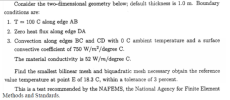 Consider the two-dimensional geometry below; default thickness is 1.0 m. Boundary conditions are 100 C along edge AB 1. T 2. Zero heat flux along edge DA 3. Convection along edges BC and CD with 0 C ambient temperature and a surface convective coefficient of 750 W/m2/degree C. The material conductivity is 52 W/m/degree C Find the smallest bilinear mesh and biquadratic mesh necessary obtain the reference value temperature at point E of 18.3 C, within a tolerance of 3...
3. The wall shown in the figure below has thickness L 0.25 m and uniform thermal...
 3. The wall shown in the figure below has thickness L 0.25 m and uniform thermal conductivity k-1 W/mK. It is exposed to circulating fluid on the surface at x = L, where the temperature ofthe fluid is T-= 30°C and the convection coefficient is h = 4 W/m2.K. The surface at x = 0 is maintained at constant temperature T-20 °C. Assume ID heat flux, and that the system is at steady state a) b) Determine the temperature distribution...
A planar wall is composed of two materials, wall 1 has a uniform heat generation of...
 A planar wall is composed of two materials, wall 1 has a uniform heat generation of 1.5 x 10⁶ W/m3 and a thermal conductivity of 60 Wm.Κ. Wall 2 has no heat generation and thermal resistance of 150 W/m.K. The inner surface of Wall 1 is well insulated, while the outer surface of Wall 2 is exposed to 30°C fluld. The temperature of the wall surface exposed to the fluid is most nearly 00 heat flow fluid at 30°C h...
Consider a pipe of length L with an inner radius r1 and outer radius r2. The...
Consider a pipe of length L with an inner radius r1 and outer radius r2. The outer surface is thermally insulated while the inner surface is at temperature T1. The thermal conductivity of the wall is k constant. Heat is generated in the wall of the pipe with a volumetric uniform heat generation g (W/m3 ). Assume steady and one dimensional heat transfer (b) Determine the temperature variation in the wall of the pipe and the heat flux on...
A plane wall of thickness L has constant thermal conductivity, k, uniform generation throughout, q, and...
 A plane wall of thickness L has constant thermal conductivity, k, uniform generation throughout, q, and is insulated on one side, at x-0. Only the outer surface temperature (Ts) is known. (a) Derive an equation describing the steady-state wall temperature at any point (x), when given the outer wall surface temperature, Tsi. (b) If L-15 cm, k: 3.4 W/m"K, q-10 kW/m3, and Ts1-300 K, what is the steady-state temperature at x - 6 cm (in K)? S1
 3/5 25 pts.J A slab of thickness L, made of material with constant thermal conductivity k, is undergoing a 1-D, steady heat transfer. Its boundary surface at x 0 is insulated while the boundary surface at x= 1 is kept at constant temperature T= oc. Heat energy is generated within the slab at a rate of 2. qx)o cos(rx/2L) is the energy generation rate per unit volume (Wm) at x= 0. where qo a. Develop an expression for the steady-state...
 ent material has the thermal conductivity k and thickness L. The temperature the material is of the form: distribution along the x-direction, T(x) in + Bx2 + C, where A, a, B, and C are constants. The irradiation is fully the material and can be characterized by a uniform volumetric heat generation, W/m3). Assuming 1D steady-state conduction and constant properties. xpressions for the conduction heat fluxes (alx) at the top and bottom surfaces; absorbed by (4 points) (b) Derive an...
 Problem 2: Consider a large plane slab of semi-thickness L = 0.3 m, thermal conductivity k = 2.5 W/m K and surface area A = 20.0 m². Both sides of the slab is maintained at a constant wall temperature of 358°K while it is subjected to a uniform but constant heat flux of 950.0 W/m2 Evaluate the temperature distribution/profile within the wall. Calculate the heat flux and temperature at location x = 0.1m. Problem 3: Consider a 10.0 m long...
 20) Me Steady-state temperature distribution in the s figure. The heat flow is one-dimensional. ibution in the sandwich of three materials (A, B, and C) is shown in the aterial B has volumetric heat generation à = 64,000 W/m. Material A has thermal conductivity of 10 W/ m K . Determine: a) The heat flux at the left side: b) The heat flux at the right side: c) The thermal conductivity of Material C: : - W/m2 W/m2 _W/mK T[deg.]...
 Problem 2 Heat Diffusion: A tall wall has a thickness of L = 400 mm and a thermal conductivity of 0.25 W/m-K. One side of the wall is maintained at Ts 80°C. The temperature in the wall varies as a function of position due to internal heat generation. The temperature variation is given as, goL2 where go 10 W/m3. Use this expression to answer the following questions. Assume that the wall temperature is at steady state. A) Find the temperature...
 Consider the two-dimensional geometry below; default thickness is 1.0 m. Boundary conditions are 100 C along edge AB 1. T 2. Zero heat flux along edge DA 3. Convection along edges BC and CD with 0 C ambient temperature and a surface convective coefficient of 750 W/m2/degree C. The material conductivity is 52 W/m/degree C Find the smallest bilinear mesh and biquadratic mesh necessary obtain the reference value temperature at point E of 18.3 C, within a tolerance of 3...
 3. The wall shown in the figure below has thickness L 0.25 m and uniform thermal conductivity k-1 W/mK. It is exposed to circulating fluid on the surface at x = L, where the temperature ofthe fluid is T-= 30°C and the convection coefficient is h = 4 W/m2.K. The surface at x = 0 is maintained at constant temperature T-20 °C. Assume ID heat flux, and that the system is at steady state a) b) Determine the temperature distribution...
 A planar wall is composed of two materials, wall 1 has a uniform heat generation of 1.5 x 10⁶ W/m3 and a thermal conductivity of 60 Wm.Κ. Wall 2 has no heat generation and thermal resistance of 150 W/m.K. The inner surface of Wall 1 is well insulated, while the outer surface of Wall 2 is exposed to 30°C fluld. The temperature of the wall surface exposed to the fluid is most nearly 00 heat flow fluid at 30°C h...
 A plane wall of thickness L has constant thermal conductivity, k, uniform generation throughout, q, and is insulated on one side, at x-0. Only the outer surface temperature (Ts) is known. (a) Derive an equation describing the steady-state wall temperature at any point (x), when given the outer wall surface temperature, Tsi. (b) If L-15 cm, k: 3.4 W/m"K, q-10 kW/m3, and Ts1-300 K, what is the steady-state temperature at x - 6 cm (in K)? S1
Most questions answered within 3 hours.
-
Where is the error in this code sequence?
String s1 = "Hello";
String s2 = "ello";...
asked 11 months ago -
Financial data for Joel de Paris, Inc., for last year
follow:
Joel de Paris, Inc.
Balance...
asked 11 months ago -
Consider this reaction:
Al2(SO4)3 (aq)+ BaCl3
(aq) Al2Cl6 (aq)- +
3BaSO4(s) . What is the...
asked 11 months ago -
Suppose that Savneet is considering increasing her
recent random sample from 20 car rentals to 40...
asked 11 months ago -
Trucks arrive at an unloading terminal at an average rate of 120
per hour.
Trucks arrive...
asked 11 months ago -
Why are methanol and ethanol completely soluble in water while
octanol is not very little soluble....
asked 11 months ago -
A facilities manager at a university reads in a research report
that the mean amount of...
asked 11 months ago -
When the CuSO4 is rehydrated by adding water to the anhydrous
compound, is this an endothermic...
asked 11 months ago -
A ray of sunlight is passing from diamond into crown glass; the
angle of incidence is...
asked 11 months ago -
A block of mass 0.249 kg is placed on top of a light, vertical
spring of...
asked 11 months ago -
how do the kidneys compensate in the presences of acidosis
a) trigger hyperventilate
b) reserve acid...
asked 11 months ago -
Question 501 pts
The rental rate of capital to the firm increases. Which of the
following...
asked 11 months ago