Which amino acid would be most soluble in hexane? A. Phe, B. Gln, C. Arg, D....
Which amino acid would be most soluble in hexane? A. Phe, B. Gln, C. Arg, D. Asp
Homework Answers
Request Answer!
We need at least 10 more requests to produce the answer.
0 / 10 have requested this problem solution
The more requests, the faster the answer.
Add Answer to:
Which amino acid would be most soluble in hexane? A. Phe, B.
Gln, C. Arg, D....
An octapeptide contains the following amino acids: Met, Thr, Cys, Asp, Phe, Arg, Glu, Gln. Carboxypeptidase...
An octapeptide contains the following amino acids: Met, Thr, Cys, Asp, Phe, Arg, Glu, Gln. Carboxypeptidase treatment of the octapeptide forms Asp and a heptapeptide. Treatment of the octapeptide with Chymotrypsin forms forms two tetrapeptides, A and B. Treatment of A with Trypsin yields two dipeptides, C and D. Edman degradation cleaves the following amino acids from each peptide: Cys (octapeptide), Cys (A), Gln (B), Cys (C), Glu(D). Partial hydrolysis of tetrapeptide B forms Gln-Thr in addition to other products....
An octapeptide contains the following amino acids: Met, Thr, Cys, Asp, Phe, Arg, Glu, Gln. Carboxypeptidase...
An octapeptide contains the following amino acids: Met, Thr, Cys, Asp, Phe, Arg, Glu, Gln. Carboxypeptidase treatment of the octapeptide forms Asp and a heptapeptide. Treatment of the octapeptide with Chymotrypsin forms forms two tetrapeptides, A and B. Treatment of A with Trypsin yields two dipeptides, C and D. Edman degradation cleaves the following amino acids from each peptide: Cys (octapeptide), Cys (A), Gln (B), Cys (C), Glu(D). Partial hydrolysis of tetrapeptide B forms Gln-Thr in addition to other products....
Consider the following amino acid sequence, found as part of a larger protein: Pro-Gly-Asp-Val-Gln-Phe-Asp-Ile-Arg-Ala-Asp-Gly What kind...
Consider the following amino acid sequence, found as part of a larger protein: Pro-Gly-Asp-Val-Gln-Phe-Asp-Ile-Arg-Ala-Asp-Gly What kind of structure do you expect this peptide segment be a part of? Where on the protein is this likely to occur?
10. The peptide shown has the amino acid sequence: A. Val-Ser-Ile-Glu-Lys B. Lys-Glu-Ile-Ser-Val C. Thr-Asp-Leu-Gln-Arg D....
 10. The peptide shown has the amino acid sequence: A. Val-Ser-Ile-Glu-Lys B. Lys-Glu-Ile-Ser-Val C. Thr-Asp-Leu-Gln-Arg D. Val-Asp-Ile-Glu-Arg 11. Which of the following describes the entire three- dimensional structure of a single polypeptide? A. Secondary structure B. Quaternary structure C. Tertiary structure D. Primary structure 12. What is the primary driving force in the formation of protein tertiary structure? A. Energy released when additional ion pairs are formed. B. The exclusion of non-polar substances from aqueous solution. C. The formation of...
Site-directed mutagenesis replaces a specific amino acid in a protein with a different amino acid, and...
Site-directed mutagenesis replaces a specific amino acid in a protein with a different amino acid, and this approach is commonly used by biochemists to determine if an amino acid is essential for a protein’s function and probe that residue’s role in that function. Which of each pair of amino acid substitutions listed below would you expect to disrupt protein structure the most? Explain. a. Gln replaced by Glu or Asn b. Lys replaced with Asp or Arg c. Thr replaced...
5. Consider the following peptide: His-Ser-Gln-Gly-Thr-Phe-Thr-Ser-Asp-Tyr-Ser-Lys-Tyr-Leu-Asp-Ser-Arg-Arg-Ala-Gin- Asp-Phe-Val-Gln-Trp-Leu-Met-Asn-Thr a. What are the fragments, if it is cleaved...
 5. Consider the following peptide: His-Ser-Gln-Gly-Thr-Phe-Thr-Ser-Asp-Tyr-Ser-Lys-Tyr-Leu-Asp-Ser-Arg-Arg-Ala-Gin- Asp-Phe-Val-Gln-Trp-Leu-Met-Asn-Thr a. What are the fragments, if it is cleaved by trypsin? b. What are the fragments, if it is cleaved by chymotrypsin? c. What are the fragments, if it is cleaved by pepsin?
Deduce the sequence of a heptapeptide that contains the amino acids Met, Gln, Phe, Leu, Cys,...
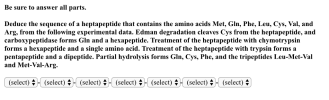 Deduce the sequence of a heptapeptide that contains the amino
acids Met, Gln, Phe, Leu, Cys, Val, and Arg, from the following
experimental data. Edman degradation cleaves Cys from the
heptapeptide, and carboxypeptidase forms Gln and a hexapeptide.
Treatment of the heptapeptide with chymotrypsin forms a hexapeptide
and a single amino acid. Treatment of the heptapeptide with trypsin
forms a pentapeptide and a dipeptide. Partial hydrolysis forms Gln,
Cys, Phe, and the tripeptides Leu-Met-Val and Met-Val-Arg.
Be sure to answer...
Deduce the sequence of a heptapeptide that contains the amino
acids Met, Gln, Phe, Leu, Cys, Val, and Arg, from the following
experimental data. Edman degradation cleaves Cys from the
heptapeptide, and carboxypeptidase forms Gln and a hexapeptide.
Treatment of the heptapeptide with chymotrypsin forms a hexapeptide
and a single amino acid. Treatment of the heptapeptide with trypsin
forms a pentapeptide and a dipeptide. Partial hydrolysis forms Gln,
Cys, Phe, and the tripeptides Leu-Met-Val and Met-Val-Arg.
Be sure to answer...
Of the amino acids below, which are most hydrophobic? Asp Glu and Arg Leu Iso and...
Of the amino acids below, which are most hydrophobic? Asp Glu and Arg Leu Iso and Phe Cys Gly and Pro Arg Asp and Asn
You have a small gene that encodes the following amino acid: N-MET-ASP-SER-VAL-ALA-ARG-PHE-MET-TRP-C. There is a single...
You have a small gene that encodes the following amino acid: N-MET-ASP-SER-VAL-ALA-ARG-PHE-MET-TRP-C. There is a single mutation in the DNA that causes a change in the amino acid sequence to: N-MET-VAL-GLN-TRP-PRO-ASP-LEU-CYS-GLY-C. a) What kind of mutation is this? Explain. (2 points) b) Indicate the DNA sequence (coding strand) of the gene. Show the original DNA sequence then the mutated sequence. Wild type DNA: Mutant DNA: You have another mutation (a different mutation from the one described in parts a and...
If the sequence Met-Lys-Glu-Ala-Phe-Leu-Gln is folded into an α-helix, the amino acid whose carbonyl group interacts...
If the sequence Met-Lys-Glu-Ala-Phe-Leu-Gln is folded into an α-helix, the amino acid whose carbonyl group interacts with the amide hydrogen of Gln would be: A. Glu B. Ala C. Phe D. Leu E. Lys The answer is A. can you explain the answer
 10. The peptide shown has the amino acid sequence: A. Val-Ser-Ile-Glu-Lys B. Lys-Glu-Ile-Ser-Val C. Thr-Asp-Leu-Gln-Arg D. Val-Asp-Ile-Glu-Arg 11. Which of the following describes the entire three- dimensional structure of a single polypeptide? A. Secondary structure B. Quaternary structure C. Tertiary structure D. Primary structure 12. What is the primary driving force in the formation of protein tertiary structure? A. Energy released when additional ion pairs are formed. B. The exclusion of non-polar substances from aqueous solution. C. The formation of...
 5. Consider the following peptide: His-Ser-Gln-Gly-Thr-Phe-Thr-Ser-Asp-Tyr-Ser-Lys-Tyr-Leu-Asp-Ser-Arg-Arg-Ala-Gin- Asp-Phe-Val-Gln-Trp-Leu-Met-Asn-Thr a. What are the fragments, if it is cleaved by trypsin? b. What are the fragments, if it is cleaved by chymotrypsin? c. What are the fragments, if it is cleaved by pepsin?
 Deduce the sequence of a heptapeptide that contains the amino
acids Met, Gln, Phe, Leu, Cys, Val, and Arg, from the following
experimental data. Edman degradation cleaves Cys from the
heptapeptide, and carboxypeptidase forms Gln and a hexapeptide.
Treatment of the heptapeptide with chymotrypsin forms a hexapeptide
and a single amino acid. Treatment of the heptapeptide with trypsin
forms a pentapeptide and a dipeptide. Partial hydrolysis forms Gln,
Cys, Phe, and the tripeptides Leu-Met-Val and Met-Val-Arg.
Be sure to answer...
Deduce the sequence of a heptapeptide that contains the amino
acids Met, Gln, Phe, Leu, Cys, Val, and Arg, from the following
experimental data. Edman degradation cleaves Cys from the
heptapeptide, and carboxypeptidase forms Gln and a hexapeptide.
Treatment of the heptapeptide with chymotrypsin forms a hexapeptide
and a single amino acid. Treatment of the heptapeptide with trypsin
forms a pentapeptide and a dipeptide. Partial hydrolysis forms Gln,
Cys, Phe, and the tripeptides Leu-Met-Val and Met-Val-Arg.
Be sure to answer...
Most questions answered within 3 hours.
-
Where is the error in this code sequence?
String s1 = "Hello";
String s2 = "ello";...
asked 10 months ago -
Financial data for Joel de Paris, Inc., for last year
follow:
Joel de Paris, Inc.
Balance...
asked 10 months ago -
Consider this reaction:
Al2(SO4)3 (aq)+ BaCl3
(aq) Al2Cl6 (aq)- +
3BaSO4(s) . What is the...
asked 10 months ago -
Suppose that Savneet is considering increasing her
recent random sample from 20 car rentals to 40...
asked 10 months ago -
Trucks arrive at an unloading terminal at an average rate of 120
per hour.
Trucks arrive...
asked 10 months ago -
Why are methanol and ethanol completely soluble in water while
octanol is not very little soluble....
asked 10 months ago -
A facilities manager at a university reads in a research report
that the mean amount of...
asked 10 months ago -
When the CuSO4 is rehydrated by adding water to the anhydrous
compound, is this an endothermic...
asked 10 months ago -
A ray of sunlight is passing from diamond into crown glass; the
angle of incidence is...
asked 10 months ago -
A block of mass 0.249 kg is placed on top of a light, vertical
spring of...
asked 10 months ago -
how do the kidneys compensate in the presences of acidosis
a) trigger hyperventilate
b) reserve acid...
asked 10 months ago -
Question 501 pts
The rental rate of capital to the firm increases. Which of the
following...
asked 10 months ago