Km represents the.... (click all that apply) the back reaction of product to ES kcat formation...
Km represents the.... (click all that apply)
| the back reaction of product to ES |
| kcat |
| formation of EP |
| formation of ES |
Homework Answers
I have marked the answer on the picture provided by you only, so please take a look-
The answer has been marked with red ink.
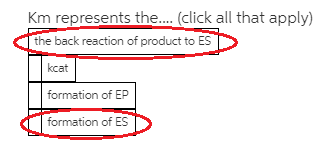
Hope it helps, Good luck !!!!
PLEASE DO PRESS LIKE :)
Add Answer to:
Km represents the.... (click all that apply)
the back reaction of product to ES
kcat
formation...
Km represents the.... formation of EP the back reaction of product to ES formation of ES kcat Km represents the......
 Km represents the.... formation of EP the back reaction of product to ES formation of ES kcat
Km represents the.... formation of EP the back reaction of product to ES formation of ES kcat
Km represents the.... formation of EP the back reaction of product to ES formation of ES kcat
)* (Vmax). 4. When [S] = KM, Vo=( A) 0.5 B) KM C) 0.75 D) kcat...
 )* (Vmax). 4. When [S] = KM, Vo=( A) 0.5 B) KM C) 0.75 D) kcat E) [S] 5. The overall transformation shown in the following reaction: E s. Es p + E For the reaction, the steady state assumption A) ES breakdown occurs at the same rate as ES formation B) [P]>>[E] C) implies that ki-k-1 D) implies that k., and k2 are such that the [ES] = k1[ES] E) [S] = [P]
For enzymes in which the slowest (rate-limiting) step is the reaction: K2 ES → E+P Km...
For enzymes in which the slowest (rate-limiting) step is the reaction: K2 ES → E+P Km becomes equivalent to: A) kcat. B) the [S] where V0 = Vmax. C) the dissociation constant, Kd, for the ES complex. D) the maximal velocity. E) the turnover number. The answer is C), could you please explain?
Glucokinase is a liver enzyme with a kcat of 33/second and a Km for Glucose of...
Glucokinase is a liver enzyme with a kcat of 33/second and a Km for Glucose of 7 mM. What is the initial reaction rate (in mM product / second) of 0.1 mM glucokinase in the presence of 50 mM glucose? Please show your work clearly.
2. In a single substrate enzyme-catalyzed reaction, the forward rate constant (formation of ES) is 2.1x10⁵...
2. In a single substrate enzyme-catalyzed reaction, the forward rate constant (formation of ES) is 2.1x10⁵ M-1 s-1 , the reverse rate constant (dissociation of ES to E +S) is 9.4x10³ s-1 , and the catalytic rate constant (turnover of ES to P) is 7.2x10² s-1 . From this data, KM is:
Consider a description of an enzymatic reaction pathway that begins with the binding of substrate S...
 Consider a description of an enzymatic reaction pathway that begins with the binding of substrate S to enzyme E and ends with the release of product P from the enzyme. E+S →ES → EP E+P Under many circumstances, KM = [E] [S] / [ES] What proportion of enzyme molecules are bound to substrate when [S] = KM? Why? Recall that when [S] = KM, the reaction rate is Vmax/2. Does your answer to Part A make sense in light of...
54. What is the catalyze reaction rate? Km=2 mM Kcat= 3 s-1 At the enzyme concentration=10...
54. What is the catalyze reaction rate? Km=2 mM Kcat= 3 s-1 At the enzyme concentration=10 nM and substrate concentration= 3 mM
Q1: Please derive rate of product formation (rp) of the following enzymatic reaction. Please apply Pseudo-...
 Q1: Please derive rate of product formation (rp) of the following enzymatic reaction. Please apply Pseudo- Steady-State Hypothesis (PSSH) on the two enzyme-substrate complexes. E+S S E S,+S,ESS E SS, P+E
01: Please derive rate of product formation (rp) of the following enzymatic reaction. Please apply Pseudo-...
 01: Please derive rate of product formation (rp) of the following enzymatic reaction. Please apply Pseudo- Steady-State Hypothesis (PSSH) on the two enzyme-substrate complexes. E+ SE. E•S,+8, E•Ss E•S,S, “P+E
01: Please derive rate of product formation (rp) of the following enzymatic reaction. Please apply Pseudo-...
 01: Please derive rate of product formation (rp) of the following enzymatic reaction. Please apply Pseudo- Steady-State Hypothesis (PSSH) on the two enzyme-substrate complexes. E+ SE. E•S,+8, E•Ss E•S,S, “P+E
 Km represents the.... formation of EP the back reaction of product to ES formation of ES kcat
Km represents the.... formation of EP the back reaction of product to ES formation of ES kcat
Km represents the.... formation of EP the back reaction of product to ES formation of ES kcat
 )* (Vmax). 4. When [S] = KM, Vo=( A) 0.5 B) KM C) 0.75 D) kcat E) [S] 5. The overall transformation shown in the following reaction: E s. Es p + E For the reaction, the steady state assumption A) ES breakdown occurs at the same rate as ES formation B) [P]>>[E] C) implies that ki-k-1 D) implies that k., and k2 are such that the [ES] = k1[ES] E) [S] = [P]
 Consider a description of an enzymatic reaction pathway that begins with the binding of substrate S to enzyme E and ends with the release of product P from the enzyme. E+S →ES → EP E+P Under many circumstances, KM = [E] [S] / [ES] What proportion of enzyme molecules are bound to substrate when [S] = KM? Why? Recall that when [S] = KM, the reaction rate is Vmax/2. Does your answer to Part A make sense in light of...
 Q1: Please derive rate of product formation (rp) of the following enzymatic reaction. Please apply Pseudo- Steady-State Hypothesis (PSSH) on the two enzyme-substrate complexes. E+S S E S,+S,ESS E SS, P+E
 01: Please derive rate of product formation (rp) of the following enzymatic reaction. Please apply Pseudo- Steady-State Hypothesis (PSSH) on the two enzyme-substrate complexes. E+ SE. E•S,+8, E•Ss E•S,S, “P+E
 01: Please derive rate of product formation (rp) of the following enzymatic reaction. Please apply Pseudo- Steady-State Hypothesis (PSSH) on the two enzyme-substrate complexes. E+ SE. E•S,+8, E•Ss E•S,S, “P+E
Most questions answered within 3 hours.
-
Where is the error in this code sequence?
String s1 = "Hello";
String s2 = "ello";...
asked 10 months ago -
Financial data for Joel de Paris, Inc., for last year
follow:
Joel de Paris, Inc.
Balance...
asked 10 months ago -
Consider this reaction:
Al2(SO4)3 (aq)+ BaCl3
(aq) Al2Cl6 (aq)- +
3BaSO4(s) . What is the...
asked 10 months ago -
Suppose that Savneet is considering increasing her
recent random sample from 20 car rentals to 40...
asked 10 months ago -
Trucks arrive at an unloading terminal at an average rate of 120
per hour.
Trucks arrive...
asked 10 months ago -
Why are methanol and ethanol completely soluble in water while
octanol is not very little soluble....
asked 10 months ago -
A facilities manager at a university reads in a research report
that the mean amount of...
asked 10 months ago -
When the CuSO4 is rehydrated by adding water to the anhydrous
compound, is this an endothermic...
asked 10 months ago -
A ray of sunlight is passing from diamond into crown glass; the
angle of incidence is...
asked 10 months ago -
A block of mass 0.249 kg is placed on top of a light, vertical
spring of...
asked 10 months ago -
how do the kidneys compensate in the presences of acidosis
a) trigger hyperventilate
b) reserve acid...
asked 10 months ago -
Question 501 pts
The rental rate of capital to the firm increases. Which of the
following...
asked 10 months ago