The following table shows the outputs per worker per day in two countries that can produce...
- The following table shows the outputs per worker per day in two countries that can produce two goods, bicycles & coffeemakers, only:
Bicycles Coffeemakers
Ambrosia 20 10
Bandaria 2 5
Ambrosia has 100 workers & Bandaria has 100 workers.
- Draw the production possibility frontiers for the two countries (output per day).
- Which country has the absolute advantage in producing the bicycles, and which one has the absolute advantage in producing the coffeemakers?
- Which country has the comparative advantage in producing the bicycles, and which one has the comparative advantage in producing the coffeemakers?
- If, as autarkies, each country decided to use half of its workers in the production of the bicycles and half of its workers to produce the coffeemakers, what would be the outputs?
- If the two countries are open to trade, which one will sell the bicycles and buy the coffeemakers?
- What will be the terms of trade? That is, how many bicycles will be offered in exchange for a coffeemaker?
- Draw a world production possibility frontier (that is, the maximum combinations of the bicycles & coffeemakers produced by two countries together).
- Show, on the graph in question g , the world production (the combination of the aggregate productions of the bicycles & the coffeemakers) the autarkies (from question d ) generate.
- Explain, in your own words, what you could conclude from the diagram that you have created to answer question h (i.e., the aggregate autarky production compared to the world production possibility frontier.
Homework Answers
With 100 workers, each country will produce
| Bicycles | Coffeemakers | |
| Ambrosia | 2000 | 1000 |
| Bandaria | 200 | 500 |
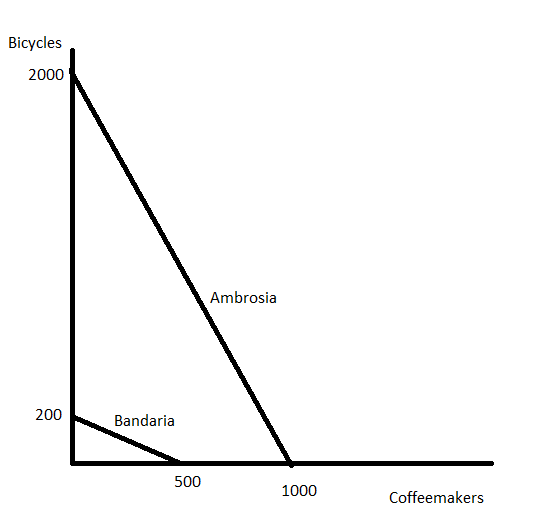
b) Ambrosia has the absolute advantage in producing both the goods
c) The opportunity cost of producing Coffeemakers for
Ambrosia = 20/10 =2
Bandaria = 2/5 = 0.4
The opportunity cost of producing Bicycles for
Ambrosia = 10/20 = 0.5
Bandaria = 5/2 = 2.5
So, Bandaria has a comparative advantage in producing Coffeemakers and Ambrosia has a comparative advantage in producing Bicycles
d) In autarky, Ambrosia will produce 50*20 = 1000 bicycles and 500 coffeemakers
Bandaria will produce 100 bicycles and 250 coffeemakers
e) When trade is open, Ambrosia will produce bicycles and buy the coffeemaker from the Bandaria
As per Chegg guidelines, more than four parts are answered.
Add Answer to:
The following table shows the outputs per worker per day in two
countries that can produce...
1. Compare the absolute and comparative advantages for two countries. Suppose there are two countries A...
1. Compare the absolute and comparative advantages for two countries. Suppose there are two countries A and B producing two products X and Y. The unit labor requirement for two countries and two products are: a A X = 1; a A Y = 5; a B X = 10; a B Y = 10 • Which country has absolute advantage in producing X? Why? • Which country has comparative advantage in producing X? Why? • Suppose there are LA...
Question 01. Suppose that both the U.S. and Japan can produce computers and bushels of wheat...
Question 01. Suppose that both the U.S. and Japan can produce computers and bushels of wheat using only labor (i.e., two countries, two goods, one factor Ricardian model). One U.S. worker can produce 3 computers or 10 bushels of wheat. One Japanese worker can produce 2 computers or 5 bushels of wheat. Given that the U.S. has 100 workers and Japan has 180 workers, answer each of the following parts. Show your work for credit. A. Which country has the...
Suppose that in a year an American worker can produce 100 shirts or 20 computers and...
Suppose that in a year an American worker can produce 100 shirts or 20 computers and a Chinese worker can produce 100 shirts or 10 computers. 1. For each country, graph the production possibilities frontier. Suppose that without trade the workers in each country spend half their time producing each good. Identify this point in your graphs. 2. Who has the comparative advantage in the production of shirts? What about for computers? 3. If these countries were open to...
2. Problems and Applications Q2 An American worker can produce either 5 cars or 9 tons...
 2. Problems and Applications Q2 An American worker can produce either 5 cars or 9 tons of grain a year. A Japanese worker can produce either 3 cars or 9 tons of grain a year. To keep things simple, assume that each country has 100 million workers. Complete the following table with the number of workers needed to make one car or 1 ton of grain in the United States and Japan. Workers Needed to Make 1 Car1 Ton of...
Consider a two countries, Portugal and England, that produce two goods, wine and cheese, with only...
Consider a two countries, Portugal and England, that produce two goods, wine and cheese, with only one factor of production, Labor. In England, one unit of labor can produce 2 units of wine or 1 unit of cheese. In Portugal, one unit of labor can produce 3 units of wine or 1/2 of cheese. There are 100 units of labor in Portugal, and 100 in England. Countries share the same tastes, and there is perfect competition. 1) Fill in the...
2. Problems and Applications Q2 An American worker can produce either 5 cars or 9 tons...
 2. Problems and Applications Q2 An American worker can produce either 5 cars or 9 tons of grain a year. A Japanese worker can produce either 3 cars or 9 tons of grain a year. To keep things simple, assume that each country has 100 million workers. Complete the following table with the number of workers needed to make one car or 1 ton of grain in the United States and Japan. Workers Needed to Make 1 Car 1 Ton...
respectively. [Here you have to use the CORREL command in Excel]. DO NOT ATTACH YOUR DATA...
 respectively. [Here you have to use the CORREL command in Excel]. DO NOT ATTACH YOUR DATA TECHNICAL ANALYSIS For technical analysis, you need to follow Step 4. Step 4. In order to conjecture the circumstances in these two countries under autarky (when there is no trade), consider the following hypothetical scenario based on Ricardian model. Assume throughout that those two countries (Italy and Sweden) are the only two countries in the world, at least for purposes of trade. There are...
need help with d and e 1. Comparative Advantage (1.5 marks) Analyze the following two countries....
 need help with d and e
1. Comparative Advantage (1.5 marks) Analyze the following two countries. In one day in Germany, it takes 24 workers to produce an airplane and 6 workers to produce a boat. In one day in France, it takes 8 workers to produce an airplane and 4 workers to produce a boat. Both countries have 48 workers available each day. Draw the PPF of each country for one day's worth of production. Use a separate graph...
need help with d and e
1. Comparative Advantage (1.5 marks) Analyze the following two countries. In one day in Germany, it takes 24 workers to produce an airplane and 6 workers to produce a boat. In one day in France, it takes 8 workers to produce an airplane and 4 workers to produce a boat. Both countries have 48 workers available each day. Draw the PPF of each country for one day's worth of production. Use a separate graph...
3. American and Japanese workers can each produce 4 cars a year. An American worker can...
3. American and Japanese workers can each produce 4 cars a year. An American worker can produce 10 tons of grain a year, whereas a Japanese worker can produce 5 tons of grain a year. To keep things simple, assume that each country has 100 million workers. a. Graph the production possibilities frontier of the American and Japanese economies. b. For the US, what is the opportunity cost of a car? Of grain? For Japan, what is the opportunity cost...
Question 1 -Chapter 3)-Gains from Trade: The only two countries in the world, Alpha and Omega,...
 Question 1 -Chapter 3)-Gains from Trade: The only two countries in the world, Alpha and Omega, face the following production possibilities frontiers (popcorn and peanuts) Alpha's Production PossibilitiesOmega's Production Possibilities Frontier Frontier 300 300 208 223 rs 150 123 100 25 215 133 25 25. 12 15 280 Assume that each country decides to use half of its resources in the production of each good. Show these points on the graphs for each country as point A a. If these...
 2. Problems and Applications Q2 An American worker can produce either 5 cars or 9 tons of grain a year. A Japanese worker can produce either 3 cars or 9 tons of grain a year. To keep things simple, assume that each country has 100 million workers. Complete the following table with the number of workers needed to make one car or 1 ton of grain in the United States and Japan. Workers Needed to Make 1 Car1 Ton of...
 2. Problems and Applications Q2 An American worker can produce either 5 cars or 9 tons of grain a year. A Japanese worker can produce either 3 cars or 9 tons of grain a year. To keep things simple, assume that each country has 100 million workers. Complete the following table with the number of workers needed to make one car or 1 ton of grain in the United States and Japan. Workers Needed to Make 1 Car 1 Ton...
 respectively. [Here you have to use the CORREL command in Excel]. DO NOT ATTACH YOUR DATA TECHNICAL ANALYSIS For technical analysis, you need to follow Step 4. Step 4. In order to conjecture the circumstances in these two countries under autarky (when there is no trade), consider the following hypothetical scenario based on Ricardian model. Assume throughout that those two countries (Italy and Sweden) are the only two countries in the world, at least for purposes of trade. There are...
 need help with d and e
1. Comparative Advantage (1.5 marks) Analyze the following two countries. In one day in Germany, it takes 24 workers to produce an airplane and 6 workers to produce a boat. In one day in France, it takes 8 workers to produce an airplane and 4 workers to produce a boat. Both countries have 48 workers available each day. Draw the PPF of each country for one day's worth of production. Use a separate graph...
need help with d and e
1. Comparative Advantage (1.5 marks) Analyze the following two countries. In one day in Germany, it takes 24 workers to produce an airplane and 6 workers to produce a boat. In one day in France, it takes 8 workers to produce an airplane and 4 workers to produce a boat. Both countries have 48 workers available each day. Draw the PPF of each country for one day's worth of production. Use a separate graph...
 Question 1 -Chapter 3)-Gains from Trade: The only two countries in the world, Alpha and Omega, face the following production possibilities frontiers (popcorn and peanuts) Alpha's Production PossibilitiesOmega's Production Possibilities Frontier Frontier 300 300 208 223 rs 150 123 100 25 215 133 25 25. 12 15 280 Assume that each country decides to use half of its resources in the production of each good. Show these points on the graphs for each country as point A a. If these...
Most questions answered within 3 hours.
-
Where is the error in this code sequence?
String s1 = "Hello";
String s2 = "ello";...
asked 11 months ago -
Financial data for Joel de Paris, Inc., for last year
follow:
Joel de Paris, Inc.
Balance...
asked 11 months ago -
Consider this reaction:
Al2(SO4)3 (aq)+ BaCl3
(aq) Al2Cl6 (aq)- +
3BaSO4(s) . What is the...
asked 11 months ago -
Suppose that Savneet is considering increasing her
recent random sample from 20 car rentals to 40...
asked 11 months ago -
Trucks arrive at an unloading terminal at an average rate of 120
per hour.
Trucks arrive...
asked 11 months ago -
Why are methanol and ethanol completely soluble in water while
octanol is not very little soluble....
asked 11 months ago -
A facilities manager at a university reads in a research report
that the mean amount of...
asked 11 months ago -
When the CuSO4 is rehydrated by adding water to the anhydrous
compound, is this an endothermic...
asked 11 months ago -
A ray of sunlight is passing from diamond into crown glass; the
angle of incidence is...
asked 11 months ago -
A block of mass 0.249 kg is placed on top of a light, vertical
spring of...
asked 11 months ago -
how do the kidneys compensate in the presences of acidosis
a) trigger hyperventilate
b) reserve acid...
asked 11 months ago -
Question 501 pts
The rental rate of capital to the firm increases. Which of the
following...
asked 11 months ago