Two objects a and b. Object a has been read by a subject s before (i.e.,...
Two objects a and b. Object a has been read by a subject s before (i.e., a is a member of PR(s)). If CD(a) = CD(b), can s read b?
a. Yes
b. no
c. cannot determine
d. none of the above
Homework Answers
Answer:
The correct answer is B)NO
A is member of PR(S) and the is the reason s read a. B is not a
member of PR(s) so, it cannot read b eventhough CD(a) = CD(b).
Thanks and all the best. Let me know in case if you have any doubts.
Add Answer to:
Two objects a and b. Object a has been read by a subject s
before (i.e.,...
Two objects, A and B, both have the same mass but B has a larger volume....
Two objects, A and B, both have the same mass but B has a larger volume. What can you say about the density of these objects? A. Since they have the same mass, they have the same density. B. Not enough data to determine. C. Object A is less dense than object B. D. Object B is less dense than object A.
two objects both with masses of 0.05kg collide. What is the final velocity of object b(...
 two objects both with masses of
0.05kg collide. What is the final velocity of object b( magnitude
and direction)?
2. Two objects, both with masses of 0.0500 kg, collide as shown in the figure. What is the final velocity of object B (magnitude and direction)? Before After sit 9 1.00 m/s 1.50 m/s.--7 0/20 20.01 ur & I of Tool D------- 30.00B 2.00 m/s
two objects both with masses of
0.05kg collide. What is the final velocity of object b( magnitude
and direction)?
2. Two objects, both with masses of 0.0500 kg, collide as shown in the figure. What is the final velocity of object B (magnitude and direction)? Before After sit 9 1.00 m/s 1.50 m/s.--7 0/20 20.01 ur & I of Tool D------- 30.00B 2.00 m/s
Two objects, A and B, have the same mass but object A is very sticky and...
Two objects, A and B, have the same mass but object A is very sticky and object B is not. If a ball is thrown with the same speed at these objects on a frictionless surface (and the ball sticks to A), what can be said about the final speeds of A and B? please explainnnn a) Object A moves faster than B. b) Object B moves faster than A. c) Both objects have the same final speed because the...
9. Two objects of the same volume,but differing densities are placed on a bookshelf.Which object has...
9. Two objects of the same volume,but differing densities are placed on a bookshelf.Which object has more mass? A) The object with higher density B) The object with higher density C) The objects have the same mass D) Indeterminable 10. In the linear equation v = at + vi, what are the units of the y-intercept for the graph v(m/s) vs t(s)? A) Force B) Distance C) Mass D) acceleration 11. How many micrometers are there in ten terameters? A)...
objects a and b are moving toward one another on a frictionless surface. Object B has...
objects a and b are moving toward one another on a frictionless surface. Object B has twice the mass and twice the speed as object A. the two objects collide and stick together. which is true about the magnitude of the final momentum of the two-object system? show work to support the answer. A. It is equal in the magnitude of the initial momentum of Object A B. It is twice in the magnitude of the initial momentum of Object...
Two objects of equal mass collide as shown below. Object A has an inital velocity of...
 Two
objects of equal mass collide as shown below. Object A has an
inital velocity of 15 m/s along the x axis. Object B has an inital
velocity of -20m/s along the x axis. After the collision, object B
has a final velocity of 16 m/s. What are the components of the
final velocity of Object A ( in m/s)?
A7) Two objects of equal mass collide as shown below. Object A has an initial velocity of 15 m/s along...
Two
objects of equal mass collide as shown below. Object A has an
inital velocity of 15 m/s along the x axis. Object B has an inital
velocity of -20m/s along the x axis. After the collision, object B
has a final velocity of 16 m/s. What are the components of the
final velocity of Object A ( in m/s)?
A7) Two objects of equal mass collide as shown below. Object A has an initial velocity of 15 m/s along...
Two objects (object A and object B) are moving with constant velocities (VA=30(m/s), VB=40(m/s))&nb
Two objects (object A and object B) are moving with constant velocities (VA=30(m/s), VB=40(m/s)) in the same direction. Object B is behind object A. At the moment that the distance between them is 15(m) object A accelerates with aA = 1 (m/s^2) and object B decelerates with aB = -3(m/s). Are they going to hit each other? (show your work)
Two objects are sitting on a frictionless surface. Object 1 has mass mi, while object 2...
 Two objects are sitting on a frictionless surface. Object 1 has mass mi, while object 2 has twice as large a mass, m2=2mı. You push with force F on object 1 for 3 s, and then push on object 2 for the same length of time with the same force F. A. After the push, what is the ratio of the momentum of object 2 to the momentum of object 1? Explain your answer. [5] a) 4/1 b) 2/1 c)...
Two objects are located on an airtrack. The magnitude of the charge on object A is...
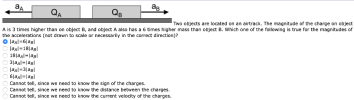 Two objects are located on an airtrack. The magnitude of the charge on object A is 3 times higher than on object B, and object A also has a 6 times higher mass than object B. Which one of the following is true for the magnitudes of the accelerations (not drawn to scale or necessarily in the correct direction)? laAl-18laBl 18laAl laBl 3laAl laBl Cannot tell, since we need to know the sign of the charges Cannot tell, since we...
 two objects both with masses of
0.05kg collide. What is the final velocity of object b( magnitude
and direction)?
2. Two objects, both with masses of 0.0500 kg, collide as shown in the figure. What is the final velocity of object B (magnitude and direction)? Before After sit 9 1.00 m/s 1.50 m/s.--7 0/20 20.01 ur & I of Tool D------- 30.00B 2.00 m/s
two objects both with masses of
0.05kg collide. What is the final velocity of object b( magnitude
and direction)?
2. Two objects, both with masses of 0.0500 kg, collide as shown in the figure. What is the final velocity of object B (magnitude and direction)? Before After sit 9 1.00 m/s 1.50 m/s.--7 0/20 20.01 ur & I of Tool D------- 30.00B 2.00 m/s
 Two
objects of equal mass collide as shown below. Object A has an
inital velocity of 15 m/s along the x axis. Object B has an inital
velocity of -20m/s along the x axis. After the collision, object B
has a final velocity of 16 m/s. What are the components of the
final velocity of Object A ( in m/s)?
A7) Two objects of equal mass collide as shown below. Object A has an initial velocity of 15 m/s along...
Two
objects of equal mass collide as shown below. Object A has an
inital velocity of 15 m/s along the x axis. Object B has an inital
velocity of -20m/s along the x axis. After the collision, object B
has a final velocity of 16 m/s. What are the components of the
final velocity of Object A ( in m/s)?
A7) Two objects of equal mass collide as shown below. Object A has an initial velocity of 15 m/s along...
 Two objects are sitting on a frictionless surface. Object 1 has mass mi, while object 2 has twice as large a mass, m2=2mı. You push with force F on object 1 for 3 s, and then push on object 2 for the same length of time with the same force F. A. After the push, what is the ratio of the momentum of object 2 to the momentum of object 1? Explain your answer. [5] a) 4/1 b) 2/1 c)...
 Two objects are located on an airtrack. The magnitude of the charge on object A is 3 times higher than on object B, and object A also has a 6 times higher mass than object B. Which one of the following is true for the magnitudes of the accelerations (not drawn to scale or necessarily in the correct direction)? laAl-18laBl 18laAl laBl 3laAl laBl Cannot tell, since we need to know the sign of the charges Cannot tell, since we...
Most questions answered within 3 hours.
-
Where is the error in this code sequence?
String s1 = "Hello";
String s2 = "ello";...
asked 11 months ago -
Financial data for Joel de Paris, Inc., for last year
follow:
Joel de Paris, Inc.
Balance...
asked 11 months ago -
Consider this reaction:
Al2(SO4)3 (aq)+ BaCl3
(aq) Al2Cl6 (aq)- +
3BaSO4(s) . What is the...
asked 11 months ago -
Suppose that Savneet is considering increasing her
recent random sample from 20 car rentals to 40...
asked 11 months ago -
Trucks arrive at an unloading terminal at an average rate of 120
per hour.
Trucks arrive...
asked 11 months ago -
Why are methanol and ethanol completely soluble in water while
octanol is not very little soluble....
asked 11 months ago -
A facilities manager at a university reads in a research report
that the mean amount of...
asked 11 months ago -
When the CuSO4 is rehydrated by adding water to the anhydrous
compound, is this an endothermic...
asked 11 months ago -
A ray of sunlight is passing from diamond into crown glass; the
angle of incidence is...
asked 11 months ago -
A block of mass 0.249 kg is placed on top of a light, vertical
spring of...
asked 11 months ago -
how do the kidneys compensate in the presences of acidosis
a) trigger hyperventilate
b) reserve acid...
asked 11 months ago -
Question 501 pts
The rental rate of capital to the firm increases. Which of the
following...
asked 11 months ago