A sample of magnesium with a mass of 0.0514g reacted with hydrochloric acid. Volume of the...
A sample of magnesium with a mass of 0.0514g reacted with hydrochloric acid. Volume of the resulting hydrogen gas was 58.5mL. Atmospheric pressure was 770.0mmHg and the temperature was 22.5°c. Vapor pressure of water at this temp is 20.5mmHg. Determine the experimental value of the universal gas constant and percent error.
Homework Answers
Request Answer!
We need at least 10 more requests to produce the answer.
0 / 10 have requested this problem solution
The more requests, the faster the answer.
Add Answer to:
A sample of magnesium with a mass of 0.0514g reacted with
hydrochloric acid. Volume of the...
Temperature °C Water Vapor Pressure (mmHg) Magnesium metal is reacted with hydrochloric acid to produce hydrogen...
 Temperature °C Water Vapor Pressure (mmHg) Magnesium metal is reacted with hydrochloric acid to produce hydrogen gas. A sample of hydrogen gas is collected over water in a eudiometer. Calculate the mass (in grams) of magnesium metal needed to produce 39.0 mL of hydrogen gas at an atmospheric pressure of 739 mmHg and a temperature of 25.9 °C. 20 17.5 22 19.8 24 22.4 Mass of Mg - g 26 25.2 28 28.3 30 31.8
-REPORT FO SECTION DATA Mass of magnesium strip: 2402 Temperature of water from the thermometer: 71 3705 Atmospheric pressure (inches) 29.3Sx 2513 Volume of gas collected: CALCULATIONS: (Show wo...
 -REPORT FO SECTION DATA Mass of magnesium strip: 2402 Temperature of water from the thermometer: 71 3705 Atmospheric pressure (inches) 29.3Sx 2513 Volume of gas collected: CALCULATIONS: (Show work) 20 94A0つ Moles of magnesium: OS10X 24.30 2.094316 3 Moles of hydrogen produced 12 29215K Temperature of gas in Kelvins: Volume of hydrpgen gas in liters: Atmospheric pressure (mm. Hg): Vapor pressure of water in eudiometer: Pressure of hydrogen gas in eudiometer (mm.Hg.): Pressure of hydrogen gas (atmosphere): Calculated value of...
Mass of Magnesium strip Use the length of your magnesium strip and the mass per m...
 Mass of Magnesium strip Use the length of your magnesium strip and the mass per m provided by your TA to calculate the mass of your magnesium strip. Make sure to convert so that your units match! Mass of magnesium strip Moles of magnesium used Convert the mass of each magnesium strip into moles using the molar mass. Moles of magnesium Moles of hydrogen produced (n) Use the mole ratio from the balanced chemical equation to convert the moles magnesium...
Experimental Determination of the Gas Constant Experimental Data . (a) Mass of Magnesium metal used (b)...
 Experimental Determination of the Gas Constant Experimental Data . (a) Mass of Magnesium metal used (b) Volume of H, gas collected mi (C) Temperature of H2 gas collected (d) Atmospheric Pressure (e) Temperature of Water in bath (bucket) Vapor Pressure of Water at above temperature Trial 0.03419 36.0 ml 22 • 766-5 mm/Hg 2214 oc 19.3 mmHg Trial 2 0.02129 20.5 mL 23-0's 766 5mnHg 224 °C 22 mmHg Data Analysis Using your experimental data, determine the value of R,...
Magnesium metal reacts with hydrochloric acid to give hydrogen gas. Mg + 2 HCl → MgCl2...
 Magnesium metal reacts with hydrochloric acid to give hydrogen gas. Mg + 2 HCl → MgCl2 + H2 Use the following reaction information to answer the subsequent questions. Show all of your work. 92 mm Length of Magnesium ribbon: Barometric Pressure: 762.9 mmHg Water Temperature: 29 °C Initial Gas Volume: 0.00 mL Final Gas Volume: 67.35 mL 0.7559 Mass = Length (in mm) x (1000 mm) 1. Magnesium is usually found in the laboratory as a ribbon strip. Find the...
calculate the mass of magnesium metal that must be reacted with hydrochloric acid to produce 1.00...
calculate the mass of magnesium metal that must be reacted with hydrochloric acid to produce 1.00 gran of hydrogen gas
2. A 0.865g sample of an unknown metal (X) reacted with hydrochloric acid according to the...
 2. A 0.865g sample of an unknown metal (X) reacted with hydrochloric acid according to the balanced chemical equation shown below. XC12 (aq) + H2() X+ 2 HCl(q) The volume of the hydrogen gas collected over water was measured at 191 mL at 22C and an atmospheric pressure of 762 mmHg. Calculate the molar mass of the unknown metal, and use a periodic table to identify the metal. Molar mass: The metal is 127
57 ldeal Gas Law: Estimation of Molar Mass of Magnesium Experiment 8 QUESTIONS A POST LAB...
 57 ldeal Gas Law: Estimation of Molar Mass of Magnesium Experiment 8 QUESTIONS A POST LAB A 0.0524-g sample of magnesium is reacted with 25 mL of 3.0 M sulfuric acid as described in the experimen- tal section. The resulting hydrogen gas is colllected over water and is found to have a volume of 53.6 mL. The temperature is 25 °C and the atmospheric pressure is 762.12 mm Hg. The column of water height inside the graduated cylinder is found...
3 part question: DATA TABLE mass of magnesium ribbon 0.0754 g volume of "wet" hydrogen produced...
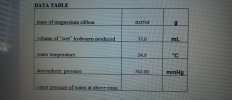 3 part question:
DATA TABLE mass of magnesium ribbon 0.0754 g volume of "wet" hydrogen produced 77.0 mL water temperature 24.0 °C atmospheric pressure 762.00 mmHg vapor pressure of water at above temp. Notepad File Edit Format View Help Calculations: 1. Show the calculation for the partial pressure of hydrogen: (Dalton's Law of Partial Pressures) 2. Show the calculation for the volume of hydrogen at STP: (Combined Gas Law) 3. Show the calculations for the molar volume of hydrogen at...
3 part question:
DATA TABLE mass of magnesium ribbon 0.0754 g volume of "wet" hydrogen produced 77.0 mL water temperature 24.0 °C atmospheric pressure 762.00 mmHg vapor pressure of water at above temp. Notepad File Edit Format View Help Calculations: 1. Show the calculation for the partial pressure of hydrogen: (Dalton's Law of Partial Pressures) 2. Show the calculation for the volume of hydrogen at STP: (Combined Gas Law) 3. Show the calculations for the molar volume of hydrogen at...
Station 2: Calculations with the Ideal Gas Law A Station Letter: A student reacted a strip...
 Station 2: Calculations with the Ideal Gas Law A Station Letter: A student reacted a strip of magnesium metal with 4.00 mL of 4.0 M hydrochloric acid and collected the hydrogen gas produced using the experimental setup you see at the station. Unfortunately, the student forgot to record the mass of the metal before they reacted it with acid. Determine the mass of the magnesium metal the student used in the experiment. For this experiment assume the pressure of the...
 Temperature °C Water Vapor Pressure (mmHg) Magnesium metal is reacted with hydrochloric acid to produce hydrogen gas. A sample of hydrogen gas is collected over water in a eudiometer. Calculate the mass (in grams) of magnesium metal needed to produce 39.0 mL of hydrogen gas at an atmospheric pressure of 739 mmHg and a temperature of 25.9 °C. 20 17.5 22 19.8 24 22.4 Mass of Mg - g 26 25.2 28 28.3 30 31.8
 -REPORT FO SECTION DATA Mass of magnesium strip: 2402 Temperature of water from the thermometer: 71 3705 Atmospheric pressure (inches) 29.3Sx 2513 Volume of gas collected: CALCULATIONS: (Show work) 20 94A0つ Moles of magnesium: OS10X 24.30 2.094316 3 Moles of hydrogen produced 12 29215K Temperature of gas in Kelvins: Volume of hydrpgen gas in liters: Atmospheric pressure (mm. Hg): Vapor pressure of water in eudiometer: Pressure of hydrogen gas in eudiometer (mm.Hg.): Pressure of hydrogen gas (atmosphere): Calculated value of...
 Mass of Magnesium strip Use the length of your magnesium strip and the mass per m provided by your TA to calculate the mass of your magnesium strip. Make sure to convert so that your units match! Mass of magnesium strip Moles of magnesium used Convert the mass of each magnesium strip into moles using the molar mass. Moles of magnesium Moles of hydrogen produced (n) Use the mole ratio from the balanced chemical equation to convert the moles magnesium...
 Experimental Determination of the Gas Constant Experimental Data . (a) Mass of Magnesium metal used (b) Volume of H, gas collected mi (C) Temperature of H2 gas collected (d) Atmospheric Pressure (e) Temperature of Water in bath (bucket) Vapor Pressure of Water at above temperature Trial 0.03419 36.0 ml 22 • 766-5 mm/Hg 2214 oc 19.3 mmHg Trial 2 0.02129 20.5 mL 23-0's 766 5mnHg 224 °C 22 mmHg Data Analysis Using your experimental data, determine the value of R,...
 Magnesium metal reacts with hydrochloric acid to give hydrogen gas. Mg + 2 HCl → MgCl2 + H2 Use the following reaction information to answer the subsequent questions. Show all of your work. 92 mm Length of Magnesium ribbon: Barometric Pressure: 762.9 mmHg Water Temperature: 29 °C Initial Gas Volume: 0.00 mL Final Gas Volume: 67.35 mL 0.7559 Mass = Length (in mm) x (1000 mm) 1. Magnesium is usually found in the laboratory as a ribbon strip. Find the...
 2. A 0.865g sample of an unknown metal (X) reacted with hydrochloric acid according to the balanced chemical equation shown below. XC12 (aq) + H2() X+ 2 HCl(q) The volume of the hydrogen gas collected over water was measured at 191 mL at 22C and an atmospheric pressure of 762 mmHg. Calculate the molar mass of the unknown metal, and use a periodic table to identify the metal. Molar mass: The metal is 127
 57 ldeal Gas Law: Estimation of Molar Mass of Magnesium Experiment 8 QUESTIONS A POST LAB A 0.0524-g sample of magnesium is reacted with 25 mL of 3.0 M sulfuric acid as described in the experimen- tal section. The resulting hydrogen gas is colllected over water and is found to have a volume of 53.6 mL. The temperature is 25 °C and the atmospheric pressure is 762.12 mm Hg. The column of water height inside the graduated cylinder is found...
 3 part question:
DATA TABLE mass of magnesium ribbon 0.0754 g volume of "wet" hydrogen produced 77.0 mL water temperature 24.0 °C atmospheric pressure 762.00 mmHg vapor pressure of water at above temp. Notepad File Edit Format View Help Calculations: 1. Show the calculation for the partial pressure of hydrogen: (Dalton's Law of Partial Pressures) 2. Show the calculation for the volume of hydrogen at STP: (Combined Gas Law) 3. Show the calculations for the molar volume of hydrogen at...
3 part question:
DATA TABLE mass of magnesium ribbon 0.0754 g volume of "wet" hydrogen produced 77.0 mL water temperature 24.0 °C atmospheric pressure 762.00 mmHg vapor pressure of water at above temp. Notepad File Edit Format View Help Calculations: 1. Show the calculation for the partial pressure of hydrogen: (Dalton's Law of Partial Pressures) 2. Show the calculation for the volume of hydrogen at STP: (Combined Gas Law) 3. Show the calculations for the molar volume of hydrogen at...
 Station 2: Calculations with the Ideal Gas Law A Station Letter: A student reacted a strip of magnesium metal with 4.00 mL of 4.0 M hydrochloric acid and collected the hydrogen gas produced using the experimental setup you see at the station. Unfortunately, the student forgot to record the mass of the metal before they reacted it with acid. Determine the mass of the magnesium metal the student used in the experiment. For this experiment assume the pressure of the...
Most questions answered within 3 hours.
-
Where is the error in this code sequence?
String s1 = "Hello";
String s2 = "ello";...
asked 11 months ago -
Financial data for Joel de Paris, Inc., for last year
follow:
Joel de Paris, Inc.
Balance...
asked 11 months ago -
Consider this reaction:
Al2(SO4)3 (aq)+ BaCl3
(aq) Al2Cl6 (aq)- +
3BaSO4(s) . What is the...
asked 11 months ago -
Suppose that Savneet is considering increasing her
recent random sample from 20 car rentals to 40...
asked 11 months ago -
Trucks arrive at an unloading terminal at an average rate of 120
per hour.
Trucks arrive...
asked 11 months ago -
Why are methanol and ethanol completely soluble in water while
octanol is not very little soluble....
asked 11 months ago -
A facilities manager at a university reads in a research report
that the mean amount of...
asked 11 months ago -
When the CuSO4 is rehydrated by adding water to the anhydrous
compound, is this an endothermic...
asked 11 months ago -
A ray of sunlight is passing from diamond into crown glass; the
angle of incidence is...
asked 11 months ago -
A block of mass 0.249 kg is placed on top of a light, vertical
spring of...
asked 11 months ago -
how do the kidneys compensate in the presences of acidosis
a) trigger hyperventilate
b) reserve acid...
asked 11 months ago -
Question 501 pts
The rental rate of capital to the firm increases. Which of the
following...
asked 11 months ago