An automatic pitching machine throws a baseball 15 degrees above horizontal with a speed of 32m/s....
An automatic pitching machine throws a baseball 15 degrees above horizontal with a speed of 32m/s. What is the ball's horizontal velocity?
Homework Answers

Add Answer to:
An automatic pitching machine throws a baseball 15
degrees above horizontal with a speed of 32m/s....
40 ft CL 5 ft A baseball pitching machine "throws" baseballs with a horizontal velocity V.....
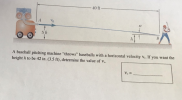 40 ft CL 5 ft A baseball pitching machine "throws" baseballs with a horizontal velocity V.. If you want the height h to be 42 in. (3.5 ft), determine the value of V.
A 68.72-kg pitching machine (excluding the baseball) is placed on a frozen pond. The machine fires...
A 68.72-kg pitching machine (excluding the baseball) is placed on a frozen pond. The machine fires a 0.05-kg baseball with a speed of 32.99 m/s in the horizontal friction. What is the recoil speed in m/s of the pitching machine? (Assume negligible friction.)
Question3 A baseball player throws a ball in the air with an initial speed of 50m/s...
 Question3 A baseball player throws a ball in the air with an initial speed of 50m/s at an angle of 30 degrees above the horizontal. What is the vertical component of the ball's initial velocity assuming up is the positive direction? Select the correct answer CHECK ANSWER 0 of 1 attempts used LAST ATTEMPT! O +43.3 m/s O -25 m/s O +50 m/s O -43.3 m/s O +25 m/s
roblem 1 angle of 40o The pitching machine is adjusted so that the baseball is launched...
 roblem 1 angle of 40o The pitching machine is adjusted so that the baseball is launched with a speed of vA- 30 m/s at an initial (a) Determine the time it takes for the ball to strike the ground at B (b) Determine the velocity of the baseball whenit strikes the ground at B. [Hint: Determine its horizontal and vertical velocity components first.] (c) Determine the distance R between the pitching machine and point B 30 m/s A 40° 1.2...
a baseball pitcher throws a baseball (145 grams) towards the batter at a speed of 35...
a baseball pitcher throws a baseball (145 grams) towards the batter at a speed of 35 m/s. the batter swings her bat (940 grams) with an unknown speed towards the ball. the bat hits the ball, and the ball goes flying back toward the pitcher at a higher speed. if the ball's speed (not velocity) increases by about 20% and the bat's speed decreases by about 50%, what was the initial speed of the bat before it hit the ball?...
A baseball outfielder throws a baseball of mass 0.24 kg at a speed of 48 m/s...
A baseball outfielder throws a baseball of mass 0.24 kg at a speed of 48 m/s and initial angle of 28 degrees. What is the kinetic energy (in J) of the baseball at the highest point of the trajectory? Ignore air friction.
A rocket can be fired with a velocity of 32m/s. At what angle above the horizontal,...
A rocket can be fired with a velocity of 32m/s. At what angle above the horizontal, must it be fired so that it clears a 9.33m barrier at its highest point?
Now assume that the pitcher throws a 0.145 kg baseball parallel to the ground with a speed of 32 m/s in the +x direction
Now assume that the pitcher throws a 0.145 kg baseball parallel to the ground with a speed of 32 m/s in the +x direction. The batter then hits the ball so it goes directly back to the pitcher along the same straight line. What is the ball's velocity just after leaving the bat if the bat applies an impulse of -8.4 N*s to the baseball? I just cant figure out how to do this problem. Please help!
A baseball pitcher throws a baseball horizontally at a linear speed of 42.5 m/s (about 95...
A baseball pitcher throws a baseball horizontally at a linear speed of 42.5 m/s (about 95 mi/h). Before being caught, the baseball travels a horizontal distance of 15.3 m and rotates through an angle of 52.1rad. The baseball has a radius of 3.67 cm and is rotating about an axis as it travels, much like the earth does. What is the tangential speed of a point on the "equator" of the baseball? m/s
A baseball player hit a ball from the ground with a speed of 30 m/s and...
A baseball player hit a ball from the ground with a speed of 30 m/s and an angle of 36.9 above the horizontal. Ignore air resistance. What is the ball's velocity when it returns to the ground? when is the ball 10 m above the ground?
 40 ft CL 5 ft A baseball pitching machine "throws" baseballs with a horizontal velocity V.. If you want the height h to be 42 in. (3.5 ft), determine the value of V.
 Question3 A baseball player throws a ball in the air with an initial speed of 50m/s at an angle of 30 degrees above the horizontal. What is the vertical component of the ball's initial velocity assuming up is the positive direction? Select the correct answer CHECK ANSWER 0 of 1 attempts used LAST ATTEMPT! O +43.3 m/s O -25 m/s O +50 m/s O -43.3 m/s O +25 m/s
 roblem 1 angle of 40o The pitching machine is adjusted so that the baseball is launched with a speed of vA- 30 m/s at an initial (a) Determine the time it takes for the ball to strike the ground at B (b) Determine the velocity of the baseball whenit strikes the ground at B. [Hint: Determine its horizontal and vertical velocity components first.] (c) Determine the distance R between the pitching machine and point B 30 m/s A 40° 1.2...
Most questions answered within 3 hours.
-
Where is the error in this code sequence?
String s1 = "Hello";
String s2 = "ello";...
asked 10 months ago -
Financial data for Joel de Paris, Inc., for last year
follow:
Joel de Paris, Inc.
Balance...
asked 10 months ago -
Consider this reaction:
Al2(SO4)3 (aq)+ BaCl3
(aq) Al2Cl6 (aq)- +
3BaSO4(s) . What is the...
asked 10 months ago -
Suppose that Savneet is considering increasing her
recent random sample from 20 car rentals to 40...
asked 10 months ago -
Trucks arrive at an unloading terminal at an average rate of 120
per hour.
Trucks arrive...
asked 10 months ago -
Why are methanol and ethanol completely soluble in water while
octanol is not very little soluble....
asked 10 months ago -
A facilities manager at a university reads in a research report
that the mean amount of...
asked 10 months ago -
When the CuSO4 is rehydrated by adding water to the anhydrous
compound, is this an endothermic...
asked 10 months ago -
A ray of sunlight is passing from diamond into crown glass; the
angle of incidence is...
asked 10 months ago -
A block of mass 0.249 kg is placed on top of a light, vertical
spring of...
asked 10 months ago -
how do the kidneys compensate in the presences of acidosis
a) trigger hyperventilate
b) reserve acid...
asked 10 months ago -
Question 501 pts
The rental rate of capital to the firm increases. Which of the
following...
asked 10 months ago