Draw an equilibrium in the AD-AS model with the economy operating above the natural rate of...
Draw an equilibrium in the AD-AS model with the economy operating above the natural rate of output (Yp). How would the self-correcting mechanism lead to a restoration of the natural rate? What happens to the price level? Describe how a more activist fiscal and monetary policy would work in this situation. What would be their effect on the price level?
Homework Answers
The figure below represents an economy operating above the natural rate of output and thus there is a inflationary gap. In this case price level and real GDP both are higher.
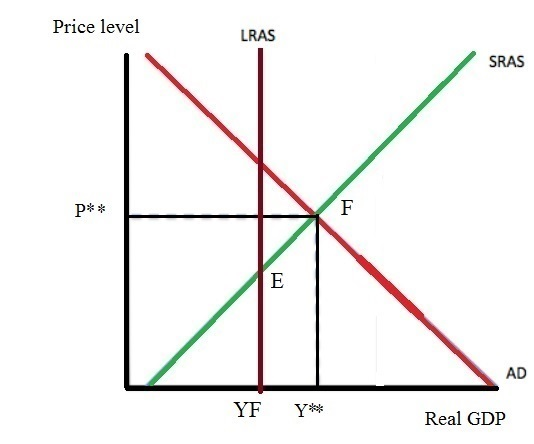
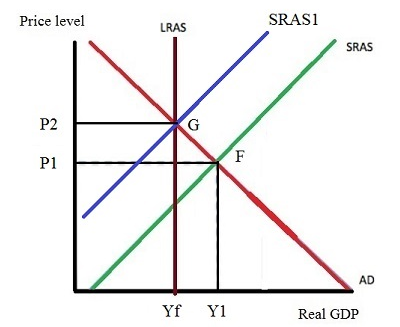
A self-correcting mechanism would start working during the transition from short run to long run when higher price level reduce raises nominal wage and reduces profits for firms. This discourages production and so aggregate supply shits to the left. Price level increased but output is reduced and so the self correcting method leads to a restoration of the natural rate of output
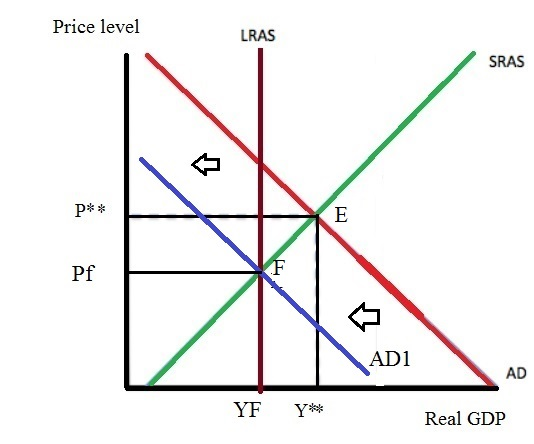
A more activist expansionary fiscal and monetary policy would work in this situation where lower government spending, money supply or increased taxes would depress aggregate demand so that AD curve shifts to the left, resulting in eliminating the GDP gap and bringing the economy back to its full employment level. Price is reduced and reached its long run level
Add Answer to:
Draw an equilibrium in the AD-AS model with the economy
operating above the natural rate of...
If the economy is at the natural rate of unemployment with the level of real GDP...
If the economy is at the natural rate of unemployment with the level of real GDP at potential output, what would expansionary fiscal or monetary policy do to the economy? How would the economy be effected in the short run and long run? Does the Phillips Curve theory explain what happens?
Q.1 Figure 1 AD and AS Model of Macroeconomics a. Label both axes and all the...
 Q.1 Figure 1 AD and AS Model of Macroeconomics a. Label both axes and all the lines on the graph and indicate Long Run equilibrium in the economy with the existing letters A, b. If the economy starts at C, explain how Trump's tax cut w move on the graph in terms the relevant line(s), equilibrium and variables in the short run. c. Explain the type d. Is the equilibriur why not. What would happen to this equilibrium in the...
one big problem. thank you!! Problem 3: AS-AD Relation Part II (20pts) AS-AD model can be used to explain how the economy transitions from the short-run to the medium-run 3a. (1pt) Can price be hi...
 one big problem. thank you!!
Problem 3: AS-AD Relation Part II (20pts) AS-AD model can be used to explain how the economy transitions from the short-run to the medium-run 3a. (1pt) Can price be higher than expected price in the short run? 3b. (1pt) if P> Pe in the short run, what happens to Pe when we go from short-run to medium-run? 3c. (2pt) If Pe increases, would AD curve shift or would AS curve shift? How would it shift?...
one big problem. thank you!!
Problem 3: AS-AD Relation Part II (20pts) AS-AD model can be used to explain how the economy transitions from the short-run to the medium-run 3a. (1pt) Can price be higher than expected price in the short run? 3b. (1pt) if P> Pe in the short run, what happens to Pe when we go from short-run to medium-run? 3c. (2pt) If Pe increases, would AD curve shift or would AS curve shift? How would it shift?...
Question 32 of 34 > Attempt 1 - Consider the AD-AS model in the graph where, in year 1, the economy is in equili...
 Question 32 of 34 > Attempt 1 - Consider the AD-AS model in the graph where, in year 1, the economy is in equilibrium at point A. In year 2, the economy will reach point B and, without the appropriate economic policy, will not achieve its potential output. Price level (CPI) Potential GDPI Potential GDP2 ASI AS2 What type of policy should the federal government pursue? AD2 (with policy) AD2 -(without policy) O contractionary monetary policy O contractionary fiscal policy...
1. Consider an economy with zero interest rate and aggregate output less than its natural output...
 1. Consider an economy with zero interest rate and aggregate output less than its natural output (liquidity trap). a. Draw IS-LM curves representing this economy. b. Draw AD-AS curves representing this economy. c. Explain why the price adjustment mechanism (wage and price changes) does not work in this condition. d. What type of policy (fiscal/monetary) is needed to reduce unemployment rate and increase output? Show on the graphs. f. Do you think that the policy packages in response to the...
Define demand-pull inflation. Using the AS/AD model, explain how demand-pull inflation affects the level of aggregate...
 Define demand-pull inflation. Using the AS/AD model, explain how demand-pull inflation affects the level of aggregate output and the price level in the economy (which curve shifts, in what direction, and what happens to equilibrium output and price level). Give an example of macroeconomic policy that can be used to counter the effects of demand-pull inflation and discuss its effect on the equilibrium output and price level.
QUESTION 7 (25 points): Economic Fluctuation using AD-AS framework Suppose that the short-run aggregate supply curve...
 QUESTION 7 (25 points): Economic Fluctuation using AD-AS framework Suppose that the short-run aggregate supply curve has a positive slope and that the economy starts at a long-run equilibrium. Now imagine that 10 million people move to Australia they found that Australians live an average of 10 extra years due to the relax lifestyle that they enjoy. This is a permanent change in Labor in the U.S. economy. (a) (10 points) No Policy Intervention: Using the model of Aggregate Demand...
6. Assume that the AD curve of the economy is given by Y 15-100π + 1, where m is a demand shock (animal spirits, govern...
 6. Assume that the AD curve of the economy is given by Y 15-100π + 1, where m is a demand shock (animal spirits, government spending, or money supply). The AS curve is given by 50(r where u is a supply shock (oil price, productivity). The variable π is the inflation rate, ETIS expected inflation rate, Y is output, and Y is long-run output. For numerical values, Y - Answer each equation using both graphs and math. Plot the above...
How fiscal policies work? A key feature in AD/AS model is that economy can deviate from...
How fiscal policies work? A key feature in AD/AS model is that economy can deviate from its potential output in the short run and eventually it will move comparable to this level. The Potential GDP/output is the maximum level of output a economy can produce given the existing resources and technology. Keynesian model assumes two types of policies to shift the AD/AS curves; namely, demand management policies and supply management policies. Both of these policies can be either monetary policies...
 Q.1 Figure 1 AD and AS Model of Macroeconomics a. Label both axes and all the lines on the graph and indicate Long Run equilibrium in the economy with the existing letters A, b. If the economy starts at C, explain how Trump's tax cut w move on the graph in terms the relevant line(s), equilibrium and variables in the short run. c. Explain the type d. Is the equilibriur why not. What would happen to this equilibrium in the...
 one big problem. thank you!!
Problem 3: AS-AD Relation Part II (20pts) AS-AD model can be used to explain how the economy transitions from the short-run to the medium-run 3a. (1pt) Can price be higher than expected price in the short run? 3b. (1pt) if P> Pe in the short run, what happens to Pe when we go from short-run to medium-run? 3c. (2pt) If Pe increases, would AD curve shift or would AS curve shift? How would it shift?...
one big problem. thank you!!
Problem 3: AS-AD Relation Part II (20pts) AS-AD model can be used to explain how the economy transitions from the short-run to the medium-run 3a. (1pt) Can price be higher than expected price in the short run? 3b. (1pt) if P> Pe in the short run, what happens to Pe when we go from short-run to medium-run? 3c. (2pt) If Pe increases, would AD curve shift or would AS curve shift? How would it shift?...
 Question 32 of 34 > Attempt 1 - Consider the AD-AS model in the graph where, in year 1, the economy is in equilibrium at point A. In year 2, the economy will reach point B and, without the appropriate economic policy, will not achieve its potential output. Price level (CPI) Potential GDPI Potential GDP2 ASI AS2 What type of policy should the federal government pursue? AD2 (with policy) AD2 -(without policy) O contractionary monetary policy O contractionary fiscal policy...
 1. Consider an economy with zero interest rate and aggregate output less than its natural output (liquidity trap). a. Draw IS-LM curves representing this economy. b. Draw AD-AS curves representing this economy. c. Explain why the price adjustment mechanism (wage and price changes) does not work in this condition. d. What type of policy (fiscal/monetary) is needed to reduce unemployment rate and increase output? Show on the graphs. f. Do you think that the policy packages in response to the...
 Define demand-pull inflation. Using the AS/AD model, explain how demand-pull inflation affects the level of aggregate output and the price level in the economy (which curve shifts, in what direction, and what happens to equilibrium output and price level). Give an example of macroeconomic policy that can be used to counter the effects of demand-pull inflation and discuss its effect on the equilibrium output and price level.
 QUESTION 7 (25 points): Economic Fluctuation using AD-AS framework Suppose that the short-run aggregate supply curve has a positive slope and that the economy starts at a long-run equilibrium. Now imagine that 10 million people move to Australia they found that Australians live an average of 10 extra years due to the relax lifestyle that they enjoy. This is a permanent change in Labor in the U.S. economy. (a) (10 points) No Policy Intervention: Using the model of Aggregate Demand...
 6. Assume that the AD curve of the economy is given by Y 15-100π + 1, where m is a demand shock (animal spirits, government spending, or money supply). The AS curve is given by 50(r where u is a supply shock (oil price, productivity). The variable π is the inflation rate, ETIS expected inflation rate, Y is output, and Y is long-run output. For numerical values, Y - Answer each equation using both graphs and math. Plot the above...
Most questions answered within 3 hours.
-
Where is the error in this code sequence?
String s1 = "Hello";
String s2 = "ello";...
asked 10 months ago -
Financial data for Joel de Paris, Inc., for last year
follow:
Joel de Paris, Inc.
Balance...
asked 10 months ago -
Consider this reaction:
Al2(SO4)3 (aq)+ BaCl3
(aq) Al2Cl6 (aq)- +
3BaSO4(s) . What is the...
asked 10 months ago -
Suppose that Savneet is considering increasing her
recent random sample from 20 car rentals to 40...
asked 10 months ago -
Trucks arrive at an unloading terminal at an average rate of 120
per hour.
Trucks arrive...
asked 10 months ago -
Why are methanol and ethanol completely soluble in water while
octanol is not very little soluble....
asked 10 months ago -
A facilities manager at a university reads in a research report
that the mean amount of...
asked 10 months ago -
When the CuSO4 is rehydrated by adding water to the anhydrous
compound, is this an endothermic...
asked 10 months ago -
A ray of sunlight is passing from diamond into crown glass; the
angle of incidence is...
asked 10 months ago -
A block of mass 0.249 kg is placed on top of a light, vertical
spring of...
asked 10 months ago -
how do the kidneys compensate in the presences of acidosis
a) trigger hyperventilate
b) reserve acid...
asked 10 months ago -
Question 501 pts
The rental rate of capital to the firm increases. Which of the
following...
asked 10 months ago