In python using numpy and for loops. How would I insert a multidimensional array into another...
Homework Answers
Here is am going to use modulo operator on the index of A which will loop back on the array A and will help to get the pattern. you can use (i%n) & (i%m) in A(n*m) to get this pattern.
Code :
import numpy as np
A = np.array([[1,2],[3,4]]) // converting the list to arrray
B = np.array([[0,0,0,0],[0,0,0,0],[0,0,0,0],[0,0,0,0]]) //
converting the list to arrray
for i in range(4):
for j in range(4):
B[i][j] = A[i%2][j%2] // assign the values of B
print(B)
Sample Run :
[[1 2 1 2]
[3 4 3 4]
[1 2 1 2]
[3 4 3 4]]
Add Answer to:
In
python using numpy and for loops. How would I insert a
multidimensional array into another...
python Problem 3-6 points First, start with the following code: import numpy as np A np.random....
 python
Problem 3-6 points First, start with the following code: import numpy as np A np.random. randint (0, 10, sie n,n)) np. savetxt ('exam2.txt', A, fmt-idelimiter B-# np. zeros ( (n, n) , dtypes, int 64, ) When run, it will produce a file named "exam2.txt" that has 5 rows each with 5 numbers separated by commas,. In addition, a 5 by 5 array of zeros named B is defined. Run this code, but do not change it Your job...
python
Problem 3-6 points First, start with the following code: import numpy as np A np.random. randint (0, 10, sie n,n)) np. savetxt ('exam2.txt', A, fmt-idelimiter B-# np. zeros ( (n, n) , dtypes, int 64, ) When run, it will produce a file named "exam2.txt" that has 5 rows each with 5 numbers separated by commas,. In addition, a 5 by 5 array of zeros named B is defined. Run this code, but do not change it Your job...
PYTHON: I have a numpy array that holds a name and a phone number such as...
PYTHON: I have a numpy array that holds a name and a phone number such as this one. import numpy as np import pandas as pd LIST = np.array([("James", "Kirk", "512-375-5585"), ("Richard", "Branson, "1234567890"), ("James", "Bond", "34567")]) Then I stuff it into a data frame by doing this df = pd.DataFrame(List, columns=('Firstname', 'Lastname', 'Phone')) How would I go about changing 10 digit phone numbers such as 1234567890 into 123-456-7890 and discarding invalid ones such as 34567 so it reflects in...
D Question 12 1.5 pts Check the true statements about NumPy arrays: O A single instantiated NumPy array can store multi...
 D Question 12 1.5 pts Check the true statements about NumPy arrays: O A single instantiated NumPy array can store multiple types (e.g., ints and strings) in its individual element positions. A NumPy array object can be instantiated using multiple types (e.g., ints and strings) in the list passed to its constructor O Memory freeing will require a double-nested loop. The number of bits used to store a particular NumPy array object is fixed. O The numpy.append(my.array, new_list) operation mutates...
How would I use Numpy in python to search in arr2 with arr1 and return the...
How would I use Numpy in python to search in arr2 with arr1 and return the string value. arr1=[0,a],[1,b],[2,c] arr2=[2],[1],[0] Expected outcome is =[c],[b],[a]
How to rewrite the following functions using only numpy array operations (universal functions, aggregations, boolean indexing)...
How to rewrite the following functions using only numpy array operations (universal functions, aggregations, boolean indexing) without using loops def mean_squared_error (v , p ): n = len ( v [0]) result = 0 for i in range ( n ): result += ( v [0][ i ] - p [0])**2 + ( v [1][ i ] - p [1])**2 result = result / n return result I tried doing it like this but nothing printed out def mean_squared_error2 (v,...
I need a Python code for this problem. We can use python's array slicing in many...
 I need a Python code for this problem.
We can use python's array slicing in many ways, and here is just one example. To take the forward derivative of an array y, we use (y[i+1] - y[i])/dx For example, if dx=1 , we might write a derivative routine as yderiv = zeros (len(y)-1) for i in range(len(y)-1): yderiv[i] = y(i+1] - y[i] Note that here, yderiv is one element shorter than y -- this is because you need 2 points...
I need a Python code for this problem.
We can use python's array slicing in many ways, and here is just one example. To take the forward derivative of an array y, we use (y[i+1] - y[i])/dx For example, if dx=1 , we might write a derivative routine as yderiv = zeros (len(y)-1) for i in range(len(y)-1): yderiv[i] = y(i+1] - y[i] Note that here, yderiv is one element shorter than y -- this is because you need 2 points...
I am able to make the array from 1 to 100, but unsure how to transform...
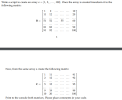 I am able to make the array from 1 to 100, but unsure how to
transform it to the listed matrices. It needs to be solved using
numpy.
Write a script to create an array a1, 2,,100]. Once the array is created transform it to the following matrix: 1 2 ...101 B-151 52 55 60 81 82... 90 91 92 100 Now, from the same array a create the following matrix: 2 12 C- 5 15 9 19 92 95...
I am able to make the array from 1 to 100, but unsure how to
transform it to the listed matrices. It needs to be solved using
numpy.
Write a script to create an array a1, 2,,100]. Once the array is created transform it to the following matrix: 1 2 ...101 B-151 52 55 60 81 82... 90 91 92 100 Now, from the same array a create the following matrix: 2 12 C- 5 15 9 19 92 95...
How to copy the values of an array to another one that has a larger length...
How to copy the values of an array to another one that has a larger length , without effecting it. For example: A = stdarray.create1D(5) A = [ 1,2,3,4,5] B = stdarray.create1D(10) B = [none, none, none, none, none, none, none , none, none, none] I want B to have A values.. B = [ 1,2,3,4,5, none, none, none, none, none] IN PYTHON, without using append.
Python Help: Using the stock.py data, write a program that does the following: Create a NumPy...
Python Help: Using the stock.py data, write a program that does the following: Create a NumPy array from the nasdaq list from stocks.py. Do the same with the other three lists from stocks.py. Thus, at the end of this tasks, you will have four NumPy arrays. Print out the type (that is, the object type, not the element type) of each array in #1 and the data type typecode of the elements in each array in #1. This task is...
In python, how do you create an array of unknown dimensional size? I want to create...
 In python, how do you create an array of unknown dimensional
size?
I want to create an array of unknown dimensional size based on a
number I recieve. To elaborate, let's say n = 2, it will output a
3D array {true, true, true}. If n = 3, then its output will be a 4D
array {true, true, true, true}. Whatever the n value is, the return
value will be an array of n + 1 dimensional size. How would...
In python, how do you create an array of unknown dimensional
size?
I want to create an array of unknown dimensional size based on a
number I recieve. To elaborate, let's say n = 2, it will output a
3D array {true, true, true}. If n = 3, then its output will be a 4D
array {true, true, true, true}. Whatever the n value is, the return
value will be an array of n + 1 dimensional size. How would...
 python
Problem 3-6 points First, start with the following code: import numpy as np A np.random. randint (0, 10, sie n,n)) np. savetxt ('exam2.txt', A, fmt-idelimiter B-# np. zeros ( (n, n) , dtypes, int 64, ) When run, it will produce a file named "exam2.txt" that has 5 rows each with 5 numbers separated by commas,. In addition, a 5 by 5 array of zeros named B is defined. Run this code, but do not change it Your job...
python
Problem 3-6 points First, start with the following code: import numpy as np A np.random. randint (0, 10, sie n,n)) np. savetxt ('exam2.txt', A, fmt-idelimiter B-# np. zeros ( (n, n) , dtypes, int 64, ) When run, it will produce a file named "exam2.txt" that has 5 rows each with 5 numbers separated by commas,. In addition, a 5 by 5 array of zeros named B is defined. Run this code, but do not change it Your job...
 D Question 12 1.5 pts Check the true statements about NumPy arrays: O A single instantiated NumPy array can store multiple types (e.g., ints and strings) in its individual element positions. A NumPy array object can be instantiated using multiple types (e.g., ints and strings) in the list passed to its constructor O Memory freeing will require a double-nested loop. The number of bits used to store a particular NumPy array object is fixed. O The numpy.append(my.array, new_list) operation mutates...
 I need a Python code for this problem.
We can use python's array slicing in many ways, and here is just one example. To take the forward derivative of an array y, we use (y[i+1] - y[i])/dx For example, if dx=1 , we might write a derivative routine as yderiv = zeros (len(y)-1) for i in range(len(y)-1): yderiv[i] = y(i+1] - y[i] Note that here, yderiv is one element shorter than y -- this is because you need 2 points...
I need a Python code for this problem.
We can use python's array slicing in many ways, and here is just one example. To take the forward derivative of an array y, we use (y[i+1] - y[i])/dx For example, if dx=1 , we might write a derivative routine as yderiv = zeros (len(y)-1) for i in range(len(y)-1): yderiv[i] = y(i+1] - y[i] Note that here, yderiv is one element shorter than y -- this is because you need 2 points...
 I am able to make the array from 1 to 100, but unsure how to
transform it to the listed matrices. It needs to be solved using
numpy.
Write a script to create an array a1, 2,,100]. Once the array is created transform it to the following matrix: 1 2 ...101 B-151 52 55 60 81 82... 90 91 92 100 Now, from the same array a create the following matrix: 2 12 C- 5 15 9 19 92 95...
I am able to make the array from 1 to 100, but unsure how to
transform it to the listed matrices. It needs to be solved using
numpy.
Write a script to create an array a1, 2,,100]. Once the array is created transform it to the following matrix: 1 2 ...101 B-151 52 55 60 81 82... 90 91 92 100 Now, from the same array a create the following matrix: 2 12 C- 5 15 9 19 92 95...
 In python, how do you create an array of unknown dimensional
size?
I want to create an array of unknown dimensional size based on a
number I recieve. To elaborate, let's say n = 2, it will output a
3D array {true, true, true}. If n = 3, then its output will be a 4D
array {true, true, true, true}. Whatever the n value is, the return
value will be an array of n + 1 dimensional size. How would...
In python, how do you create an array of unknown dimensional
size?
I want to create an array of unknown dimensional size based on a
number I recieve. To elaborate, let's say n = 2, it will output a
3D array {true, true, true}. If n = 3, then its output will be a 4D
array {true, true, true, true}. Whatever the n value is, the return
value will be an array of n + 1 dimensional size. How would...
Most questions answered within 3 hours.
-
Where is the error in this code sequence?
String s1 = "Hello";
String s2 = "ello";...
asked 11 months ago -
Financial data for Joel de Paris, Inc., for last year
follow:
Joel de Paris, Inc.
Balance...
asked 11 months ago -
Consider this reaction:
Al2(SO4)3 (aq)+ BaCl3
(aq) Al2Cl6 (aq)- +
3BaSO4(s) . What is the...
asked 11 months ago -
Suppose that Savneet is considering increasing her
recent random sample from 20 car rentals to 40...
asked 11 months ago -
Trucks arrive at an unloading terminal at an average rate of 120
per hour.
Trucks arrive...
asked 11 months ago -
Why are methanol and ethanol completely soluble in water while
octanol is not very little soluble....
asked 11 months ago -
A facilities manager at a university reads in a research report
that the mean amount of...
asked 11 months ago -
When the CuSO4 is rehydrated by adding water to the anhydrous
compound, is this an endothermic...
asked 11 months ago -
A ray of sunlight is passing from diamond into crown glass; the
angle of incidence is...
asked 11 months ago -
A block of mass 0.249 kg is placed on top of a light, vertical
spring of...
asked 11 months ago -
how do the kidneys compensate in the presences of acidosis
a) trigger hyperventilate
b) reserve acid...
asked 11 months ago -
Question 501 pts
The rental rate of capital to the firm increases. Which of the
following...
asked 11 months ago