The CPI differs from the GDP deflator in that a. the CPI is an inflation index,...
The CPI differs from the GDP deflator in that
| a. |
the CPI is an inflation index, while the GDP deflator is a price index. |
|
| b. |
increases in the prices of foreign produced goods that are sold to U.S. consumers show up in the GDP deflator but not in the CPI. |
|
| c. |
substitution bias is not a problem with the CPI, but it is a problem with the GDP deflator. |
|
| d. |
increases in the prices of domestically produced goods that are sold to the U.S. government show up in the GDP deflator but not in the CPI. |
Homework Answers
The CPI measure price change of the goods or services which is bought by the consumer.
The GDP deflator is a measure the change in the price of all goods or services currently produced domestically.
The CPI differs from the GDP deflator is that increase in the prices of domestically produced goods that are sold the US government show up in the GDP deflator but not in the CPI.
Answer: Option (D).
Add Answer to:
The CPI differs from the GDP deflator in that
a.
the CPI is an inflation index,...
ASSIGNMENT #5 9. One way the consumer price index (CPI) differs from the GDP chain price...
 ASSIGNMENT #5 9. One way the consumer price index (CPI) differs from the GDP chain price index is that the CPI: uses current year quantities of goods and services b. a. includes separate market baskets of goods and services for both base and current years. includes only goods and services bought by typical urban consumers. d. C. is bias free. 10. Suppose a market basket of goods and services costs $1,000 in the base year and the consumer price index...
Which of the following is right about CPI and GDP deflator? Select one: a. CPI reflects...
Which of the following is right about CPI and GDP deflator? Select one: a. CPI reflects all goods and services produced domestically b. They both measure inflation c. They both measure nominal value relative to the real value d. GDP deflator is calculated using a fixed basket of consumer goods
How does the Consumer Price Index differ from the GDP deflator? Explain what is meant by...
How does the Consumer Price Index differ from the GDP deflator? Explain what is meant by the "substitution bias" in the CPI. If food prices increase by 10%, and people always spend 25% of their total consumption expenditure on food, how much will the CPI increase (all other prices stay the same)?
Because there isn't one single measure of inflation, the government and researchers use a variety of methods to get the most balanced picture of how prices fluctuate in the economy
 Alternative price indexes Because there isn't one single measure of inflation, the government and researchers use a variety of methods to get the most balanced picture of how prices fluctuate in the economy. Two of the most commonly used price indexes are the consumer price index (CPI) and the GDP deflator. The CPI for this year is calculated by dividing the _______ using by the _______ using and _______ multiplying by 100. However, the GDP deflator reflects only the prices of all...
22. Use your knowledge of price indexes to answer the following three-part question 22a. An index...
22. Use your knowledge of price indexes to answer the following three-part question 22a. An index of prices of all domestically produced goods in the economy is the a. Consumer Price Index. b. GDP Chain Price Index. c. Producer Price Index. d. Wholesale Price Index. 22b. The most comprehensive (inclusive of goods) measure of the rate at which prices are changing is: a. the CPI b. the balance-of-payments index. c. the GDP Chain Price Index....
32.) Suppose that in 2010, the producer price index increases by 1.5 percent. As a result,...
32.) Suppose that in 2010, the producer price index increases by 1.5 percent. As a result, economists most likely will predict that A GDP will increase in 2011. B the producer price index will increase by more than 1.5 percent in 2011. C interest rates will decrease in the future. D the consumer price index will increase in the future. 34.) Assume that consumers consider rice and potatoes to be substitutes, but they buy rice more regularly and so rice...
3:55 If CPI includes all goods, does CPl inflation match GDP deflator inflation? If CPI excludes...
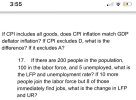 3:55 If CPI includes all goods, does CPl inflation match GDP deflator inflation? If CPI excludes D, what is the difference? If it excludes A? 17. If there are 200 people in the population, 100 in the labor force, and 5 unemployed, what is the LFP and unemployment rate? If 10 more people join the labor force but 8 of those immediately find jobs, what is the change in LFP and UR?
Fill in the Blanks: is the component of GDP that includes spending on new structures and equipment. ANSWER: 2. Con...
 Fill in the Blanks: is the component of GDP that includes spending on new structures and equipment. ANSWER: 2. Consumption is $5.5 trillion, investment is $1 trillion, government expenditures are $1.5 trillion, transfer payments are $.5 trillion, exports are $.75 trillion and imports are $1.25 trillion. GDP is equal to - ANSWER: 3. Foreign countries buy $1.2 trillion of U.S. goods and services. U.S. residents purchase $1.8 trillion of foreign goods and services. What is net exports? ANSWER: 4. In...
Which measure of inflation means most to U.S. households? A the CPI B the GDP deflator...
 Which measure of inflation means most to U.S. households? A the CPI B the GDP deflator C the PPI Deflation occurs when the average level of prices A falls rises Between 2001 and 2008, which country experienced very rapid hyperinflation? The velocity of money is usually A constant (fixed) B stable and predictable C volatile and unpredictable Inflation is A always and everywhere a monetary phenomenon B moderate or non-existent under commodity-money standards C both A and B are true...
Homework (Ch 11) Back to Assignment Attempts: 08 Average: 0.8/2 2. Alternative price indexes Because there...
 Homework (Ch 11) Back to Assignment Attempts: 08 Average: 0.8/2 2. Alternative price indexes Because there isn't one single measure of inflation, the government and researchers use a variety of methods to get the most balanced picture of how prices fluctuate in the economy. Two of the most commonly used price indexes are the consumer price index (CPI) and the GDP deflator. using The CPI for this year is calculated by dividing the by the using and multiplying by 100....
 ASSIGNMENT #5 9. One way the consumer price index (CPI) differs from the GDP chain price index is that the CPI: uses current year quantities of goods and services b. a. includes separate market baskets of goods and services for both base and current years. includes only goods and services bought by typical urban consumers. d. C. is bias free. 10. Suppose a market basket of goods and services costs $1,000 in the base year and the consumer price index...
 Alternative price indexes Because there isn't one single measure of inflation, the government and researchers use a variety of methods to get the most balanced picture of how prices fluctuate in the economy. Two of the most commonly used price indexes are the consumer price index (CPI) and the GDP deflator. The CPI for this year is calculated by dividing the _______ using by the _______ using and _______ multiplying by 100. However, the GDP deflator reflects only the prices of all...
 3:55 If CPI includes all goods, does CPl inflation match GDP deflator inflation? If CPI excludes D, what is the difference? If it excludes A? 17. If there are 200 people in the population, 100 in the labor force, and 5 unemployed, what is the LFP and unemployment rate? If 10 more people join the labor force but 8 of those immediately find jobs, what is the change in LFP and UR?
 Fill in the Blanks: is the component of GDP that includes spending on new structures and equipment. ANSWER: 2. Consumption is $5.5 trillion, investment is $1 trillion, government expenditures are $1.5 trillion, transfer payments are $.5 trillion, exports are $.75 trillion and imports are $1.25 trillion. GDP is equal to - ANSWER: 3. Foreign countries buy $1.2 trillion of U.S. goods and services. U.S. residents purchase $1.8 trillion of foreign goods and services. What is net exports? ANSWER: 4. In...
 Which measure of inflation means most to U.S. households? A the CPI B the GDP deflator C the PPI Deflation occurs when the average level of prices A falls rises Between 2001 and 2008, which country experienced very rapid hyperinflation? The velocity of money is usually A constant (fixed) B stable and predictable C volatile and unpredictable Inflation is A always and everywhere a monetary phenomenon B moderate or non-existent under commodity-money standards C both A and B are true...
 Homework (Ch 11) Back to Assignment Attempts: 08 Average: 0.8/2 2. Alternative price indexes Because there isn't one single measure of inflation, the government and researchers use a variety of methods to get the most balanced picture of how prices fluctuate in the economy. Two of the most commonly used price indexes are the consumer price index (CPI) and the GDP deflator. using The CPI for this year is calculated by dividing the by the using and multiplying by 100....
Most questions answered within 3 hours.
-
Where is the error in this code sequence?
String s1 = "Hello";
String s2 = "ello";...
asked 10 months ago -
Financial data for Joel de Paris, Inc., for last year
follow:
Joel de Paris, Inc.
Balance...
asked 10 months ago -
Consider this reaction:
Al2(SO4)3 (aq)+ BaCl3
(aq) Al2Cl6 (aq)- +
3BaSO4(s) . What is the...
asked 10 months ago -
Suppose that Savneet is considering increasing her
recent random sample from 20 car rentals to 40...
asked 10 months ago -
Trucks arrive at an unloading terminal at an average rate of 120
per hour.
Trucks arrive...
asked 10 months ago -
Why are methanol and ethanol completely soluble in water while
octanol is not very little soluble....
asked 10 months ago -
A facilities manager at a university reads in a research report
that the mean amount of...
asked 10 months ago -
When the CuSO4 is rehydrated by adding water to the anhydrous
compound, is this an endothermic...
asked 10 months ago -
A ray of sunlight is passing from diamond into crown glass; the
angle of incidence is...
asked 10 months ago -
A block of mass 0.249 kg is placed on top of a light, vertical
spring of...
asked 10 months ago -
how do the kidneys compensate in the presences of acidosis
a) trigger hyperventilate
b) reserve acid...
asked 10 months ago -
Question 501 pts
The rental rate of capital to the firm increases. Which of the
following...
asked 10 months ago