DNA replication: what is the biology of making a precise copy of the genomic DNA in...
-
DNA replication: what is the biology of making a precise copy of the genomic DNA in a timely fashion? What are the issues that need to be resolved? And how? Given that DNA=life, how do you go about dissecting the mechanism of DNA replication?
-
Eukaryotic DNA is highly condensed making it NOT readily available to TF. What is the biological significance of this observation? How is “packing” modulated? And why is it that prokaryotic DNA is not condensed in a similar fashion?
-
Control of gene expression. Why is it necessarily? How do the lac and trp operons and catabolite repression inform you of the schematics of metabolic controls?
Homework Answers
The DNA replication consists of three major steps namely: Unwinding of the DNA, elongation of the strand by addition of new nucleotides and ligation by DNA ligase to remove any gaps within the DNA molecule.
The unwinding step is carried out as follows:
The DNA helicase enzymes unwinds the DNA and the single strands of DNA are stabilized and held in place by the single cell binding proteins.
Starting DNA replication
How do DNA polymerases and other replication factors know where to begin? Replication always starts at specific locations on the DNA, which are called origins of replication and are recognized by their sequence.
E. coli, like most bacteria, has a single origin of replication on its chromosome. The origin is about 245245245 base pairs long and has mostly A/T base pairs (which are held together by fewer hydrogen bonds than G/C base pairs), making the DNA strands easier to separate.
Specialized proteins recognize the origin, bind to this site, and open up the DNA. As the DNA opens, two Y-shaped structures called replication forks are formed, together making up what's called a replication bubble. The replication forks will move in opposite directions as replication proceeds.
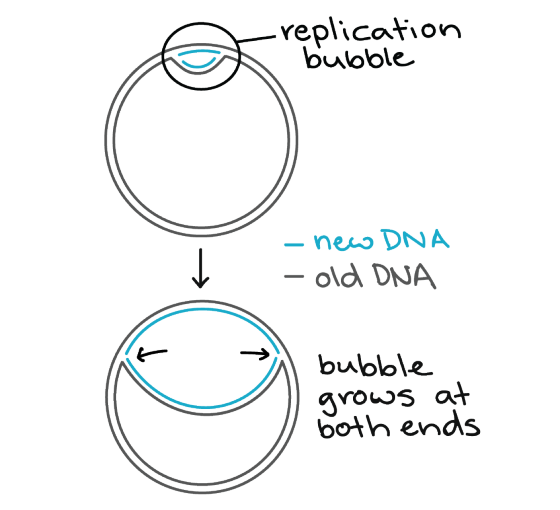
Bacterial chromosome. The double-stranded DNA of the circular bacteria chromosome is opened at the origin of replication, forming a replication bubble. Each end of the bubble is a replication fork, a Y-shaped junction where double-stranded DNA is separated into two single strands. New DNA complementary to each single strand is synthesized at each replication fork. The two forks move in opposite directions around the circumference of the bacterial chromosome, creating a larger and larger replication bubble that grows at both ends
Helicase is the first replication enzyme to load on at the origin of replication start. Helicase's job is to move the replication forks forward by "unwinding" the DNA (breaking the hydrogen bonds between the nitrogenous base pairs).
Proteins called single-strand binding proteins coat the separated strands of DNA near the replication fork, keeping them from coming back together into a double helix.
Primers and primase
Primase makes an RNA primer, or short stretch of nucleic acid complementary to the template, that provides a 3' end for DNA polymerase to work on. A typical primer is about five to ten nucleotides long. The primer primes DNA synthesis, i.e., gets it started.
Once the RNA primer is in place, DNA polymerase "extends" it, adding nucleotides one by one to make a new DNA strand that's complementary to the template strand.
Leading and lagging strands
In E. coli, the DNA polymerase that handles most of the synthesis is DNA polymerase III. There are two molecules of DNA polymerase III at a replication fork, each of them hard at work on one of the two new DNA strands.
DNA polymerases can only make DNA in the 5' to 3' direction, and this poses a problem during replication. A DNA double helix is always anti-parallel; in other words, one strand runs in the 5' to 3' direction, while the other runs in the 3' to 5' direction. This makes it necessary for the two new strands, which are also antiparallel to their templates, to be made in slightly different ways.
One new strand, which runs 5' to 3' towards the replication fork, is the easy one. This strand is made continuously, because the DNA polymerase is moving in the same direction as the replication fork. This continuously synthesized strand is called the leading strand.
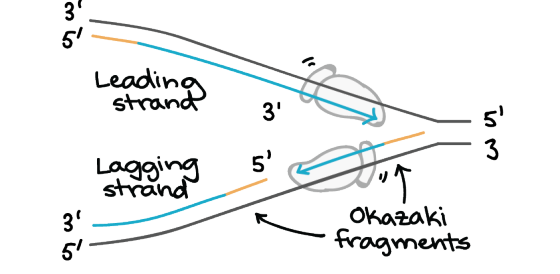
The other new strand, which runs 5' to 3' away from the fork, is tricker. This strand is made in fragments because, as the fork moves forward, the DNA polymerase (which is moving away from the fork) must come off and reattach on the newly exposed DNA. This tricky strand, which is made in fragments, is called the lagging strand.
The small fragments are called Okazaki fragments, named for the Japanese scientist who discovered them. The leading strand can be extended from one primer alone, whereas the lagging strand needs a new primer for each of the short Okazaki fragments.
The maintenance
Some other proteins and enzymes, in addition the main ones above, are needed to keep DNA replication running smoothly. One is a protein called the sliding clamp, which holds DNA polymerase III molecules in place as they synthesize DNA. The sliding clamp is a ring-shaped protein and keeps the DNA polymerase of the lagging strand from floating off when it re-starts at a new Okazaki fragment.
Topoisomerase also plays an important maintenance role during DNA replication. This enzyme prevents the DNA double helix ahead of the replication fork from getting too tightly wound as the DNA is opened up. It acts by making temporary nicks in the helix to release the tension, then sealing the nicks to avoid permanent damage.
Finally, there is a little cleanup work to do if we want DNA that doesn't contain any RNA or gaps. The RNA primers are removed and replaced by DNA through the activity of DNA polymerase I, the other polymerase involved in replication. The nicks that remain after the primers are replaced get sealed by the enzyme DNA ligase.
Summary of DNA replication in E. coli
Let's zoom out and see how the enzymes and proteins involved in replication work together to synthesize new DNA.
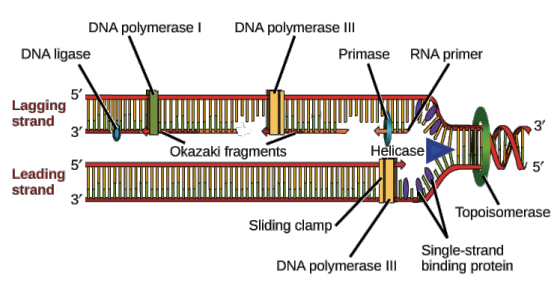
Illustration shows the replication fork. Helicase unwinds the helix, and single-strand binding proteins prevent the helix from re-forming. Topoisomerase prevents the DNA from getting too tightly coiled ahead of the replication fork. DNA primase forms an RNA primer, and DNA polymerase extends the DNA strand from the RNA primer. DNA synthesis occurs only in the 5' to 3' direction. On the leading strand, DNA synthesis occurs continuously. On the lagging strand, DNA synthesis restarts many times as the helix unwinds, resulting in many short fragments called “Okazaki fragments.” DNA ligase joins the Okazaki fragments together into a single DNA molecule.
- Helicase opens up the DNA at the replication fork.
- Single-strand binding proteins coat the DNA around the replication fork to prevent rewinding of the DNA.
- Topoisomerase works at the region ahead of the replication fork to prevent supercoiling.
- Primase synthesizes RNA primers complementary to the DNA strand.
- DNA polymerase III extends the primers, adding on to the 3' end, to make the bulk of the new DNA.
- RNA primers are removed and replaced with DNA by DNA polymerase I.
- The gaps between DNA fragments are sealed by DNA ligase.
DNA replication in eukaryotes
The basics of DNA replication are similar between bacteria and eukaryotes such as humans, but there are also some differences:
- Eukaryotes usually have multiple linear chromosomes, each with multiple origins of replication. Humans can have up to 100,100,100 origins of replication.
- Most of the E. coli enzymes have counterparts in eukaryotic DNA replication, but a single enzyme in E. coli may be represented by multiple enzymes in eukaryotes. For instance, there are five human DNA polymerases with important roles in replication.
- Most eukaryotic chromosomes are linear. Because of the way the lagging strand is made, some DNA is lost from the ends of linear chromosomes (the telomeres) in each round of replication.
The trp and lac operons are explained as follows:
What is the trp operon?
Bacteria such as Escherichia coli (a friendly inhabitant of our gut) need amino acids to survive—because, like us, they need to build proteins. One of the amino acids they need is tryptophan.
If tryptophan is available in the environment, E. coli will take it up and use it to build proteins. However, E. coli can also make their own tryptophan using enzymes that are encoded by five genes. These five genes are located next to each other in what is called the trp operon.
If tryptophan is present in the environment, then E. coli bacteria don't need to synthesize it, so transcription of the genes in the trp operon is switched "off." When tryptophan availability is low, on the other hand, the operon is switched "on," the genes are transcribed, biosynthetic enzymes are made, and more tryptophan is produced.
Structure of the trp operon
The trp operon includes five genes that encode enzymes needed for tryptophan biosynthesis, along with a promoter (RNA polymerase binding site) and an operator (binding site for a repressor protein). The genes of the trpoperon are transcribed as a single mRNA.
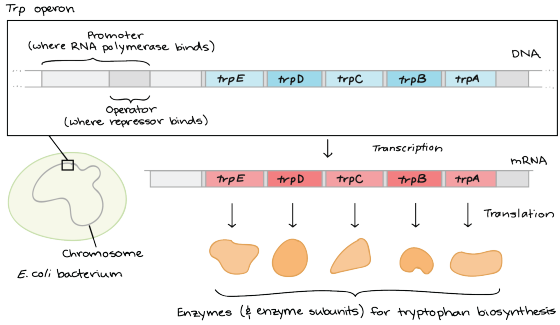
Diagram of the trpoperon. First, we see an E. colibacterium with a circular chromosome. We zoom in on a small portion of the chromosome and see that the DNA is that of the trpoperon.
From left to right, the operon contains a promoter (where RNA polymerase binds), and within the right end of the promoter, an operator (where a repressor binds). There are some additional regulatory sequences, not labeled in this diagram, and then five coding sequences: trpE, trp_D, _trpC, trpB, and trpA.
The operon is transcribed to produce a single mRNA that contains the coding sequences of all five of the genes.
The coding sequences in the mRNA are translated separately, each one producing a protein. These proteins are enzymes (or enzyme subunits) needed for tryptophan biosynthesis.
Turning the operon "on" and "off"
What does the operator do? This stretch of DNA is recognized by a regulatory protein known as the trp repressor. When the repressor binds to the DNA of the operator, it keeps the operon from being transcribed by physically getting in the way of RNA polymerase, the transcription enzyme.
The trp repressor does not always bind to DNA. Instead, it binds and blocks transcription only when tryptophan is present. When tryptophan is around, it attaches to the repressor molecules and changes their shape so they become active. A small molecule like trytophan, which switches a repressor into its active state, is called a corepressor.
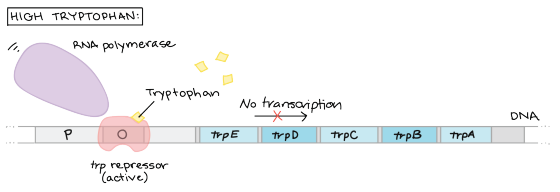
High tryptophan: The tryptophan binds to the trprepressor and causes it to change shape, converting into its active (DNA-binding) form. The trprepressor with the bound tryptophan attaches to the operator, blocking RNA polymerase from binding to the promoter and preventing transcription of the operon.
When there is little tryptophan in the cell, on the other hand, the trp repressor is inactive (because no tryptophan is available to bind to and activate it). It does not attach to the DNA or block transcription, and this allows the trpoperon to be transcribed by RNA polymerase.
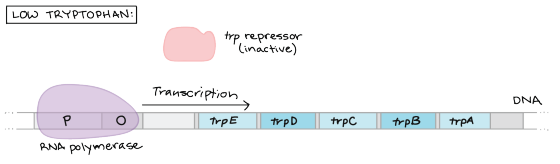
Low tryptophan: trprepressor is not bound to tryptophan (since there is no tryptophan) and is thus in its inactive state (does not bind to the DNA of the operator). This allows RNA polymerase to bind to the operator and transcribe the operon.
In this system, the trp repressor acts as both a sensor and a switch. It senses whether tryptophan is already present at high levels, and if so, it switches the operon to the "off" position, preventing unnecessary biosynthetic enzymes from being made.
More trp operon regulation: Attenuation
Depending on the class you're taking, or on your own interests, you may also have heard about another form of trp operon regulation called attenuation.
Like regulation by the trp repressor, attenuation is a mechanism for reducing expression of the trp operon when levels of tryptophan are high. However, rather than blocking initiation of transcription, attenuation prevents completionof transcription.
When levels of tryptophan are high, attenuation causes RNA polymerase to stop prematurely when it's transcribing the trp operon. Only a short, stubby mRNA is made, one that does not encode any tryptophan biosynthesis enzymes. Attenuation works through a mechanism that depends on coupling (the translation of an mRNA that is still in the process of being transcribed).
Key points:
- The lac operon of E. coli contains genes involved in lactose metabolism. It's expressed only when lactose is present and glucose is absent.
- Two regulators turn the operon "on" and "off" in response to lactose and glucose levels: the lac repressor and catabolite activator protein (CAP).
- The lac repressor acts as a lactose sensor. It normally blocks transcription of the operon, but stops acting as a repressor when lactose is present. The lac repressor senses lactose indirectly, through its isomer allolactose.
- Catabolite activator protein (CAP) acts as a glucose sensor. It activates transcription of the operon, but only when glucose levels are low. CAP senses glucose indirectly, through the "hunger signal" molecule cAMP.
Introduction
Lactose: it's what's for dinner! While that may not sound delicious to us (lactose is the main sugar in milk, and you probably don't want to eat it plain), lactose can be an excellent meal for E. coli bacteria. However, they'll only gobble up lactose when other, better sugars – like glucose – are unavailable.
With that for context, what exactly is the lac operon? The lac operon is anoperon, or group of genes with a single promoter (transcribed as a single mRNA). The genes in the operon encode proteins that allow the bacteria to use lactose as an energy source.
What makes the lac operon turn on?
E. coli bacteria can break down lactose, but it's not their favorite fuel. If glucose is around, they would much rather use that. Glucose requires fewer steps and less energy to break down than lactose. However, if lactose is the only sugar available, the E. coli will go right ahead and use it as an energy source.
To use lactose, the bacteria must express the lac operon genes, which encode key enzymes for lactose uptake and metabolism. To be as efficient as possible, E. coli should express the lac operon only when two conditions are met:
- Lactose is available, and
- Glucose is not available
How are levels of lactose and glucose detected, and how how do changes in levels affect lac operon transcription? Two regulatory proteins are involved:
- One, the lac repressor, acts as a lactose sensor.
- The other, catabolite activator protein (CAP), acts as a glucose sensor.
These proteins bind to the DNA of the lac operon and regulate its transcription based on lactose and glucose levels. Let's take a look at how this works.
Structure of the lac operon
The lac operon contains three genes: lacZ, lacY, and lacA. These genes are transcribed as a single mRNA, under control of one promoter.
Genes in the lac operon specify proteins that help the cell utilize lactose. lacZencodes an enzyme that splits lactose into monosaccharides (single-unit sugars) that can be fed into glycolysis. Similarly, lacY encodes a membrane-embedded transporter that helps bring lactose into the cell.
[More details]
In addition to the three genes, the lac operon also contains a number of regulatory DNA sequences. These are regions of DNA to which particular regulatory proteins can bind, controlling transcription of the operon.
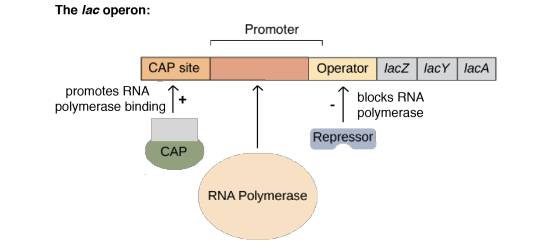
Structure of the lacoperon. The DNA of the lacoperon contains (in order from left to right): CAP binding site, promoter (RNA polymerase binding site), operator (which overlaps with promoter), lacZgene, lacYgene, and lacAgene. The activator protein CAP, when bound to a molecule called cAMP (discussed later), binds to the CAP binding site and promotes RNA polymerase binding to the promoter. The lacrepressor protein binds to the operator and blocks RNA polymerase from binding to the promoter and transcribing the operon.
- The promoter is the binding site for RNA polymerase, the enzyme that performs transcription.
- The operator is a negative regulatory site bound by the lac repressor protein. The operator overlaps with the promoter, and when the lacrepressor is bound, RNA polymerase cannot bind to the promoter and start transcription.
- The CAP binding site is a positive regulatory site that is bound by catabolite activator protein (CAP). When CAP is bound to this site, it promotes transcription by helping RNA polymerase bind to the promoter.
Let's take a closer look at the lac repressor and CAP and their roles in regulation of the lac operon.
The lac repressor
The lac repressor is a protein that represses (inhibits) transcription of the lacoperon. It does this by binding to the operator, which partially overlaps with the promoter. When bound, the lac repressor gets in RNA polymerase's way and keeps it from transcribing the operon.
When lactose is not available, the lac repressor binds tightly to the operator, preventing transcription by RNA polymerase. However, when lactose is present, the lac repressor loses its ability to bind DNA. It floats off the operator, clearing the way for RNA polymerase to transcribe the operon.
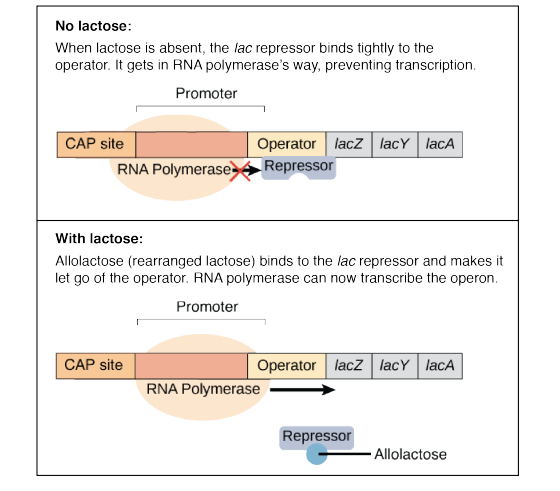
Upper panel: No lactose. When lactose is absent, the lacrepressor binds tightly to the operator. It gets in RNA polymerase's way, preventing transcription.
Lower panel: With lactose. Allolactose (rearranged lactose) binds to the lacrepressor and makes it let go of the operator. RNA polymerase can now transcribe the operon.
This change in the lac repressor is caused by the small molecule allolactose, an isomer (rearranged version) of lactose. When lactose is available, some molecules will be converted to allolactose inside the cell. Allolactose binds to the lac repressor and makes it change shape so it can no longer bind DNA.
Allolactose is an example of an inducer, a small molecule that triggers expression of a gene or operon. The lac operon is considered an inducible operon because it is usually turned off (repressed), but can be turned on in the presence of the inducer allolactose.
Catabolite activator protein (CAP)
When lactose is present, the lac repressor loses its DNA-binding ability. This clears the way for RNA polymerase to bind to the promoter and transcribe the lac operon. That sounds like the end of the story, right?
Well...not quite. As it turns out, RNA polymerase alone does not bind very well to the lac operon promoter. It might make a few transcripts, but it won't do much more unless it gets extra help from catabolite activator protein (CAP). CAP binds to a region of DNA just before the lac operon promoter and helps RNA polymerase attach to the promoter, driving high levels of transcription
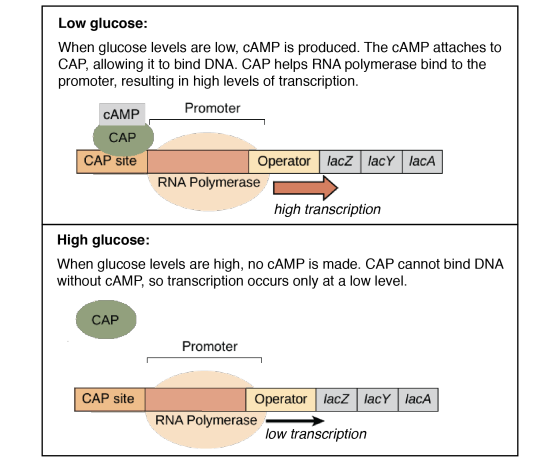
Upper panel: Low glucose. When glucose levels are low, cAMP is produced. The cAMP attaches to CAP, allowing it to bind DNA. CAP helps RNA polymerase bind to the promoter, resulting in high levels of transcription.
Lower panel: High glucose. When glucose levels are high, no cAMP is made. CAP cannot bind DNA without cAMP, so transcription occurs only at a low level.
CAP isn't always active (able to bind DNA). Instead, it's regulated by a small molecule called cyclic AMP (cAMP). cAMP is a "hunger signal" made by E. coliwhen glucose levels are low. cAMP binds to CAP, changing its shape and making it able to bind DNA and promote transcription. Without cAMP, CAP cannot bind DNA and is inactive.
CAP is only active when glucose levels are low (cAMP levels are high). Thus, the lac operon can only be transcribed at high levels when glucose is absent. This strategy ensures that bacteria only turn on the lac operon and start using lactose after they have used up all of the preferred energy source (glucose).
So, when does the lac operon really turn on?
The lac operon will be expressed at high levels if two conditions are met:
- Glucose must be unavailable: When glucose is unavailable, cAMP binds to CAP, making CAP able to bind DNA. Bound CAP helps RNA polymerase attach to the lac operon promoter.
- Lactose must be available: If lactose is available, the lac repressor will be released from the operator (by binding of allolactose). This allows RNA polymerase to move forward on the DNA and transcribe the operon.
These two events in combination – the binding of the activator and the release of the repressor – allow RNA polymerase to bind strongly to the promoter and give it a clear path for transcription. They lead to strong transcription of the lacoperon and production of enzymes needed for lactose utilization.
Add Answer to:
DNA replication: what is the biology of
making a precise copy of the genomic DNA in...
Most questions answered within 3 hours.
-
Where is the error in this code sequence?
String s1 = "Hello";
String s2 = "ello";...
asked 11 months ago -
Financial data for Joel de Paris, Inc., for last year
follow:
Joel de Paris, Inc.
Balance...
asked 11 months ago -
Consider this reaction:
Al2(SO4)3 (aq)+ BaCl3
(aq) Al2Cl6 (aq)- +
3BaSO4(s) . What is the...
asked 11 months ago -
Suppose that Savneet is considering increasing her
recent random sample from 20 car rentals to 40...
asked 11 months ago -
Trucks arrive at an unloading terminal at an average rate of 120
per hour.
Trucks arrive...
asked 11 months ago -
Why are methanol and ethanol completely soluble in water while
octanol is not very little soluble....
asked 11 months ago -
A facilities manager at a university reads in a research report
that the mean amount of...
asked 11 months ago -
When the CuSO4 is rehydrated by adding water to the anhydrous
compound, is this an endothermic...
asked 11 months ago -
A ray of sunlight is passing from diamond into crown glass; the
angle of incidence is...
asked 11 months ago -
A block of mass 0.249 kg is placed on top of a light, vertical
spring of...
asked 11 months ago -
how do the kidneys compensate in the presences of acidosis
a) trigger hyperventilate
b) reserve acid...
asked 11 months ago -
Question 501 pts
The rental rate of capital to the firm increases. Which of the
following...
asked 11 months ago