An object of mass M is in free-fall (the only force on the object is its...
An object of mass M is in free-fall (the only force on the object is its own weight). Make a force diagram for this case. Use Newton’s Second Law to calculate the acceleration of the object. What would happen to the acceleration if we double the mass of the object? Why is this case different than the previous question?
Homework Answers

Add Answer to:
An object of mass M is in free-fall (the only force on the
object is its...
Question Translation: On a car of mass M, two forces act as shown in the figure...
 Question Translation:
On a car of mass M, two forces act as shown in the figure
above. Find an expression for the acceleration of the car in terms
of T, F, and M. What happens to the acceleration if we double the
mass of the car?
An object of mass M is in free fall (the only force on the
object is its weight). Make a force diagram for this case. Use
Newton's second law to calculate the acceleration of...
Question Translation:
On a car of mass M, two forces act as shown in the figure
above. Find an expression for the acceleration of the car in terms
of T, F, and M. What happens to the acceleration if we double the
mass of the car?
An object of mass M is in free fall (the only force on the
object is its weight). Make a force diagram for this case. Use
Newton's second law to calculate the acceleration of...
Newton’s second law relates an object’s acceleration to its mass and the net force acting on...
Newton’s second law relates an object’s acceleration to its mass and the net force acting on it. Does Newton’s second law apply to a situation in which there is no net force? Select the best explanation. A. Yes. The law applies and it tells us that the object has a nonzero acceleration. B. No. The law applies only to situations in which a net force acts. C. No. The law does not apply because a zero net force would produce...
Question Translation: On a car of mass M, two forces act as shown in the figure above. Find an expression for the acceleration of the car in terms of T, F, and M. What happens to the acceleration if...
 Question Translation:
On a car of mass M, two forces act as shown in the figure
above. Find an expression for the acceleration of the car in terms
of T, F, and M. What happens to the acceleration if we double the
mass of the car?
An object of mass M is in free fall (the only force on the
object is its weight). Make a force diagram for this case. Use
Newton's second law to calculate the acceleration of...
Question Translation:
On a car of mass M, two forces act as shown in the figure
above. Find an expression for the acceleration of the car in terms
of T, F, and M. What happens to the acceleration if we double the
mass of the car?
An object of mass M is in free fall (the only force on the
object is its weight). Make a force diagram for this case. Use
Newton's second law to calculate the acceleration of...
. Terminal velocity - free fall. Estimate (order of magnitude) the terminal speed vT of a...
. Terminal velocity - free fall. Estimate (order of magnitude) the terminal speed vT of a typical human in free fall. Draw a free body diagram for the person falling at terminal velocity. Use the FBD, Newton’s second law, and the formula for air resistance (drag force) mentioned in class FD = 1/2 D ρ A v2 to find an expression for vT . Explain/justify any assumptions that you make (e.g., for quantities like the cross-sectional area A or the...
Which of the following is generally true for an object in free fall? Choose all that...
Which of the following is generally true for an object in free fall? Choose all that apply. a. An object in free fall feels only the force of gravity b. An object in free fall feels at least three forces c. An object in free fall moves with a constant velocity d. An object in free fall moves with a constant acceleration e. An object in free fall feels zero net force
The sum of the forces on an object is directly proportional to the mass of the...
 The sum of the forces on an object is directly proportional to
the mass of the object and directly proportional to the
acceleration of the object. The second law is expressed by the
equation: (1) F=ma
If the mass is in kg and the acceleration in m/s2,
then the force is in Newtons.
In (1), F is the net applied force, m is the mass of the object
on which the force is applied, and a is the acceleration of...
The sum of the forces on an object is directly proportional to
the mass of the object and directly proportional to the
acceleration of the object. The second law is expressed by the
equation: (1) F=ma
If the mass is in kg and the acceleration in m/s2,
then the force is in Newtons.
In (1), F is the net applied force, m is the mass of the object
on which the force is applied, and a is the acceleration of...
An object is launched at the initial velocity of v0=12 m/s up a Θ=20 degrees incline....
An object is launched at the initial velocity of v0=12 m/s up a Θ=20 degrees incline. The initial velocity is along the incline.The coefficient of kinetic friction is μ=0.2 a) Draw a free body diagram and apply Newton’s Second Law. b) Find the acceleration of the object as it moves up the incline. Find an expression first, then plug in numerical values. c) Find the distance travelled up the incline.. Find an expression first, then plug in numerical values. d)...
An object is launched at the initial velocity of v 0 =12 m/s up a Θ=...
An object is launched at the initial velocity of v 0 =12 m/s up a Θ= 20 degrees incline. The initial velocity is along the incline.The coefficient of kinetic friction is μ= 0.2 a) Draw a free body diagram and apply Newton’s Second Law. b) Find the acceleration of the object as it moves up the incline. Find an expression first, then plug in numerical values. c) Find the distance travelled up the incline.. Find an expression first, then plug...
Please Help!!! (a.) Vary the mass (10 different masses), calculate the weight in this case, the...
 Please Help!!!
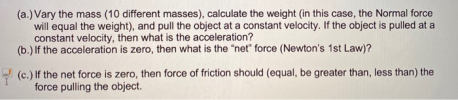
(a.) Vary the mass (10 different masses), calculate the weight in this case, the Normal force will equal the weight), and pull the object at a constant velocity. If the object is pulled at a constant velocity, then what is the acceleration? (b.) If the acceleration is zero, then what is the "net" force (Newton's 1st Law)? (c.) If the net force is zero, then force of friction should (equal, be greater than, less than) the force pulling...
Please Help!!!
(a.) Vary the mass (10 different masses), calculate the weight in this case, the Normal force will equal the weight), and pull the object at a constant velocity. If the object is pulled at a constant velocity, then what is the acceleration? (b.) If the acceleration is zero, then what is the "net" force (Newton's 1st Law)? (c.) If the net force is zero, then force of friction should (equal, be greater than, less than) the force pulling...
constant force mass (g) acceleration (m/s2) 300 10F/3 550 100F/55 800 10F/8 1050 100F/105 Include graphs...
constant force mass (g) acceleration (m/s2) 300 10F/3 550 100F/55 800 10F/8 1050 100F/105 Include graphs of mass on the x-axis vs acceleration on the y-axis and inverse mass on the x-axis vs. acceleration on the y-axis. Slope of the line for the second graph only: _________ (include units) Questions: According to Newton’s Second Law, F = ma, the equation has a y-intercept of zero. How does the graph of force versus acceleration for a system of constant mass support...
 Question Translation:
On a car of mass M, two forces act as shown in the figure
above. Find an expression for the acceleration of the car in terms
of T, F, and M. What happens to the acceleration if we double the
mass of the car?
An object of mass M is in free fall (the only force on the
object is its weight). Make a force diagram for this case. Use
Newton's second law to calculate the acceleration of...
Question Translation:
On a car of mass M, two forces act as shown in the figure
above. Find an expression for the acceleration of the car in terms
of T, F, and M. What happens to the acceleration if we double the
mass of the car?
An object of mass M is in free fall (the only force on the
object is its weight). Make a force diagram for this case. Use
Newton's second law to calculate the acceleration of...
 Question Translation:
On a car of mass M, two forces act as shown in the figure
above. Find an expression for the acceleration of the car in terms
of T, F, and M. What happens to the acceleration if we double the
mass of the car?
An object of mass M is in free fall (the only force on the
object is its weight). Make a force diagram for this case. Use
Newton's second law to calculate the acceleration of...
Question Translation:
On a car of mass M, two forces act as shown in the figure
above. Find an expression for the acceleration of the car in terms
of T, F, and M. What happens to the acceleration if we double the
mass of the car?
An object of mass M is in free fall (the only force on the
object is its weight). Make a force diagram for this case. Use
Newton's second law to calculate the acceleration of...
 The sum of the forces on an object is directly proportional to
the mass of the object and directly proportional to the
acceleration of the object. The second law is expressed by the
equation: (1) F=ma
If the mass is in kg and the acceleration in m/s2,
then the force is in Newtons.
In (1), F is the net applied force, m is the mass of the object
on which the force is applied, and a is the acceleration of...
The sum of the forces on an object is directly proportional to
the mass of the object and directly proportional to the
acceleration of the object. The second law is expressed by the
equation: (1) F=ma
If the mass is in kg and the acceleration in m/s2,
then the force is in Newtons.
In (1), F is the net applied force, m is the mass of the object
on which the force is applied, and a is the acceleration of...
 Please Help!!!
(a.) Vary the mass (10 different masses), calculate the weight in this case, the Normal force will equal the weight), and pull the object at a constant velocity. If the object is pulled at a constant velocity, then what is the acceleration? (b.) If the acceleration is zero, then what is the "net" force (Newton's 1st Law)? (c.) If the net force is zero, then force of friction should (equal, be greater than, less than) the force pulling...
Please Help!!!
(a.) Vary the mass (10 different masses), calculate the weight in this case, the Normal force will equal the weight), and pull the object at a constant velocity. If the object is pulled at a constant velocity, then what is the acceleration? (b.) If the acceleration is zero, then what is the "net" force (Newton's 1st Law)? (c.) If the net force is zero, then force of friction should (equal, be greater than, less than) the force pulling...
Most questions answered within 3 hours.
-
Where is the error in this code sequence?
String s1 = "Hello";
String s2 = "ello";...
asked 11 months ago -
Financial data for Joel de Paris, Inc., for last year
follow:
Joel de Paris, Inc.
Balance...
asked 11 months ago -
Consider this reaction:
Al2(SO4)3 (aq)+ BaCl3
(aq) Al2Cl6 (aq)- +
3BaSO4(s) . What is the...
asked 11 months ago -
Suppose that Savneet is considering increasing her
recent random sample from 20 car rentals to 40...
asked 11 months ago -
Trucks arrive at an unloading terminal at an average rate of 120
per hour.
Trucks arrive...
asked 11 months ago -
Why are methanol and ethanol completely soluble in water while
octanol is not very little soluble....
asked 11 months ago -
A facilities manager at a university reads in a research report
that the mean amount of...
asked 11 months ago -
When the CuSO4 is rehydrated by adding water to the anhydrous
compound, is this an endothermic...
asked 11 months ago -
A ray of sunlight is passing from diamond into crown glass; the
angle of incidence is...
asked 11 months ago -
A block of mass 0.249 kg is placed on top of a light, vertical
spring of...
asked 11 months ago -
how do the kidneys compensate in the presences of acidosis
a) trigger hyperventilate
b) reserve acid...
asked 11 months ago -
Question 501 pts
The rental rate of capital to the firm increases. Which of the
following...
asked 11 months ago