Consider an Erdős-Rényi network with N = 3,000 nodes, connected to each other with probability p...
Consider an Erdős-Rényi network with N = 3,000 nodes, connected to each other with probability p = 10–3.
Given the linking probability p = 10–3, calculate the number of nodes Ncr so that the network has only one component.
Homework Answers
I HOPE ITS HELPFULL TO YOU ...IF YOU HAVE ANY DOUBTS PLS COMMENTS BELOW...I WILL BE THERE TO HELP YOU...PLS RATE THUMBS UP...!! ALL THE BEST ...
ANSWER::-
AS FOR GIVEN DATA....
Consider an Erdős-Rényi network with N = 3,000 nodes, connected to each other with probability p = 10–3.
Given the linking probability p = 10–3, calculate the number of nodes Ncr so that the network has only one component.
SOL ::-
NOTE ::-
There are two closely related variants of the Erdos–Rényi (ER) random graph model.
In the G(n, M) model, a
graph is chosen uniformly at random from the collection of all
graphs which have n nodes and M edges. For example, in the G(3, 2)
model, each of the three possible graphs on three vertices and two
edges are included with probability 1/3.
In the G(n, p) model, a graph is constructed by connecting nodes
randomly. Each edge is included in the graph with probability p
independent from every other edge. Equivalently, all graphs with n
nodes and M edges have equal probability of

CODE ::-
|
#importing the networkx library >>> import networkx as nx
#importing the matplotlib library for plotting the graph >>> import matplotlib.pyplot as plt
>>> G= nx.erdos_renyi_graph(3000,0.1) >>> nx.draw(G, with_labels=True) >>> plt.show() >>> I= nx.erdos_renyi_graph(3000,0.1) >>> nx.draw(I, with_labels=True) >>> plt.show() |
I HOPE YOU UNDERSTAND..
I HOPE ITS HELP FULL TO YOU..PLS RATE THUMBS UP ITS HELPS ME ALOT...!
THANK YOU....!!!
Add Answer to:
Consider an Erdős-Rényi network with N = 3,000 nodes, connected
to each other with probability p...
Question 1 (20 points: Events, counting, and properties f probabniny Consider the network shown below. There are two kinds of links in the network. Each link of kind o-p +0 fails with probability...
 Question 1 (20 points: Events, counting, and properties f probabniny Consider the network shown below. There are two kinds of links in the network. Each link of kind o-p +0 fails with probability p and that of kind O 4+0 fails with probability q. Each link is assumed to fail independently of the other. We say that a path is successful if no link in the path fails. For example, the path S-B-T succeeds if none of the links S...
You have a network composed of many nodes connected by a big circuit. All nodes are...
 You have a network composed of many nodes connected by a big circuit. All nodes are of equal distance apart from each other. Assuming that you start traveling on one node and go all the way to the last node in one direction, it will take you a certain amount of time, referred to as "n." What is the average travel time in terms of "n" to get to any node from the starting node, if you have the option...
Consider the communication network shown in the figure below and suppose that each link can fail with probability p. As...
 Consider the communication network shown in the figure below and suppose that each link can fail with probability p. Assume that failures of different links are independent Link 1 Link 2 B A Link 5 Link 3 Link 4 1. Assume that p = 1/3. Find the probability that there exists a path from A to Balong which no link has failed. (Give a numerical answer.) 2. Given that exactly one link in the network has failed, find the probability...
For n Boolean variables, the full joint probability distribution contains 2^n numbers. A Bayes net can reduce this to n 2^k, where k is: A. the number of nodes in the network. B. the maximum number of...
For n Boolean variables, the full joint probability distribution contains 2^n numbers. A Bayes net can reduce this to n 2^k, where k is: A. the number of nodes in the network. B. the maximum number of nodes that directly influence any node. C. the number of parameters in each conditional probability table. EXPLAIN, THANKS
Network science e
Consider the following model to generate random graphs. Start with one single node. At each time step, to every node of the network either zero, one or two new nodes are connected by means of a single link with probability 𝑞0 = 0.1, 𝑞1 = 0.3 and 𝑞2 = 0.6, respectively. If at any time step no node gains a new neighbour, the algorithm stops.Starting with one single node, what is the probability that a network with only 3 nodes...
4. Consider the network shown below, and assume that each node initially knows the costs to each of its neighbors. Consider the distance-vector algorithm. 6 2 What are the distances from y to all oth...
 4. Consider the network shown below, and assume that each node initially knows the costs to each of its neighbors. Consider the distance-vector algorithm. 6 2 What are the distances from y to all other nodes after y receives one message from each of its direct neighbors (assuming that these messages are the only messages that have been sent and received so far in the entire system)? What are the distances from x to all other nodes after x receives...
A mobile computer network consists of a number of computers (called nodes) that communicate with each...
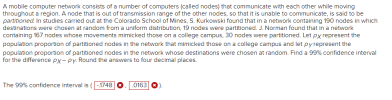 A mobile computer network consists of a number of computers (called nodes) that communicate with each other while moving throughout a region. A node that is out of transmission range of the other nodes, so that it is unable to communicate, is said to be partitioned. In studies carried out at the Colorado School of Mines, S. Kurkowski found that in a network containing 190 nodes in which destinations were chosen at random from a uniform distribution, 19 nodes were...
Consider a noisy communication channel, where each bit is flipped with probability p (the probability that...
Consider a noisy communication channel, where each bit is flipped with probability p (the probability that a bit is sent in error is p). Assume that n−1 bits, b1,b2,⋯,b(n−1), are going to be sent on this channel. A parity check bit is added to these bits so that the sum b1+b2+⋯+bn is an even number. This way, the receiver can distinguish occurrence of odd number of errors, that is, if one, three, or any odd number of errors occur, the...
A mobile computer network consists of a number of computers (called nodes) that communicate with each...
 A mobile computer network consists of a number of computers
(called nodes) that communicate with each other while moving
throughout a region. A node that is out of transmission range of
the other nodes, so that it is unable to communicate, is said to be
partitioned. In studies carried out at the Colorado School
of Mines, S. Kurkowski found that in a network containing 186 nodes
in which destinations were chosen at random from a uniform
distribution, 19 nodes were...
A mobile computer network consists of a number of computers
(called nodes) that communicate with each other while moving
throughout a region. A node that is out of transmission range of
the other nodes, so that it is unable to communicate, is said to be
partitioned. In studies carried out at the Colorado School
of Mines, S. Kurkowski found that in a network containing 186 nodes
in which destinations were chosen at random from a uniform
distribution, 19 nodes were...
2. Consider a problem where a monopolistic airline chooses between a fully-connected (FC) network and a...
 2. Consider a problem where a monopolistic airline chooses between a fully-connected (FC) network and a hub-and-spoke (HS) network for its operations. There are three cities in the airline's network, denoted by A, B, and H, respectively Note that there are 3 pairs of cities (equivalently 3 markets, including AH, HB, and AB markets) in the network. Under the FC network, the airline provides nonstop flight services for these 3 pairs of cities. Under the HS network, while the airline...
 Question 1 (20 points: Events, counting, and properties f probabniny Consider the network shown below. There are two kinds of links in the network. Each link of kind o-p +0 fails with probability p and that of kind O 4+0 fails with probability q. Each link is assumed to fail independently of the other. We say that a path is successful if no link in the path fails. For example, the path S-B-T succeeds if none of the links S...
 You have a network composed of many nodes connected by a big circuit. All nodes are of equal distance apart from each other. Assuming that you start traveling on one node and go all the way to the last node in one direction, it will take you a certain amount of time, referred to as "n." What is the average travel time in terms of "n" to get to any node from the starting node, if you have the option...
 Consider the communication network shown in the figure below and suppose that each link can fail with probability p. Assume that failures of different links are independent Link 1 Link 2 B A Link 5 Link 3 Link 4 1. Assume that p = 1/3. Find the probability that there exists a path from A to Balong which no link has failed. (Give a numerical answer.) 2. Given that exactly one link in the network has failed, find the probability...
 4. Consider the network shown below, and assume that each node initially knows the costs to each of its neighbors. Consider the distance-vector algorithm. 6 2 What are the distances from y to all other nodes after y receives one message from each of its direct neighbors (assuming that these messages are the only messages that have been sent and received so far in the entire system)? What are the distances from x to all other nodes after x receives...
 A mobile computer network consists of a number of computers (called nodes) that communicate with each other while moving throughout a region. A node that is out of transmission range of the other nodes, so that it is unable to communicate, is said to be partitioned. In studies carried out at the Colorado School of Mines, S. Kurkowski found that in a network containing 190 nodes in which destinations were chosen at random from a uniform distribution, 19 nodes were...
 A mobile computer network consists of a number of computers
(called nodes) that communicate with each other while moving
throughout a region. A node that is out of transmission range of
the other nodes, so that it is unable to communicate, is said to be
partitioned. In studies carried out at the Colorado School
of Mines, S. Kurkowski found that in a network containing 186 nodes
in which destinations were chosen at random from a uniform
distribution, 19 nodes were...
A mobile computer network consists of a number of computers
(called nodes) that communicate with each other while moving
throughout a region. A node that is out of transmission range of
the other nodes, so that it is unable to communicate, is said to be
partitioned. In studies carried out at the Colorado School
of Mines, S. Kurkowski found that in a network containing 186 nodes
in which destinations were chosen at random from a uniform
distribution, 19 nodes were...
 2. Consider a problem where a monopolistic airline chooses between a fully-connected (FC) network and a hub-and-spoke (HS) network for its operations. There are three cities in the airline's network, denoted by A, B, and H, respectively Note that there are 3 pairs of cities (equivalently 3 markets, including AH, HB, and AB markets) in the network. Under the FC network, the airline provides nonstop flight services for these 3 pairs of cities. Under the HS network, while the airline...
Most questions answered within 3 hours.
-
Where is the error in this code sequence?
String s1 = "Hello";
String s2 = "ello";...
asked 10 months ago -
Financial data for Joel de Paris, Inc., for last year
follow:
Joel de Paris, Inc.
Balance...
asked 10 months ago -
Consider this reaction:
Al2(SO4)3 (aq)+ BaCl3
(aq) Al2Cl6 (aq)- +
3BaSO4(s) . What is the...
asked 10 months ago -
Suppose that Savneet is considering increasing her
recent random sample from 20 car rentals to 40...
asked 10 months ago -
Trucks arrive at an unloading terminal at an average rate of 120
per hour.
Trucks arrive...
asked 10 months ago -
Why are methanol and ethanol completely soluble in water while
octanol is not very little soluble....
asked 10 months ago -
A facilities manager at a university reads in a research report
that the mean amount of...
asked 10 months ago -
When the CuSO4 is rehydrated by adding water to the anhydrous
compound, is this an endothermic...
asked 10 months ago -
A ray of sunlight is passing from diamond into crown glass; the
angle of incidence is...
asked 10 months ago -
A block of mass 0.249 kg is placed on top of a light, vertical
spring of...
asked 10 months ago -
how do the kidneys compensate in the presences of acidosis
a) trigger hyperventilate
b) reserve acid...
asked 10 months ago -
Question 501 pts
The rental rate of capital to the firm increases. Which of the
following...
asked 10 months ago