
Homework Answers
Add Answer to:
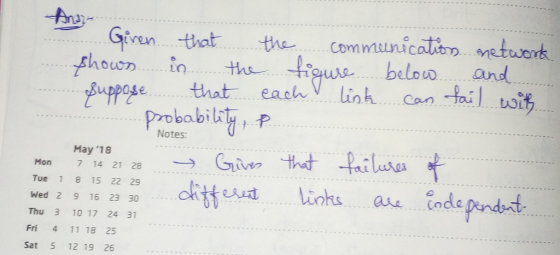
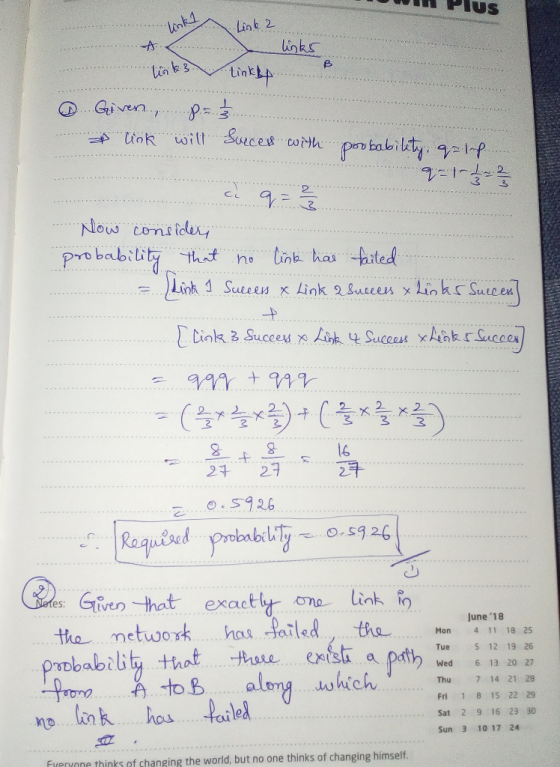
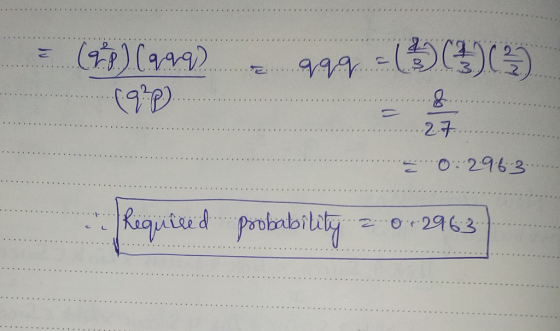
Consider the communication network shown in the figure below and suppose that each link can fail with probability p. As...
Question 1 (20 points: Events, counting, and properties f probabniny Consider the network shown below. There are two kinds of links in the network. Each link of kind o-p +0 fails with probability...
 Question 1 (20 points: Events, counting, and properties f probabniny Consider the network shown below. There are two kinds of links in the network. Each link of kind o-p +0 fails with probability p and that of kind O 4+0 fails with probability q. Each link is assumed to fail independently of the other. We say that a path is successful if no link in the path fails. For example, the path S-B-T succeeds if none of the links S...
9 Consider the computer network with nodes and communication links as shown below Each link has...
 9 Consider the computer network with nodes and communication links as shown below Each link has a cost associated with it. Find a minimum spanning tree of the network that connects all nodes with minimum total link cost. Specify the minimum total cost You t use Prim's algorithm. Show all steps of the algorithm. mus 2 2 4
In the communications networks diagrammed below, suppose that the communication link labeled 1くіく5 is working with...
 In the communications networks diagrammed below, suppose that the communication link labeled 1くіく5 is working with probability pi, and fails with probability i-pi, independently of the others. What is the probability that A can communicate with B in each case, that is, the probability that there are one or more paths from A to B all of whose links are working? Give your answer as a function of pi, p2, p3, pa, ps, and simplify your formula as much as...
The probability that each link is working is 0.95. what is the probability of being able...
 The probability that each link is working is 0.95.
what is the probability of being able to transmit a message from
point A to point B? if the message is successfully sent, what is
the probability that the middle link was working?
1-7.5 A communication network has five links as shown below.
The probability that each link is working is 0.95.
what is the probability of being able to transmit a message from
point A to point B? if the message is successfully sent, what is
the probability that the middle link was working?
1-7.5 A communication network has five links as shown below.
Problem 4. Two communication systems (shown below) are composed from several links, where, for proper operation,...
 Problem 4. Two communication systems (shown below) are composed from several links, where, for proper operation, a connection must be available between two end points of each system. For a link to work properly, it must provide a connection across its end points. The links are assumed to fail independently of each other. Each link is numbered with i, and we assume that the probability that link fails is equal to p Find the probability of failure of each system,...
Consider the network shown below. The numbers shown for each link are the delays between nearest...
 Consider the network shown below. The numbers shown for each
link are the delays between nearest neighbors for that link. Apply
Dijkstra’s algorithm to this network starting at node 1, and label
each node with the shortest path route to node 1.
2 Al 3 5
Consider the network shown below. The numbers shown for each
link are the delays between nearest neighbors for that link. Apply
Dijkstra’s algorithm to this network starting at node 1, and label
each node with the shortest path route to node 1.
2 Al 3 5
The next three questions are related to the local area network shown below. In this network computers attached to link...
 The next three questions are related to the local area network shown below. In this network computers attached to links 1 & 2 send data to the server attached to link 3. The three devices are connected through a router. Link 1 Link 2 Link 3 Following parameters of the network have been provided. Propagation delay in link 1-138 micro seconds Propagation delay in link 2-309 micro seconds Propagation delay in link 3-216 micro seconds Frame size 1432 bytes ACK...
In the network below, let us suppose that the link between nodes ‘k’ and ‘m’ has...
 In the network below, let us suppose that the link between nodes
‘k’ and ‘m’ has been failed. Using your knowledge of link-state
routing, calculate the shortest path from node ‘i’ to node ‘j’
before failure and after failure.
Also, mention the costs from node ‘i’ to node ‘j’ before
failure and after failure.
[Hint = For example, the cost from node ‘i’ to
node ‘r’ is 1 and the path is i-r]
m 4 n 5 r 1
In the network below, let us suppose that the link between nodes
‘k’ and ‘m’ has been failed. Using your knowledge of link-state
routing, calculate the shortest path from node ‘i’ to node ‘j’
before failure and after failure.
Also, mention the costs from node ‘i’ to node ‘j’ before
failure and after failure.
[Hint = For example, the cost from node ‘i’ to
node ‘r’ is 1 and the path is i-r]
m 4 n 5 r 1
Consider N users who share a communication link. Suppose each user transmits a fraction p of...
Consider N users who share a communication link. Suppose each user transmits a fraction p of the time, i.e., at any time instant, each user is transmitting with probability p. The probability that at any time instant, n users are transmitting is given by the Binomial distribution: C(N,n) = N!/[n!(N-n)!] i. What is the probability of more than 12 users transmitting at the same time? ( 10 pts) ii. What is the probability of less than 5 users transmitting at...
Consider the following network. a. (16 pt.) With the indicated link costs, use Dijkstra’s shortest-path algorithm...
 Consider the following network.
a. (16 pt.)
With the indicated link costs, use Dijkstra’s shortest-path
algorithm to compute the shortest path from “w” to
all network nodes. Show how the algorithm works by computing the
table below. Note: If there exists any tie in each step, choose the
left-most column first.
Step
N’
D(s),
p(s)
D(t),
p(t)
D(u),
p(u)
D(v),
p(v)
D(x),
p(x)
D(y),
p(y)
D(z),
p(z)
0
1
2
3
4
5
6
7
b. (7 pt.)
Construct the...
Consider the following network.
a. (16 pt.)
With the indicated link costs, use Dijkstra’s shortest-path
algorithm to compute the shortest path from “w” to
all network nodes. Show how the algorithm works by computing the
table below. Note: If there exists any tie in each step, choose the
left-most column first.
Step
N’
D(s),
p(s)
D(t),
p(t)
D(u),
p(u)
D(v),
p(v)
D(x),
p(x)
D(y),
p(y)
D(z),
p(z)
0
1
2
3
4
5
6
7
b. (7 pt.)
Construct the...
 Question 1 (20 points: Events, counting, and properties f probabniny Consider the network shown below. There are two kinds of links in the network. Each link of kind o-p +0 fails with probability p and that of kind O 4+0 fails with probability q. Each link is assumed to fail independently of the other. We say that a path is successful if no link in the path fails. For example, the path S-B-T succeeds if none of the links S...
 9 Consider the computer network with nodes and communication links as shown below Each link has a cost associated with it. Find a minimum spanning tree of the network that connects all nodes with minimum total link cost. Specify the minimum total cost You t use Prim's algorithm. Show all steps of the algorithm. mus 2 2 4
 In the communications networks diagrammed below, suppose that the communication link labeled 1くіく5 is working with probability pi, and fails with probability i-pi, independently of the others. What is the probability that A can communicate with B in each case, that is, the probability that there are one or more paths from A to B all of whose links are working? Give your answer as a function of pi, p2, p3, pa, ps, and simplify your formula as much as...
 The probability that each link is working is 0.95.
what is the probability of being able to transmit a message from
point A to point B? if the message is successfully sent, what is
the probability that the middle link was working?
1-7.5 A communication network has five links as shown below.
The probability that each link is working is 0.95.
what is the probability of being able to transmit a message from
point A to point B? if the message is successfully sent, what is
the probability that the middle link was working?
1-7.5 A communication network has five links as shown below.
 Problem 4. Two communication systems (shown below) are composed from several links, where, for proper operation, a connection must be available between two end points of each system. For a link to work properly, it must provide a connection across its end points. The links are assumed to fail independently of each other. Each link is numbered with i, and we assume that the probability that link fails is equal to p Find the probability of failure of each system,...
 Consider the network shown below. The numbers shown for each
link are the delays between nearest neighbors for that link. Apply
Dijkstra’s algorithm to this network starting at node 1, and label
each node with the shortest path route to node 1.
2 Al 3 5
Consider the network shown below. The numbers shown for each
link are the delays between nearest neighbors for that link. Apply
Dijkstra’s algorithm to this network starting at node 1, and label
each node with the shortest path route to node 1.
2 Al 3 5
 The next three questions are related to the local area network shown below. In this network computers attached to links 1 & 2 send data to the server attached to link 3. The three devices are connected through a router. Link 1 Link 2 Link 3 Following parameters of the network have been provided. Propagation delay in link 1-138 micro seconds Propagation delay in link 2-309 micro seconds Propagation delay in link 3-216 micro seconds Frame size 1432 bytes ACK...
 In the network below, let us suppose that the link between nodes
‘k’ and ‘m’ has been failed. Using your knowledge of link-state
routing, calculate the shortest path from node ‘i’ to node ‘j’
before failure and after failure.
Also, mention the costs from node ‘i’ to node ‘j’ before
failure and after failure.
[Hint = For example, the cost from node ‘i’ to
node ‘r’ is 1 and the path is i-r]
m 4 n 5 r 1
In the network below, let us suppose that the link between nodes
‘k’ and ‘m’ has been failed. Using your knowledge of link-state
routing, calculate the shortest path from node ‘i’ to node ‘j’
before failure and after failure.
Also, mention the costs from node ‘i’ to node ‘j’ before
failure and after failure.
[Hint = For example, the cost from node ‘i’ to
node ‘r’ is 1 and the path is i-r]
m 4 n 5 r 1
 Consider the following network.
a. (16 pt.)
With the indicated link costs, use Dijkstra’s shortest-path
algorithm to compute the shortest path from “w” to
all network nodes. Show how the algorithm works by computing the
table below. Note: If there exists any tie in each step, choose the
left-most column first.
Step
N’
D(s),
p(s)
D(t),
p(t)
D(u),
p(u)
D(v),
p(v)
D(x),
p(x)
D(y),
p(y)
D(z),
p(z)
0
1
2
3
4
5
6
7
b. (7 pt.)
Construct the...
Consider the following network.
a. (16 pt.)
With the indicated link costs, use Dijkstra’s shortest-path
algorithm to compute the shortest path from “w” to
all network nodes. Show how the algorithm works by computing the
table below. Note: If there exists any tie in each step, choose the
left-most column first.
Step
N’
D(s),
p(s)
D(t),
p(t)
D(u),
p(u)
D(v),
p(v)
D(x),
p(x)
D(y),
p(y)
D(z),
p(z)
0
1
2
3
4
5
6
7
b. (7 pt.)
Construct the...
Most questions answered within 3 hours.
-
Where is the error in this code sequence?
String s1 = "Hello";
String s2 = "ello";...
asked 10 months ago -
Financial data for Joel de Paris, Inc., for last year
follow:
Joel de Paris, Inc.
Balance...
asked 10 months ago -
Consider this reaction:
Al2(SO4)3 (aq)+ BaCl3
(aq) Al2Cl6 (aq)- +
3BaSO4(s) . What is the...
asked 10 months ago -
Suppose that Savneet is considering increasing her
recent random sample from 20 car rentals to 40...
asked 10 months ago -
Trucks arrive at an unloading terminal at an average rate of 120
per hour.
Trucks arrive...
asked 10 months ago -
Why are methanol and ethanol completely soluble in water while
octanol is not very little soluble....
asked 10 months ago -
A facilities manager at a university reads in a research report
that the mean amount of...
asked 10 months ago -
When the CuSO4 is rehydrated by adding water to the anhydrous
compound, is this an endothermic...
asked 10 months ago -
A ray of sunlight is passing from diamond into crown glass; the
angle of incidence is...
asked 10 months ago -
A block of mass 0.249 kg is placed on top of a light, vertical
spring of...
asked 10 months ago -
how do the kidneys compensate in the presences of acidosis
a) trigger hyperventilate
b) reserve acid...
asked 10 months ago -
Question 501 pts
The rental rate of capital to the firm increases. Which of the
following...
asked 10 months ago