A student measured the mass of 10.0 mL of unknown polymer to be 13.2 g at...
A student measured the mass of 10.0 mL of unknown polymer to be 13.2 g at 28oC. she then used a viscometer to measure the flow times for water and an unknown polymer and found them to be 10.6 s and 15.4 s respectively. given the density of water at 28oC is 0.999 g/cm3 and the viscosity of water at 28oC is 0.7978 cP, find the viscosity of the unknown polymer at the same temperature.
Homework Answers
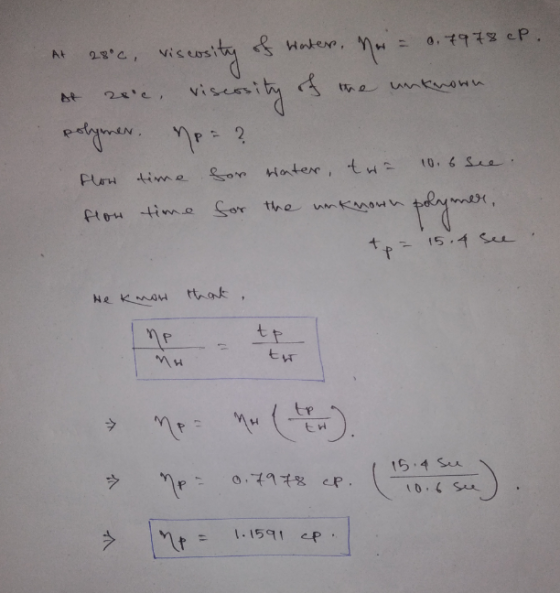
The viscosity and flow time of a particular solution are directly proportional to each other at a fixed temperature .
The viscosity of the unknown polymer at 28°C is 1.1591 centipoise (cP).
The detail calculation is shown below.
Add Answer to:
A student measured the mass of 10.0 mL of unknown polymer to be
13.2 g at...
A student is determining the density of an unknown metal with a mass of 56.5 g....
A student is determining the density of an unknown metal with a mass of 56.5 g. The student partially fills a graduated cylinder with water and measures the volume of the water by itself as 54.8 mL. The student then adds the metal to the water and measures the new volume as 87.3 mL. What is the density, in g/mL, of the metal?
A student measured a mass of a metal bar as 57.21 g. The student filled a...
 A student measured a mass of a metal bar as 57.21 g. The student filled a graduated cylinder with water and determined the volume of water to be 48.60 ml Then the student placed the metal bar into the graduated cylinder and determined the new volume to be 53.70 mL Calculate the density of the metal and identify its name from the choices that appear in Table 1.2. A chemist has a 9.50 ml, sample of rubbing alcohol (isopropyl alcohol)....
An irregular lump of an unknown metal has a measured density of 3.84 g/mL. The metal...
An irregular lump of an unknown metal has a measured density of 3.84 g/mL. The metal is heated to a temperature of 161 °C and placed in a graduated cylinder filled with 25.0 mL of water at 25.0 °C. After the system has reached thermal equilibrium, the volume in the cylinder is read at 33.7 mL, and the temperature is recorded as 37.4 °C. What is the specific heat of the unknown metal sample? Assume no heat is lost to...
-A sample of kerosene weighs 36.4 g. Its volume was measured to be 45.6 mL. What...
-A sample of kerosene weighs 36.4 g. Its volume was measured to be 45.6 mL. What is the density of kerosene? -Acetone, the solvent in some nail polish removers, has a density of 0.791 g/mL. What is the volume of 16.4 g of acetone? -A graduated cylinder was filled with water to the 19.1 mL mark and weighed on a balance. Its mass was 34.16 g. An object made of silver was placed in the cylinder and completely submerged in...
Post Lab #1 A student was assigned the task of determining the molar mass of an unknown gas. The student measured t...
 Post Lab #1 A student was assigned the task of determining the molar mass of an unknown gas. The student measured the mass of a sealed 843 mL rigid flask that contained dry air. The student then flushed the flask with the unknown gas, resealed it, and measured the mass again. Both the air and the unknown gas were at 23.0°C and 750. torr. The data for the experiment are shown in the table below. Volume of sealed flask 843...
An irregular lump of an unknown metal has a measured density of 5.33 g/mL. The metal...
 An irregular lump of an unknown metal has a measured density of 5.33 g/mL. The metal is heated to a temperature of 157 °C and placed in a graduated cylinder filled with 25.0 mL of water at 25.0°C. After the system has reached thermal equilibrium, the volume in the cylinder is read at 33.7 mL, and the temperature is recorded as 37.8 °C. What is the specific heat of the unknown metal sample? Assume no heat is lost to the...
An irregular lump of an unknown metal has a measured density of 5.92 g/mL. The metal...
 An irregular lump of an unknown metal has a measured density of 5.92 g/mL. The metal is heated to a temperature of 191 °C and placed in a graduated cylinder filled with 25.0 mL of water at 25.0 °C. After the system has reached thermal equilibrium, the volume in the cylinder is read at 34.3 mL, and the temperature is recorded as 40.8 °C. What is the specific heat of the unknown metal sample? Assume no heat is lost to...
An irregular lump of an unknown metal has a measured density of 4.51 g/mL. The metal...
An irregular lump of an unknown metal has a measured density of 4.51 g/mL. The metal is heated to a temperature of 171 °C and placed in a graduated cylinder filled with 25.0 mL of water at 25.0 °C. After the system has reached thermal equilibrium, the volume in the cylinder is read at 30.2 mL, and the temperature is recorded as 47.7 °C. What is the specific heat of the unknown metal sample? Assume no heat is lost to...
An irregular lump of an unknown metal has a measured density of 3.05 g/mL. The metal...
An irregular lump of an unknown metal has a measured density of 3.05 g/mL. The metal is heated to a temperature of 175 °C and placed in a graduated cylinder filled with 25.0 mL of water at 25.0 °C. After the system has reached thermal equilibrium, the volume in the cylinder is read at 31.4 mL, and the temperature is recorded as 43.8 °C. What is the specific heat of the unknown metal sample? Assume no heat is lost to...
An irregular lump of an unknown metal has a measured density of 4.04 g/mL. The metal...
An irregular lump of an unknown metal has a measured density of 4.04 g/mL. The metal is heated to a temperature of 161 °C and placed in a graduated cylinder filled with 25.0 mL of water at 25.0 °C. After the system has reached thermal equilibrium, the volume in the cylinder is read at 34.1 mL, and the temperature is recorded as 45.2 °C. What is the specific heat of the unknown metal sample? Assume no heat is lost to...
 A student measured a mass of a metal bar as 57.21 g. The student filled a graduated cylinder with water and determined the volume of water to be 48.60 ml Then the student placed the metal bar into the graduated cylinder and determined the new volume to be 53.70 mL Calculate the density of the metal and identify its name from the choices that appear in Table 1.2. A chemist has a 9.50 ml, sample of rubbing alcohol (isopropyl alcohol)....
 Post Lab #1 A student was assigned the task of determining the molar mass of an unknown gas. The student measured the mass of a sealed 843 mL rigid flask that contained dry air. The student then flushed the flask with the unknown gas, resealed it, and measured the mass again. Both the air and the unknown gas were at 23.0°C and 750. torr. The data for the experiment are shown in the table below. Volume of sealed flask 843...
 An irregular lump of an unknown metal has a measured density of 5.33 g/mL. The metal is heated to a temperature of 157 °C and placed in a graduated cylinder filled with 25.0 mL of water at 25.0°C. After the system has reached thermal equilibrium, the volume in the cylinder is read at 33.7 mL, and the temperature is recorded as 37.8 °C. What is the specific heat of the unknown metal sample? Assume no heat is lost to the...
 An irregular lump of an unknown metal has a measured density of 5.92 g/mL. The metal is heated to a temperature of 191 °C and placed in a graduated cylinder filled with 25.0 mL of water at 25.0 °C. After the system has reached thermal equilibrium, the volume in the cylinder is read at 34.3 mL, and the temperature is recorded as 40.8 °C. What is the specific heat of the unknown metal sample? Assume no heat is lost to...
Most questions answered within 3 hours.
-
Where is the error in this code sequence?
String s1 = "Hello";
String s2 = "ello";...
asked 11 months ago -
Financial data for Joel de Paris, Inc., for last year
follow:
Joel de Paris, Inc.
Balance...
asked 11 months ago -
Consider this reaction:
Al2(SO4)3 (aq)+ BaCl3
(aq) Al2Cl6 (aq)- +
3BaSO4(s) . What is the...
asked 11 months ago -
Suppose that Savneet is considering increasing her
recent random sample from 20 car rentals to 40...
asked 11 months ago -
Trucks arrive at an unloading terminal at an average rate of 120
per hour.
Trucks arrive...
asked 11 months ago -
Why are methanol and ethanol completely soluble in water while
octanol is not very little soluble....
asked 11 months ago -
A facilities manager at a university reads in a research report
that the mean amount of...
asked 11 months ago -
When the CuSO4 is rehydrated by adding water to the anhydrous
compound, is this an endothermic...
asked 11 months ago -
A ray of sunlight is passing from diamond into crown glass; the
angle of incidence is...
asked 11 months ago -
A block of mass 0.249 kg is placed on top of a light, vertical
spring of...
asked 11 months ago -
how do the kidneys compensate in the presences of acidosis
a) trigger hyperventilate
b) reserve acid...
asked 11 months ago -
Question 501 pts
The rental rate of capital to the firm increases. Which of the
following...
asked 11 months ago