When 5.325 g of KCl dissolved in 100.0 ML of water, the temperature of the solution...
Homework Answers
First calculate mass of solution
Mass of solution (m) = Mass of water + Mass of KCl
Assume density of water = 1.00 g /ml. Therefore, Mass of water = density x volume = 1.00 g / ml x 100 ml = 100.0 g
Therefore, Mass of solution = 100 g + 5.325 g = 105.325 g
Specific heat capacity of solution ( C) = 4.18 J / g 0 C
Change in temperature (  T) of
solution = T final - T initial = 21.2 0 C - 24.1
0 C = - 2.9 0 C
T) of
solution = T final - T initial = 21.2 0 C - 24.1
0 C = - 2.9 0 C
In this case, q reaction = - q solution
Hence ,Enthalpy change of solution =- m x C
x  T
T
Enthalpy change of solution = - 105.325 g x 4.18 J / g 0 C x ( - 2.9 0 C )
= 1276.7 J
Enthalpy change of solution on dissolution of 1 g KCl = 1276.7 J / 5.325 g =239.8 J / g
Molar mass of KCl = 39.10 + 35.45 = 74.55 g /mol
Enthalpy change of solution on dissolution of 1 mole KCl =239.8 J / g x 74.55 g /mol = 17877.1 J / mol
Enthalpy change of solution on dissolution of 1 mole KCl = 17877.1 J / mol = 17.877 kJ / mol
Add Answer to:
When 5.325 g of KCl dissolved in 100.0 ML of water, the temperature
of the solution...
Calculate the final temperature that will be obtained when a 10g portion of KCL is dissolved...
Calculate the final temperature that will be obtained when a 10g portion of KCL is dissolved in a coffee-cup calorimeter containing 100g of water. Specific heat of the solution is 4.084j/gc delta H sol (KCL)= 17.0kj/mol and initial temperature is 21.0. Assume that density of the solution is 1.00 g/ml and the calorimeter loses only a neglible amount of heat.
What is the final temperature of the solution when 4.806 g of sodium hydroxide is dissolved in 100.0 mL of water at an i...
What is the final temperature of the solution when 4.806 g of sodium hydroxide is dissolved in 100.0 mL of water at an initial temperature of 24.5 C?. The density of water is 0.9969 g/cm3, and the heat capacity is 4.184 J/C. The enthalpy of dissolution for sodium hydroxide is -44.2 kJ/mol.
Calculate the energy change with the correct sign) when the temperature of 100.0 mL of liquid...
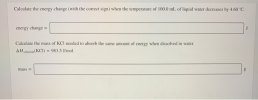 Calculate the energy change with the correct sign) when the temperature of 100.0 mL of liquid water decreases by 4.60 °C. energy change = Calculate the mass of KCl needed to absorb the same amount of energy when dissolved in water. A Holution (KCI) = 983.5J/mol. mass
16.41 g of MgSO₄ is placed into 100.0 mL of water. The water's temperature increases by...
16.41 g of MgSO₄ is placed into 100.0 mL of water. The water's temperature increases by 6.7°C. Calculate ∆H, in kJ/mol, for the dissolution of MgSO₄. (The specific heat of water is 4.18 J/g・°C and the density of the water is 1.00 g/mL). You can assume that the specific heat of the solution is the same as that of water.
16) When 0.800 grams of NaOH is dissolved in 100.0 grams of water, the temperature of...
16) When 0.800 grams of NaOH is dissolved in 100.0 grams of water, the temperature of the solution increases from 25.00 °C to 27.06 °C. The amount of heat absorbed by the water is _______J. (The specific heat of water is 4.18 J/g-°C.)
The solubility of KCl at 20°C is 34.0 g per 100.0 g of water. What is...
The solubility of KCl at 20°C is 34.0 g per 100.0 g of water. What is the maximum amount (in grams) of KCl that will dissolve in 40.0 g of water at 20°C?
When 10.0 mg of sucrose is dissolved in enough water to make 100.0 mL of solution...
When 10.0 mg of sucrose is dissolved in enough water to make 100.0 mL of solution at 25.00 °C, an osmotic pressure of 5.43 mmHg is measured. What is the molar mass of sucrose? Show your work, and provide your answer in g/mol.
The salt sodium perchlorate is soluble in water. When 9.07 g of NaClO4 is dissolved in...
The salt sodium perchlorate is soluble in water. When 9.07 g of NaClO4 is dissolved in 103.00 g of water, the temperature of the solution decreases from 25.00 to 22.70 °C. Based on this observation, calculate the enthalpy of dissolution of NaClO4 (in kJ/mol). Assume that the specific heat of the solution is 4.184 J/g °C and that the heat absorbed by the calorimeter is negligible. ΔHdissolution kJ/mol =
A solution was prepared by adding 2.00g KCl (MW = 74.55g / mol) in 100.0 mL...
A solution was prepared by adding 2.00g KCl (MW = 74.55g / mol) in 100.0 mL of water. Determine the molality of the solution. Assume that the water density is 1.002 g / mL
when a 7.00 g sample of KSCN is dissolved in water in a calorimeter that has...
 when a 7.00 g sample of KSCN is dissolved in water in a calorimeter
that has a total he capacity of 4.36 kJ. K^-1, the temperature
decreases by .400 K. calculate the molar heat of solution of KSCN.
Resources Give Up?9 When a 7.00 g sample of KSCN is dissolved in water in a calorimeter that has a total heat capacity of 4.36 kJ .K-, the decreases by 0.400 K. Calculate the molar heat of solution of KSCN kJ/mol TOOLS...
when a 7.00 g sample of KSCN is dissolved in water in a calorimeter
that has a total he capacity of 4.36 kJ. K^-1, the temperature
decreases by .400 K. calculate the molar heat of solution of KSCN.
Resources Give Up?9 When a 7.00 g sample of KSCN is dissolved in water in a calorimeter that has a total heat capacity of 4.36 kJ .K-, the decreases by 0.400 K. Calculate the molar heat of solution of KSCN kJ/mol TOOLS...
 Calculate the energy change with the correct sign) when the temperature of 100.0 mL of liquid water decreases by 4.60 °C. energy change = Calculate the mass of KCl needed to absorb the same amount of energy when dissolved in water. A Holution (KCI) = 983.5J/mol. mass
 when a 7.00 g sample of KSCN is dissolved in water in a calorimeter
that has a total he capacity of 4.36 kJ. K^-1, the temperature
decreases by .400 K. calculate the molar heat of solution of KSCN.
Resources Give Up?9 When a 7.00 g sample of KSCN is dissolved in water in a calorimeter that has a total heat capacity of 4.36 kJ .K-, the decreases by 0.400 K. Calculate the molar heat of solution of KSCN kJ/mol TOOLS...
when a 7.00 g sample of KSCN is dissolved in water in a calorimeter
that has a total he capacity of 4.36 kJ. K^-1, the temperature
decreases by .400 K. calculate the molar heat of solution of KSCN.
Resources Give Up?9 When a 7.00 g sample of KSCN is dissolved in water in a calorimeter that has a total heat capacity of 4.36 kJ .K-, the decreases by 0.400 K. Calculate the molar heat of solution of KSCN kJ/mol TOOLS...
Most questions answered within 3 hours.
-
Where is the error in this code sequence?
String s1 = "Hello";
String s2 = "ello";...
asked 11 months ago -
Financial data for Joel de Paris, Inc., for last year
follow:
Joel de Paris, Inc.
Balance...
asked 11 months ago -
Consider this reaction:
Al2(SO4)3 (aq)+ BaCl3
(aq) Al2Cl6 (aq)- +
3BaSO4(s) . What is the...
asked 11 months ago -
Suppose that Savneet is considering increasing her
recent random sample from 20 car rentals to 40...
asked 11 months ago -
Trucks arrive at an unloading terminal at an average rate of 120
per hour.
Trucks arrive...
asked 11 months ago -
Why are methanol and ethanol completely soluble in water while
octanol is not very little soluble....
asked 11 months ago -
A facilities manager at a university reads in a research report
that the mean amount of...
asked 11 months ago -
When the CuSO4 is rehydrated by adding water to the anhydrous
compound, is this an endothermic...
asked 11 months ago -
A ray of sunlight is passing from diamond into crown glass; the
angle of incidence is...
asked 11 months ago -
A block of mass 0.249 kg is placed on top of a light, vertical
spring of...
asked 11 months ago -
how do the kidneys compensate in the presences of acidosis
a) trigger hyperventilate
b) reserve acid...
asked 11 months ago -
Question 501 pts
The rental rate of capital to the firm increases. Which of the
following...
asked 11 months ago