Synthesis of 1,4-di-t-butyl-2,5-dimethoxybenzene via Friedel-Crafts Alkylation Describe the HNMR spectrum of this experiment’s product.
Synthesis of 1,4-di-t-butyl-2,5-dimethoxybenzene via Friedel-Crafts Alkylation
Describe the HNMR spectrum of this experiment’s product.
Homework Answers
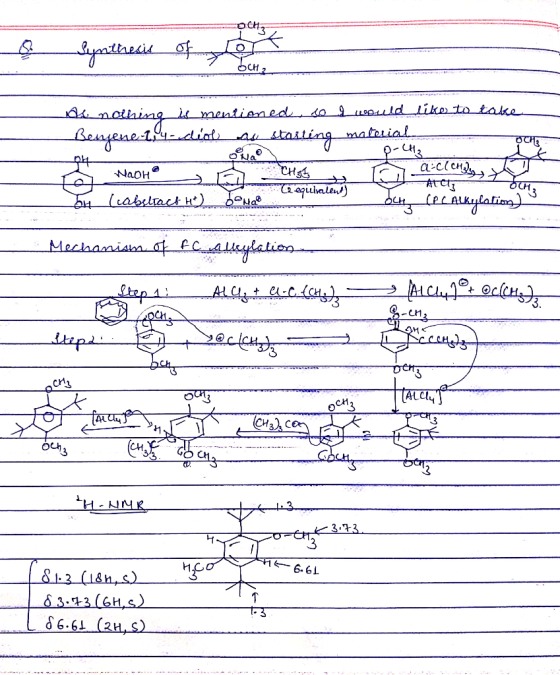
I hope this is the description of HNMR of this molecule you wanted to know. If you want to know more please let us know. If you find difficulty in getting any point please let me know.
Add Answer to:
Synthesis of 1,4-di-t-butyl-2,5-dimethoxybenzene via
Friedel-Crafts Alkylation
Describe the HNMR spectrum of this experiment’s
product.
These question are for the Friedel Crafts Alkylation of 1,4-Dimethoxybenzene organic chem lab 1. Why is...
 These question are for the Friedel Crafts Alkylation of
1,4-Dimethoxybenzene organic chem lab
1. Why is 1,4-di-t-butyl-2,5-dimethoxybenzene the preferred product of this reaction? Why is neither 1,2-di-t-butyl-3,6-dimethoxybenzene nor 1,3-di-t-butyl-3,6-dimethoxybenzene formed as side products? OCH3 OCH3 OCH3 OCH3 1,2-di-t-butyl-3,6-dimethoxybenzene 1,3-di-t-butyl-3,6-dimethoxybenzene 2. 3. 4. Why was the product washed with water? Why was the product washed with methanol? We used t-butyl alcohol to generate t-butyl cation. Suggest two other compounds that could be used to generate the t-butyl cation.
These question are for the Friedel Crafts Alkylation of
1,4-Dimethoxybenzene organic chem lab
1. Why is 1,4-di-t-butyl-2,5-dimethoxybenzene the preferred product of this reaction? Why is neither 1,2-di-t-butyl-3,6-dimethoxybenzene nor 1,3-di-t-butyl-3,6-dimethoxybenzene formed as side products? OCH3 OCH3 OCH3 OCH3 1,2-di-t-butyl-3,6-dimethoxybenzene 1,3-di-t-butyl-3,6-dimethoxybenzene 2. 3. 4. Why was the product washed with water? Why was the product washed with methanol? We used t-butyl alcohol to generate t-butyl cation. Suggest two other compounds that could be used to generate the t-butyl cation.
What's the theoretical yield of 1,4-di-t-butyl-2,5-dimethoxybenzene (MW = 250.38 g/mol) if 0.0008 mols of 1,4-dimethoxybenzene (MW...
What's the theoretical yield of 1,4-di-t-butyl-2,5-dimethoxybenzene (MW = 250.38 g/mol) if 0.0008 mols of 1,4-dimethoxybenzene (MW = 138.16 g/mol) were used? Please help and show work if possible.
For a Friedel-Crafts alkylation reaction between 1,4-dimethoxybenzene with 3-methyl-2-butanol and sulfuric acid what product was formed...
For a Friedel-Crafts alkylation reaction between 1,4-dimethoxybenzene with 3-methyl-2-butanol and sulfuric acid what product was formed in this reaction? Use a discussion of the reaction mechanism, IR, and NMR data to justify your conclusion. A figure should be included to aid in the discussion of the reaction mechanism.
Provide structures for two compounds that could be used in place of tert-butyl alcohol to form...
 Provide structures for two compounds that could be used in place of tert-butyl alcohol to form 1,4-di-tert-butyl-2,5-dimethoxybenzene from 1,4- dimethoxybenzene via a Friedel-Crafts reaction:
4.0 g of 1,4-di-t-butyl-2,5-dimethoxynezene (250.37m ) were synthesized by reacting 9.1 mL of t-butyl alcohol (MW...
 4.0 g of 1,4-di-t-butyl-2,5-dimethoxynezene (250.37m ) were synthesized by reacting 9.1 mL of t-butyl alcohol (MW 74.125/mol, D 0.799 ,25 mL of concentrated sulfuric acid (MW 98.08 /mol, D 1.84m), and 5.7 g of 1,4-dimethoxybenzene (MW 138.17 /mall together. Calculate the percent yiel of this reaction. t-butanol 1,4-di-tert-butyl-2,5-dimethoxybenzer 1,4-dimethoxybenzene Write your answer without a percent sign and to 2 decimal places. MW=molecular weight, D-density of liquid.
5.8 g of 1,4-di-t-butyl-2,5-dimethoxynezene (250.37 g/mol) were synthesized by reacting 10.5 mL of t-butyl alcohol (MW...
 5.8 g of
1,4-di-t-butyl-2,5-dimethoxynezene
(250.37 g/mol) were synthesized by reacting
10.5 mL of t-butyl alcohol (MW 74.12 g/mol, D
0.79 g/mL), 25 mL of concentrated sulfuric
acid (MW 98.08 g/mol, D 1.84
g/mL), and 5.9 g of 1,4-dimethoxybenzene (MW
138.17 g/mol) together. Calculate the percent
yield of this reaction.
Question 1 2 pts 5.8 g of 1,4-di-t-butyl-2,5-dimethoxynezene (250.373/mol) were synthesized by reacting 10.5 mL oft- butyl alcohol (MW 74.12 3/mol. D 0.795/mL), 25 mL of concentrated sulfuric acid (MW 98.08...
5.8 g of
1,4-di-t-butyl-2,5-dimethoxynezene
(250.37 g/mol) were synthesized by reacting
10.5 mL of t-butyl alcohol (MW 74.12 g/mol, D
0.79 g/mL), 25 mL of concentrated sulfuric
acid (MW 98.08 g/mol, D 1.84
g/mL), and 5.9 g of 1,4-dimethoxybenzene (MW
138.17 g/mol) together. Calculate the percent
yield of this reaction.
Question 1 2 pts 5.8 g of 1,4-di-t-butyl-2,5-dimethoxynezene (250.373/mol) were synthesized by reacting 10.5 mL oft- butyl alcohol (MW 74.12 3/mol. D 0.795/mL), 25 mL of concentrated sulfuric acid (MW 98.08...
5.1 g of 1,4-di-t-butyl-2,5-dimethoxynezene (250.37 g/mol) were synthesized by reacting 9.7 mL of t-butyl alcohol (MW...
 5.1 g of
1,4-di-t-butyl-2,5-dimethoxynezene
(250.37 g/mol) were synthesized by reacting
9.7 mL of t-butyl alcohol (MW 74.12 g/mol, D
0.79 g/mL), 25 mL of concentrated sulfuric
acid (MW 98.08 g/mol, D 1.84
g/mL), and 4.2 g of 1,4-dimethoxybenzene (MW
138.17 g/mol) together. Calculate the percent
yield of this reaction. Write your answer without a percent
sign and to 2 decimal places. MW=molecular weight, D=density of
liquid. PLEASE SHOW WORK
OH t-butanol 1,4-di-tert-butyl-2,5-dimethoxybenzene 1,4-dimethoxybenzene
5.1 g of
1,4-di-t-butyl-2,5-dimethoxynezene
(250.37 g/mol) were synthesized by reacting
9.7 mL of t-butyl alcohol (MW 74.12 g/mol, D
0.79 g/mL), 25 mL of concentrated sulfuric
acid (MW 98.08 g/mol, D 1.84
g/mL), and 4.2 g of 1,4-dimethoxybenzene (MW
138.17 g/mol) together. Calculate the percent
yield of this reaction. Write your answer without a percent
sign and to 2 decimal places. MW=molecular weight, D=density of
liquid. PLEASE SHOW WORK
OH t-butanol 1,4-di-tert-butyl-2,5-dimethoxybenzene 1,4-dimethoxybenzene
Calculate the moles of 1,4-di-tert-butyl-2,5-dimethoxybenzene (0.500 mL) that 2-methyl-2-propanol would form if it were the limiting...
Calculate the moles of 1,4-di-tert-butyl-2,5-dimethoxybenzene (0.500 mL) that 2-methyl-2-propanol would form if it were the limiting reactant. Use proper significant figures, units and show all work.
Give a detailed mechanism including all resonance isomers for intermediates (show electron flow) for the Friedel-Crafts...
Give a detailed mechanism including all resonance isomers for intermediates (show electron flow) for the Friedel-Crafts reaction done in the lab. NOTE: It is likely the mechanism from reactants to only 1-t-butyl-2,5-dimethoxybenzene is on the blackboard in class. I want a complete mechanism showing all steps and resonance isomers for the synthesis of the dialkylated product!
QUESTIONS 1. What is the purpose of the sulfuric acid (yes, it's a catalyst, but why...
 QUESTIONS 1. What is the purpose of the sulfuric acid (yes, it's a catalyst, but why is it a catalyst? What is it doing that makes the reaction possible? Would the reaction just go slower without it, or would the reaction not go at all? Why?) 2. If isobutyl alcohol (2 methyl propanol) is used instead of tert butyl alcohol, a mixture of products is obtained. One the products is the same as the product obtained with the tert butyl...
 These question are for the Friedel Crafts Alkylation of
1,4-Dimethoxybenzene organic chem lab
1. Why is 1,4-di-t-butyl-2,5-dimethoxybenzene the preferred product of this reaction? Why is neither 1,2-di-t-butyl-3,6-dimethoxybenzene nor 1,3-di-t-butyl-3,6-dimethoxybenzene formed as side products? OCH3 OCH3 OCH3 OCH3 1,2-di-t-butyl-3,6-dimethoxybenzene 1,3-di-t-butyl-3,6-dimethoxybenzene 2. 3. 4. Why was the product washed with water? Why was the product washed with methanol? We used t-butyl alcohol to generate t-butyl cation. Suggest two other compounds that could be used to generate the t-butyl cation.
These question are for the Friedel Crafts Alkylation of
1,4-Dimethoxybenzene organic chem lab
1. Why is 1,4-di-t-butyl-2,5-dimethoxybenzene the preferred product of this reaction? Why is neither 1,2-di-t-butyl-3,6-dimethoxybenzene nor 1,3-di-t-butyl-3,6-dimethoxybenzene formed as side products? OCH3 OCH3 OCH3 OCH3 1,2-di-t-butyl-3,6-dimethoxybenzene 1,3-di-t-butyl-3,6-dimethoxybenzene 2. 3. 4. Why was the product washed with water? Why was the product washed with methanol? We used t-butyl alcohol to generate t-butyl cation. Suggest two other compounds that could be used to generate the t-butyl cation.
 Provide structures for two compounds that could be used in place of tert-butyl alcohol to form 1,4-di-tert-butyl-2,5-dimethoxybenzene from 1,4- dimethoxybenzene via a Friedel-Crafts reaction:
 4.0 g of 1,4-di-t-butyl-2,5-dimethoxynezene (250.37m ) were synthesized by reacting 9.1 mL of t-butyl alcohol (MW 74.125/mol, D 0.799 ,25 mL of concentrated sulfuric acid (MW 98.08 /mol, D 1.84m), and 5.7 g of 1,4-dimethoxybenzene (MW 138.17 /mall together. Calculate the percent yiel of this reaction. t-butanol 1,4-di-tert-butyl-2,5-dimethoxybenzer 1,4-dimethoxybenzene Write your answer without a percent sign and to 2 decimal places. MW=molecular weight, D-density of liquid.
 5.8 g of
1,4-di-t-butyl-2,5-dimethoxynezene
(250.37 g/mol) were synthesized by reacting
10.5 mL of t-butyl alcohol (MW 74.12 g/mol, D
0.79 g/mL), 25 mL of concentrated sulfuric
acid (MW 98.08 g/mol, D 1.84
g/mL), and 5.9 g of 1,4-dimethoxybenzene (MW
138.17 g/mol) together. Calculate the percent
yield of this reaction.
Question 1 2 pts 5.8 g of 1,4-di-t-butyl-2,5-dimethoxynezene (250.373/mol) were synthesized by reacting 10.5 mL oft- butyl alcohol (MW 74.12 3/mol. D 0.795/mL), 25 mL of concentrated sulfuric acid (MW 98.08...
5.8 g of
1,4-di-t-butyl-2,5-dimethoxynezene
(250.37 g/mol) were synthesized by reacting
10.5 mL of t-butyl alcohol (MW 74.12 g/mol, D
0.79 g/mL), 25 mL of concentrated sulfuric
acid (MW 98.08 g/mol, D 1.84
g/mL), and 5.9 g of 1,4-dimethoxybenzene (MW
138.17 g/mol) together. Calculate the percent
yield of this reaction.
Question 1 2 pts 5.8 g of 1,4-di-t-butyl-2,5-dimethoxynezene (250.373/mol) were synthesized by reacting 10.5 mL oft- butyl alcohol (MW 74.12 3/mol. D 0.795/mL), 25 mL of concentrated sulfuric acid (MW 98.08...
 5.1 g of
1,4-di-t-butyl-2,5-dimethoxynezene
(250.37 g/mol) were synthesized by reacting
9.7 mL of t-butyl alcohol (MW 74.12 g/mol, D
0.79 g/mL), 25 mL of concentrated sulfuric
acid (MW 98.08 g/mol, D 1.84
g/mL), and 4.2 g of 1,4-dimethoxybenzene (MW
138.17 g/mol) together. Calculate the percent
yield of this reaction. Write your answer without a percent
sign and to 2 decimal places. MW=molecular weight, D=density of
liquid. PLEASE SHOW WORK
OH t-butanol 1,4-di-tert-butyl-2,5-dimethoxybenzene 1,4-dimethoxybenzene
5.1 g of
1,4-di-t-butyl-2,5-dimethoxynezene
(250.37 g/mol) were synthesized by reacting
9.7 mL of t-butyl alcohol (MW 74.12 g/mol, D
0.79 g/mL), 25 mL of concentrated sulfuric
acid (MW 98.08 g/mol, D 1.84
g/mL), and 4.2 g of 1,4-dimethoxybenzene (MW
138.17 g/mol) together. Calculate the percent
yield of this reaction. Write your answer without a percent
sign and to 2 decimal places. MW=molecular weight, D=density of
liquid. PLEASE SHOW WORK
OH t-butanol 1,4-di-tert-butyl-2,5-dimethoxybenzene 1,4-dimethoxybenzene
 QUESTIONS 1. What is the purpose of the sulfuric acid (yes, it's a catalyst, but why is it a catalyst? What is it doing that makes the reaction possible? Would the reaction just go slower without it, or would the reaction not go at all? Why?) 2. If isobutyl alcohol (2 methyl propanol) is used instead of tert butyl alcohol, a mixture of products is obtained. One the products is the same as the product obtained with the tert butyl...
Most questions answered within 3 hours.
-
Where is the error in this code sequence?
String s1 = "Hello";
String s2 = "ello";...
asked 11 months ago -
Financial data for Joel de Paris, Inc., for last year
follow:
Joel de Paris, Inc.
Balance...
asked 11 months ago -
Consider this reaction:
Al2(SO4)3 (aq)+ BaCl3
(aq) Al2Cl6 (aq)- +
3BaSO4(s) . What is the...
asked 11 months ago -
Suppose that Savneet is considering increasing her
recent random sample from 20 car rentals to 40...
asked 11 months ago -
Trucks arrive at an unloading terminal at an average rate of 120
per hour.
Trucks arrive...
asked 11 months ago -
Why are methanol and ethanol completely soluble in water while
octanol is not very little soluble....
asked 11 months ago -
A facilities manager at a university reads in a research report
that the mean amount of...
asked 11 months ago -
When the CuSO4 is rehydrated by adding water to the anhydrous
compound, is this an endothermic...
asked 11 months ago -
A ray of sunlight is passing from diamond into crown glass; the
angle of incidence is...
asked 11 months ago -
A block of mass 0.249 kg is placed on top of a light, vertical
spring of...
asked 11 months ago -
how do the kidneys compensate in the presences of acidosis
a) trigger hyperventilate
b) reserve acid...
asked 11 months ago -
Question 501 pts
The rental rate of capital to the firm increases. Which of the
following...
asked 11 months ago