Provide a brief explanation or show work 7. Suppose the banking system currently has $400 billion...
Provide a brief explanation or show work
7. Suppose the banking system currently has $400 billion in reserves, the reserve requirement is 8 percent, and excess reserves amount to $5 billion. What is the level of deposits?
8. Explain the effect of each of the following scenarios on money supply: (You need to say if money supply increases or decreases and also how)
a. When the Fed buys treasury bonds from the public b. When the Fed decides to ease on banks by lowering the reserve-requirements: c. When the Fed decides to pay interest on excess reserves of banks: d. When the Fed sells treasury bonds to the public e.When the Fed raises the discount rates
9. In a simple graph show the structure of the Fed and very shortly explain the main objective of the Fed.
10. What are the three basic functions of money? Which one is more important than the other two functions and why?
11. The amount of currency in Assumptionland is 430,000. The amount of bank deposits in Assumptionland is 4,310,000. The amount of bank reserves in Assumptionland is 3,400,000 What is the money multiplier in Assumptionland?
Homework Answers
Answer - 7
The reserve requirement is 8%
Suppose the level of deposit is $x
The required reserve = 8x/100=2x/25
Required reserve=Reserve- Excess Reserve
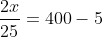

Add Answer to:
Provide a brief explanation or show work
7. Suppose the banking system currently has $400 billion...
Assume that the banking system has total reserves of $200 billion. Assume also that required reserves...
Assume that the banking system has total reserves of $200 billion. Assume also that required reserves are 12.5 percent of checking deposits and that banks hold no excess reserves and households hold no currency. The money multiplier is ____. The money supply is ____ billion. Suppose the Fed raises required reserves to 16 percent of deposits. The new money multiplier is____, and the money supply Increases/Decreases to _____ billion.
The banking system currently has $50 billion of reserves, none of which are excess. People hold...
The banking system currently has $50 billion of reserves, none of which are excess. People hold only deposits and no currency, and the reserve requirement is 10percent. If the Fed raises the reserve requirement to 12.5 percent and at the same time sells $10 billion worth of bonds, then by how much does the money supplychange?
Economics question CH30: The Banking System and Money Supply Suppose a country's financial system has $500,000...
 Economics question
CH30: The Banking System and Money Supply Suppose a country's financial system has $500,000 in deposits and banks keep 100% in reserves. After a period of time, banks decide to keep $100,000 in reserves while the Central Bank requires 10% reserve ratic i. What is the initial money supply? ii. What is the current amount of loans this banking system is making? iii. What is the money supply after loans are made? iv. Are there any excess reserves?...
Economics question
CH30: The Banking System and Money Supply Suppose a country's financial system has $500,000 in deposits and banks keep 100% in reserves. After a period of time, banks decide to keep $100,000 in reserves while the Central Bank requires 10% reserve ratic i. What is the initial money supply? ii. What is the current amount of loans this banking system is making? iii. What is the money supply after loans are made? iv. Are there any excess reserves?...
Suppose a banking system with the following balance sheet has no excess reserves. Assume that ban...
 Suppose a banking system with the following balance sheet has no excess reserves. Assume that banks will make loans in the full amount of any excess reserves that they acquire and will immediately be able to eliminate loans from their portfolio to cover inadequate reserves Assets (in Billions) Liabilities (in Billions) Total reserves $ 30 Transactions account 190 deposits 180 400 Loans Total assets 400 Total liabilities 400 Instructions: In part a, enter your response as a percentage rounded to...
Suppose the banking system currently has $400 billion in reserves, the reserve requirement is 8...
Suppose the banking system currently has $400 billion in reserves, the reserve requirement is 8 percent, and excess reserves amount to $5 billion. What is the level of deposits? Selected Answer: d. $4,937.5 billion Answers: a. $5,062.5 billion b. $4,995 billion c. $5,000 billion
Assume that the following data describe the condition of the banking system: Total Reserves: $150 billion...
Assume that the following data describe the condition of the banking system: Total Reserves: $150 billion Transactions deposits: $600 billion saving deposits: 300 Cash held by public: $100 billion Reserve Requirement: 0.15 1. How large is the money supply (M1)? 2.How large are required reserves? 3.How large are excess reserves? 4. By how much could the banks increase their lending activity?
Assume that the following data describe the condition of the commercial banking 7. system: Total reserves: $ 80 bil...
 Assume that the following data describe the condition of the commercial banking 7. system: Total reserves: $ 80 billion Transactions deposits: $700 billion Cash held by public: $30o billion Reserve requirement: o.10 (a) How large is the money supply (M1)? (b) Are the banks fully utilizing their lending capacity? (c) What would happen to the money supply initially if the public deposited another $20 billion in cash in transactions accounts? (d) What would the lending capacity of the banking system...
1. Suppose that currency in circulation is $600 billion, the amount of checkable deposits is $900...
 1. Suppose that currency in circulation is $600 billion, the amount of checkable deposits is $900 billion, required reserve on checkable deposits is 10% and excess reserves are $15 billion. a. Calculate the money supply, the currency deposit ratio, the excess reserve ratio, and the money multiplier. Suppose the central bank conducts an unusually large open market purchase of bonds held by banks of $1400 billion due to a sharp contraction in the economy. Assuming the ratios, you calculated in...
Discussion Questions for Tuesday, Apr. 23 1. Suppose the Fed conducts $10 million open market pur...
 Discussion Questions for Tuesday, Apr. 23 1. Suppose the Fed conducts $10 million open market purchase from Bank A. If Bank A and all the other banks use reserves to purchase only securities, what will happen to deposits in the banking system and how much does it expand? 2. Let's assume that in a hypothetical economy currency in circulation is $600 billion, the amount of checkable deposits is $900 billion, excess reserves are $15 billion and required reserve ratio is...
Question 1. (15 points) Suppose that currency in circulation is $600 billion, the amount of chequable...
 Question 1. (15 points) Suppose that currency in circulation is $600 billion, the amount of chequable deposits is $900 billion, and excess reserves are $15 billion and the desired reserve ratio is 10%. a. Calculate the money supply, the currency deposit ratio, the excess reserve ratio, and the money multiplier. b. Suppose the central bank conducts an unusually large open market purchase of bonds held by banks of $1400 billion due to a sharp contraction in the economy. Assuming the...
 Economics question
CH30: The Banking System and Money Supply Suppose a country's financial system has $500,000 in deposits and banks keep 100% in reserves. After a period of time, banks decide to keep $100,000 in reserves while the Central Bank requires 10% reserve ratic i. What is the initial money supply? ii. What is the current amount of loans this banking system is making? iii. What is the money supply after loans are made? iv. Are there any excess reserves?...
Economics question
CH30: The Banking System and Money Supply Suppose a country's financial system has $500,000 in deposits and banks keep 100% in reserves. After a period of time, banks decide to keep $100,000 in reserves while the Central Bank requires 10% reserve ratic i. What is the initial money supply? ii. What is the current amount of loans this banking system is making? iii. What is the money supply after loans are made? iv. Are there any excess reserves?...
 Suppose a banking system with the following balance sheet has no excess reserves. Assume that banks will make loans in the full amount of any excess reserves that they acquire and will immediately be able to eliminate loans from their portfolio to cover inadequate reserves Assets (in Billions) Liabilities (in Billions) Total reserves $ 30 Transactions account 190 deposits 180 400 Loans Total assets 400 Total liabilities 400 Instructions: In part a, enter your response as a percentage rounded to...
 Assume that the following data describe the condition of the commercial banking 7. system: Total reserves: $ 80 billion Transactions deposits: $700 billion Cash held by public: $30o billion Reserve requirement: o.10 (a) How large is the money supply (M1)? (b) Are the banks fully utilizing their lending capacity? (c) What would happen to the money supply initially if the public deposited another $20 billion in cash in transactions accounts? (d) What would the lending capacity of the banking system...
 1. Suppose that currency in circulation is $600 billion, the amount of checkable deposits is $900 billion, required reserve on checkable deposits is 10% and excess reserves are $15 billion. a. Calculate the money supply, the currency deposit ratio, the excess reserve ratio, and the money multiplier. Suppose the central bank conducts an unusually large open market purchase of bonds held by banks of $1400 billion due to a sharp contraction in the economy. Assuming the ratios, you calculated in...
 Discussion Questions for Tuesday, Apr. 23 1. Suppose the Fed conducts $10 million open market purchase from Bank A. If Bank A and all the other banks use reserves to purchase only securities, what will happen to deposits in the banking system and how much does it expand? 2. Let's assume that in a hypothetical economy currency in circulation is $600 billion, the amount of checkable deposits is $900 billion, excess reserves are $15 billion and required reserve ratio is...
 Question 1. (15 points) Suppose that currency in circulation is $600 billion, the amount of chequable deposits is $900 billion, and excess reserves are $15 billion and the desired reserve ratio is 10%. a. Calculate the money supply, the currency deposit ratio, the excess reserve ratio, and the money multiplier. b. Suppose the central bank conducts an unusually large open market purchase of bonds held by banks of $1400 billion due to a sharp contraction in the economy. Assuming the...
Most questions answered within 3 hours.
-
Where is the error in this code sequence?
String s1 = "Hello";
String s2 = "ello";...
asked 10 months ago -
Financial data for Joel de Paris, Inc., for last year
follow:
Joel de Paris, Inc.
Balance...
asked 10 months ago -
Consider this reaction:
Al2(SO4)3 (aq)+ BaCl3
(aq) Al2Cl6 (aq)- +
3BaSO4(s) . What is the...
asked 10 months ago -
Suppose that Savneet is considering increasing her
recent random sample from 20 car rentals to 40...
asked 10 months ago -
Trucks arrive at an unloading terminal at an average rate of 120
per hour.
Trucks arrive...
asked 10 months ago -
Why are methanol and ethanol completely soluble in water while
octanol is not very little soluble....
asked 10 months ago -
A facilities manager at a university reads in a research report
that the mean amount of...
asked 10 months ago -
When the CuSO4 is rehydrated by adding water to the anhydrous
compound, is this an endothermic...
asked 10 months ago -
A ray of sunlight is passing from diamond into crown glass; the
angle of incidence is...
asked 10 months ago -
A block of mass 0.249 kg is placed on top of a light, vertical
spring of...
asked 10 months ago -
how do the kidneys compensate in the presences of acidosis
a) trigger hyperventilate
b) reserve acid...
asked 10 months ago -
Question 501 pts
The rental rate of capital to the firm increases. Which of the
following...
asked 10 months ago