Particle in a 1-D box can be thought of confining the particle moving a long a...
Particle in a 1-D box can be thought of confining the particle moving a long a
string, confined by the two ends of the string. 2-D PIB confines the particle's
motion on a plane, confined by the rectangular perimeter. 3-D PIB confines
the particle's motion in a real box. For those three cases, we can find geometry
analogues in real life. Now, let's tackle a hypothetical 4-D PIB model. The
four dimensions have variable x, y, z, and w, respectively (such as x for 1-D
PIB and x, y for 2-D PIB). The infinite potential energy walls are at (0, a), (0,
b), (0, c), and (0, d) in the four dimensions.
(a) Please write down the Schrodinger equation for this 4-D PIB model and
specify the boundary conditions.
(b) Without solving the differential equations, directly write down the nor-
malised eigen wavefunctions and eigenenergies of the 4-D PIB, based on
your knowledge of 1-D and 2-D PIB.
(c) For the special case a = b = c = d, what is the degeneracy of the first-
excited-state (the state with the second lowest energy)?
Homework Answers

Add Answer to:
Particle in a 1-D box can be thought of confining the particle
moving a long a...
The following information pertains to a particle in a 2-D box. Both dimensions of the box...
The following information pertains to a particle in a 2-D box. Both dimensions of the box are equal (Lx=Ly=L) Normalized Eigen functions: 1. Ψ(x,y)= 2/L sin (nπx/L)sin( kπy/L) 2. H= h2/2m( d2/dx2+ d2/dy2)+ V (x,y) Boundary Conditions: V( x,y > 0; x,y < L) =0 V(x,y > L; x,y < 0 ) = Infinity a. Draw the 2-D potential energy surface ("box") that confines the particle. b. Use equations 2 and 3 to produce the general solution ( a formula in...
Consider a particle confined in two-dimensional box with infinite walls at x 0, L;y 0, L. the dou...
 quantum mechanics
Consider a particle confined in two-dimensional box with infinite walls at x 0, L;y 0, L. the doubly degenerate eigenstates are: Ιψη, p (x,y))-2sinnLx sinpry for 0 < x, y < L elsewhere and their eigenenergies are: n + p, n, p where n, p-1,2, 3,.... Calculate the energy of the first excited state up to the first order in perturbation theory due to the addition of: 2 2
Consider a particle confined in two-dimensional box with infinite...
quantum mechanics
Consider a particle confined in two-dimensional box with infinite walls at x 0, L;y 0, L. the doubly degenerate eigenstates are: Ιψη, p (x,y))-2sinnLx sinpry for 0 < x, y < L elsewhere and their eigenenergies are: n + p, n, p where n, p-1,2, 3,.... Calculate the energy of the first excited state up to the first order in perturbation theory due to the addition of: 2 2
Consider a particle confined in two-dimensional box with infinite...
nh 61. The energy for one-dimensional particle-in-a-box is E=" 1. For a particle in a 0...
 nh 61. The energy for one-dimensional particle-in-a-box is E=" 1. For a particle in a 0 three-dimensional cubic box (Lx=Ly=L2), if an energy level has twice the energy of the ground state, what is the degeneracy of this energy level? (B) 1 (C)2 (D) 3 (E) 4 (A) 0
Consider a perturbed particle in a box, with potential energy: for x <-L/2 2brx/L for -1/2sxSL2 for x >L/2 nd confining the zero order functions to n-1,2, 3, 4 (i.e. the lowest four Using M...
 Consider a perturbed particle in a box, with potential energy: for x <-L/2 2brx/L for -1/2sxSL2 for x >L/2 nd confining the zero order functions to n-1,2, 3, 4 (i.e. the lowest four Using Matrix algebra, and confining the zero order functions to n solutions to the unperturbed particle in a box problem) determine the energy of the l (Hint: In diagonalizing a matrix, you may reorder the quantum numbers in any way you like). d)
Consider a perturbed particle...
Consider a perturbed particle in a box, with potential energy: for x <-L/2 2brx/L for -1/2sxSL2 for x >L/2 nd confining the zero order functions to n-1,2, 3, 4 (i.e. the lowest four Using Matrix algebra, and confining the zero order functions to n solutions to the unperturbed particle in a box problem) determine the energy of the l (Hint: In diagonalizing a matrix, you may reorder the quantum numbers in any way you like). d)
Consider a perturbed particle...
probabilities. A box containing a particle is divided into a right and left compartment by a...
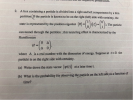 probabilities. A box containing a particle is divided into a right and left compartment by a thin 2. partition If the particle is known to be on the right (left) side with certainty, the state is represented by the position eigenket |R)=|, ||2)=|, .T The particle can tunnel through the partition; this tunneling effect is characterized by the Hamiltonian -) 0 A Н%D where A is a real number with the dimension of energy. Suppose at t 0 the particlé...
Question # 1: Find the unit of energy in the energy expression of a free particle...
 Question # 1: Find the unit of energy in the energy expression of a free particle in 1-D box: Question # 2: A proton in a box is in a state n = 5 falls to a state n = 4 and loose energy with a wavelength of 2000 nm, what is the length of the box? (answer: 4 x 10 m) Question # 3: a. Consider an electron confined to move in an atom in one dimension over a...
3. A particle is in a 1D box (infinite potential well) of dimension, a, situated symmetrically ab...
 3. A particle is in a 1D box (infinite potential well) of dimension, a, situated symmetrically about the origin of the x-axis. A measurement of energy is made and the particle is found to have the ground state energy: 2ma The walls of the box are expanded instantaneously, doubling the well width symmetrically about the origin, leaving the particle in the same state. a) Sketch the initial potential well making it symmetric about x - 0 (note this is different...
please help 1. The eigenfunctions of a particle in a square two-dimensional box with side lengths...
 please help
1. The eigenfunctions of a particle in a square two-dimensional box with side lengths a = b = L are non, (x, y) = { sin ("T") sin (9,7%) = xn, (x)}n, (y) where n. (c) and on, (y) are one-dimensional particle-in-a-box wave functions in the x and y directions. a. Suppose we prepare the particle in such a way that it has a wave function V (2,y) given by 26,0) = Võru (s. 1) + Vedra ....
please help
1. The eigenfunctions of a particle in a square two-dimensional box with side lengths a = b = L are non, (x, y) = { sin ("T") sin (9,7%) = xn, (x)}n, (y) where n. (c) and on, (y) are one-dimensional particle-in-a-box wave functions in the x and y directions. a. Suppose we prepare the particle in such a way that it has a wave function V (2,y) given by 26,0) = Võru (s. 1) + Vedra ....
Q 1: For particle in a box problem, answer the following questions, a) Why n=0 is...
Q 1: For particle in a box problem, answer the following questions, a) Why n=0 is not an allowed quantum number? b) En = 0 is not allowed for particle in a box, why? c) Ground state wavefunction is orthogonal to the first excited state wavefunction, what does it mean? Q 2: An electronic system that is treated as particle in 3-D box with dimensions of 3Å x 3Å x 4Å. Calculate the wavelength corresponding to the lowest energy transition...
1 Particle in a Box with a Bump (based on B&J 4.11) Consider a particle of...
 1 Particle in a Box with a Bump (based on B&J 4.11) Consider a particle of mass m in a 1-D double well with potential given by Vo, 05\x\<b V(x) = { 0, b<\x<c 100, [x]>c . We will study the lowest energy states, for which 0 <E<V, corresponding to tunnelling between the two wells. (a) Write down the time-independent Schödinger equation in the three regions -c<x<-b, –b< <b, and b< I< c. Write down the most general wavefunction solution...
 quantum mechanics
Consider a particle confined in two-dimensional box with infinite walls at x 0, L;y 0, L. the doubly degenerate eigenstates are: Ιψη, p (x,y))-2sinnLx sinpry for 0 < x, y < L elsewhere and their eigenenergies are: n + p, n, p where n, p-1,2, 3,.... Calculate the energy of the first excited state up to the first order in perturbation theory due to the addition of: 2 2
Consider a particle confined in two-dimensional box with infinite...
quantum mechanics
Consider a particle confined in two-dimensional box with infinite walls at x 0, L;y 0, L. the doubly degenerate eigenstates are: Ιψη, p (x,y))-2sinnLx sinpry for 0 < x, y < L elsewhere and their eigenenergies are: n + p, n, p where n, p-1,2, 3,.... Calculate the energy of the first excited state up to the first order in perturbation theory due to the addition of: 2 2
Consider a particle confined in two-dimensional box with infinite...
 nh 61. The energy for one-dimensional particle-in-a-box is E=" 1. For a particle in a 0 three-dimensional cubic box (Lx=Ly=L2), if an energy level has twice the energy of the ground state, what is the degeneracy of this energy level? (B) 1 (C)2 (D) 3 (E) 4 (A) 0
 Consider a perturbed particle in a box, with potential energy: for x <-L/2 2brx/L for -1/2sxSL2 for x >L/2 nd confining the zero order functions to n-1,2, 3, 4 (i.e. the lowest four Using Matrix algebra, and confining the zero order functions to n solutions to the unperturbed particle in a box problem) determine the energy of the l (Hint: In diagonalizing a matrix, you may reorder the quantum numbers in any way you like). d)
Consider a perturbed particle...
Consider a perturbed particle in a box, with potential energy: for x <-L/2 2brx/L for -1/2sxSL2 for x >L/2 nd confining the zero order functions to n-1,2, 3, 4 (i.e. the lowest four Using Matrix algebra, and confining the zero order functions to n solutions to the unperturbed particle in a box problem) determine the energy of the l (Hint: In diagonalizing a matrix, you may reorder the quantum numbers in any way you like). d)
Consider a perturbed particle...
 probabilities. A box containing a particle is divided into a right and left compartment by a thin 2. partition If the particle is known to be on the right (left) side with certainty, the state is represented by the position eigenket |R)=|, ||2)=|, .T The particle can tunnel through the partition; this tunneling effect is characterized by the Hamiltonian -) 0 A Н%D where A is a real number with the dimension of energy. Suppose at t 0 the particlé...
 Question # 1: Find the unit of energy in the energy expression of a free particle in 1-D box: Question # 2: A proton in a box is in a state n = 5 falls to a state n = 4 and loose energy with a wavelength of 2000 nm, what is the length of the box? (answer: 4 x 10 m) Question # 3: a. Consider an electron confined to move in an atom in one dimension over a...
 3. A particle is in a 1D box (infinite potential well) of dimension, a, situated symmetrically about the origin of the x-axis. A measurement of energy is made and the particle is found to have the ground state energy: 2ma The walls of the box are expanded instantaneously, doubling the well width symmetrically about the origin, leaving the particle in the same state. a) Sketch the initial potential well making it symmetric about x - 0 (note this is different...
 please help
1. The eigenfunctions of a particle in a square two-dimensional box with side lengths a = b = L are non, (x, y) = { sin ("T") sin (9,7%) = xn, (x)}n, (y) where n. (c) and on, (y) are one-dimensional particle-in-a-box wave functions in the x and y directions. a. Suppose we prepare the particle in such a way that it has a wave function V (2,y) given by 26,0) = Võru (s. 1) + Vedra ....
please help
1. The eigenfunctions of a particle in a square two-dimensional box with side lengths a = b = L are non, (x, y) = { sin ("T") sin (9,7%) = xn, (x)}n, (y) where n. (c) and on, (y) are one-dimensional particle-in-a-box wave functions in the x and y directions. a. Suppose we prepare the particle in such a way that it has a wave function V (2,y) given by 26,0) = Võru (s. 1) + Vedra ....
 1 Particle in a Box with a Bump (based on B&J 4.11) Consider a particle of mass m in a 1-D double well with potential given by Vo, 05\x\<b V(x) = { 0, b<\x<c 100, [x]>c . We will study the lowest energy states, for which 0 <E<V, corresponding to tunnelling between the two wells. (a) Write down the time-independent Schödinger equation in the three regions -c<x<-b, –b< <b, and b< I< c. Write down the most general wavefunction solution...
Most questions answered within 3 hours.
-
Where is the error in this code sequence?
String s1 = "Hello";
String s2 = "ello";...
asked 11 months ago -
Financial data for Joel de Paris, Inc., for last year
follow:
Joel de Paris, Inc.
Balance...
asked 11 months ago -
Consider this reaction:
Al2(SO4)3 (aq)+ BaCl3
(aq) Al2Cl6 (aq)- +
3BaSO4(s) . What is the...
asked 11 months ago -
Suppose that Savneet is considering increasing her
recent random sample from 20 car rentals to 40...
asked 11 months ago -
Trucks arrive at an unloading terminal at an average rate of 120
per hour.
Trucks arrive...
asked 11 months ago -
Why are methanol and ethanol completely soluble in water while
octanol is not very little soluble....
asked 11 months ago -
A facilities manager at a university reads in a research report
that the mean amount of...
asked 11 months ago -
When the CuSO4 is rehydrated by adding water to the anhydrous
compound, is this an endothermic...
asked 11 months ago -
A ray of sunlight is passing from diamond into crown glass; the
angle of incidence is...
asked 11 months ago -
A block of mass 0.249 kg is placed on top of a light, vertical
spring of...
asked 11 months ago -
how do the kidneys compensate in the presences of acidosis
a) trigger hyperventilate
b) reserve acid...
asked 11 months ago -
Question 501 pts
The rental rate of capital to the firm increases. Which of the
following...
asked 11 months ago